Results by title
6 books match the query 'Salem (Mass.)'
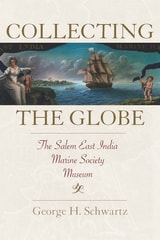
Collecting the Globe
The Salem East India Marine Society MuseumGeorge H. Schwartz
University of Massachusetts Press, 2020
Collecting the Globe presents the first in-depth exploration of the East India Marine Society Museum, the precursor to the internationally acclaimed Peabody Essex Museum. Offering fresh perspectives on museums in the United States before the Civil War and how they helped shape an American identity, George H. Schwartz explores the practices of collecting, exhibiting, and interpreting a diversity of international objects and art in the early United States.
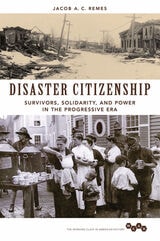
Disaster Citizenship
Survivors, Solidarity, and Power in the Progressive EraJacob Remes
University of Illinois Press, 2015
In Disaster Citizenship, Jacob A. C. Remes draws on histories of the Salem and Halifax events to explore the institutions--both formal and informal--that ordinary people relied upon in times of crisis. He explores patterns and traditions of self-help, informal order, and solidarity and details how people adapted these traditions when necessary. Yet, as he shows, these methods--though often quick and effective--remained illegible to reformers. Indeed, soldiers, social workers, and reformers wielding extraordinary emergency powers challenged these grassroots practices to impose progressive "solutions" on what they wrongly imagined to be a fractured social landscape.
Elizabeth Manning Hawthorne
A Life in LettersElizabeth Manning Hawthorne
University of Alabama Press, 2006
An annotated selection of unpublished letters by Nathaniel Hawthorne's sister.
Retrieved from seven different libraries, this corpus of letters was preserved by the Manning family chiefly for their value as records of Nathaniel Hawthorne's life and work; but they ironically also illuminate the life and mind of a fascinating correspondent and citizen of New England with incisive views and commentaries on her contemporaries, her role as a woman writer, Boston and Salem literary culture, and family life in mid-19th-century America.
This book illuminates Elizabeth's early life; the trauma caused for sister and brother by the death of their father; her and her brother's education; and the tensions the two children experienced when they moved in with their mother's family, the welthier Mannings, instead of the poorer though socially more venerable Hawthornes, following their father's death. The letters portray Elizabeth's constrained relationship with Nathaniel's wife Sofia Peabody and counter Sophia's portrayal of her sister-in-law as a recluse, oddity, and “queer scribbler.”
These 118 letters also reveal Elizabeth Hawthorne's tremendous gifts as a thinker, correspondent, and essayist, her interest in astronomy, a lifelong drive toward self-edification in many fields, and her extraordinary relationship with Nathaniel. As a sibling and a fellow author, they were sometimes lovingly codependent and sometimes competitive. Finally, her writing reveals the larger worlds of politics, war, the literary landscape, class, family life, and the freedoms and constraints of a woman's role, all by a heretofore understudied figure.
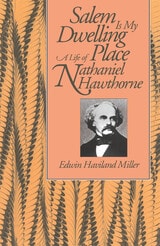
Salem Is My Dwelling Place
Life Of Nathaniel HawthorneEdwin Haviland Miller
University of Iowa Press, 1992
In one of his public disavowals of autobiography, Nathaniel Hawthorne informed his readers that external traits "hide the man, instead of displaying him," directing them instead to "look through the whole range of his fictitious characters, good and evil, in order to detect any of his essential traits." In this multidimensional biography of America's first great storyteller, Edwin Haviland Miller answers Hawthorne's challenge and reveals the inner landscapes of this modest, magnetic man who hid himself in his fiction. Thomas Woodson hails Miller's account as "the best biography of this most elusive of American authors."
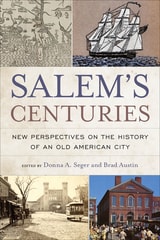
Salem's Centuries
New Perspectives on the History of an Old American CityEdited by Donna A. Seger and Brad Austin
Temple University Press, 2026
In advance of the city’s quadricentennial, the editors and contributors highlight the depth and diversity of Salem’s history, including stories of indigenous peoples, early settlers, African Americans, and immigrants, spanning from the American and industrial revolutions to World War II and the present. Chronologically arranged by century, chapters examine how Salem’s history has been lost or distorted in its public presentations over time.
Salem’s Centuries is a fresh look at an old American city. And yes, it includes the accused witches.
Contributors: Kimberly S. Alexander, Emerson W. Baker, Aviva Chomsky, Andrew Darien, Elizabeth Duclos-Orsello, Theresa Giard, Marilyn Hayward, Bethany Jay, Michele Louro, Elizabeth McKeigue, Robert W. McMicken, Dane A. Morrison, Maria Pride, J.D. Scrimgeour, Margo Shea, Hans Schwartz, Brian Valimont, Maryann Zujewski, and the editors
In the series History and the Public
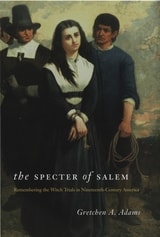
The Specter of Salem
Remembering the Witch Trials in Nineteenth-Century AmericaGretchen A. Adams
University of Chicago Press, 2008
In The Specter of Salem, Gretchen A. Adams reveals the many ways that the Salem witch trials loomed over the American collective memory from the Revolution to the Civil War and beyond. Schoolbooks in the 1790s, for example, evoked the episode to demonstrate the new nation’s progress from a disorderly and brutal past to a rational present, while critics of new religious movements in the 1830s cast them as a return to Salem-era fanaticism, and during the Civil War, southerners evoked witch burning to criticize Union tactics. Shedding new light on the many, varied American invocations of Salem, Adams ultimately illuminates the function of collective memories in the life of a nation.
“Imaginative and thoughtful. . . . Thought-provoking, informative, and convincingly presented, The Specter of Salem is an often spellbinding mix of politics, cultural history, and public historiography.”— New England Quarterly
“This well-researched book, forgoing the usual heft of scholarly studies, is not another interpretation of the Salem trials, but an important major work within the scholarly literature on the witch-hunt, linking the hysteria of the period to the evolving history of the American nation. A required acquisition for academic libraries.”—Choice, Outstanding Academic Title 2009