Results by title
12 books match the query 'Salt'
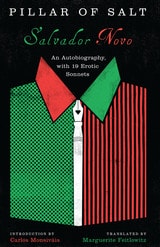
Pillar of Salt
An Autobiography, with 19 Erotic SonnetsBy Salvador Novo, Translated by Marguerite Feitlowitz, Introduction by Carlos Monsiváis
University of Texas Press, 2014
Written with exquisite sensitivity and wit, this memoir by one of Mexico’s foremost men of letters describes coming of age during the violence of the Mexican Revolution and “living dangerously” as an openly homosexual man in a brutally machista society.
Salvador Novo (1904–1974) was a provocative and prolific cultural presence in Mexico City through much of the twentieth century. With his friend and fellow poet Xavier Villaurrutia, he cofounded Ulises and Contemporáneos, landmark avant-garde journals of the late 1920s and 1930s. At once “outsider” and “insider,” Novo held high posts at the Ministries of Culture and Public Education and wrote volumes about Mexican history, politics, literature, and culture. The author of numerous collections of poems, including XX poemas, Nuevo amor, Espejo, Dueño mío, and Poesía 1915–1955, Novo is also considered one of the finest, most original prose stylists of his generation.
Pillar of Salt is Novo’s incomparable memoir of growing up during and after the Mexican Revolution; shuttling north to escape the Zapatistas, only to see his uncle murdered at home by the troops of Pancho Villa; and his initiations into literature and love with colorful, poignant, complicated men of usually mutually exclusive social classes. Pillar of Salt portrays the codes, intrigues, and dynamics of what, decades later, would be called “a gay ghetto.” But in Novo’s Mexico City, there was no name for this parallel universe, as full of fear as it was canny and vibrant. Novo’s memoir plumbs the intricate subtleties of this world with startling frankness, sensitivity, and potential for hilarity. Also included in this volume are nineteen erotic sonnets, one of which was long thought to have been lost.
Pillar of Salt
Gender, Memory, and the Perils of Looking BackHaaken, Janice
Rutgers University Press, 2000
Pillar of Salt
Gender, Memory, and the Perils of Looking BackHaaken, Janice
Rutgers University Press, 1998
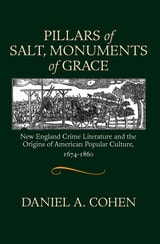
Pillars of Salt, Monuments of Grace
New England Crime Literature and the Origins of American Popular Culture, 1674-1860Daniel A. Cohen
University of Massachusetts Press, 2006
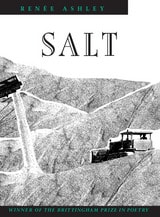
Salt
Renee Ashley
University of Wisconsin Press, 1991
Renée Ashley describes Salt as an attempt, in part, to mythologize a period of the 1950s and early 1960s in the California Bay Area suburb where she grew up, “a racially rich, economically varied section of town east of El Camino Real—the major road and the ‘tracks’, so to speak, that one grew up on the right or wrong side of.” Many of the poems in the collection explore Ashley’s adjustment to the East Coast after a virtual lifetime in “that one place.” They deal with landscape, with marriage, with the insight distance seems to lend to hindsight, with amusement, with regret.
“Renée Ashley can tune our ears to the thoughts of a wounded sparrow, to the sibilance of snow on stone, even to the song rocks make as they thaw in spring. . . . She wakes us to an intricate, enthralling world behind, beneath, beyond the one we thought we knew, alive with particulars, laced with compassion, luminous with humor.”—Donald Finkel
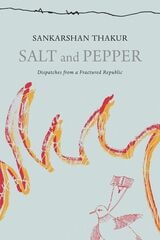
Salt and Pepper
Selected Literary ColumnsSankarshan Thakur
Seagull Books, 2026
Salt and Pepper is a collection of literary columns that defy convention—acerbic, tender, and unrelenting in their gaze. Written between the margins of news and national spectacle, these pieces are not topical commentary but something far more enduring: political satire that reads like poetry, reportage that mutates into parable, lament, and fable. In these dispatches from a fractured republic, written over the past decade, journalist Sankarshan Thakur captures the surreal absurdities and deep disquiet of an India caught between thunderous assertion and muffled dissent. Governments speak in acronyms, mobs chant in hashtags, silence acquires a sound—and memory becomes an act of resistance. These are chronicles of a society slipping into curated amnesia, of belonging turned conditional, and of patriotism twisted into performance.
Salt and State
An Annotated Translation of the <em>Songshi</em> Salt Monopoly TreatiseCecilia Lee-fang Chien
University of Michigan Press, 2004
Salt as a Factor in the Confederacy
Ella Lonn
University of Alabama Press, 1965
It is only when a prime necessity thrusts itself upon public attention by its absence that a person ceases to take it for granted. Only when he no longer has it, does he realize what an important ingredient for his palate and digestion is plain, ordinary salt, necessary alike for man and beast. He then recalls that the salt licks and salt springs have from the earliest times been centers of interest and development.
The author has searched into the archives of most of the states of the old confederacy, and also into departments of knowledge remote from her own, so that she has had to delve into geological libraries, consult colleagues in the fields of chemistry and physiology, and do more sums in arithmetic than have fallen to her lot since she was in the primary school. But it has been a pleasant and profitable search.
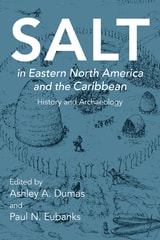
Salt in Eastern North America and the Caribbean
History and ArchaeologyEdited by Ashley A. Dumas and Paul N. Eubanks
University of Alabama Press, 2021
Case studies examining the archaeological record of an overlooked mineral
Salt, once a highly prized trade commodity essential for human survival, is often overlooked in research because it is invisible in the archaeological record. Salt in Eastern North America and the Caribbean: History and Archaeology brings salt back into archaeology, showing that it was valued as a dietary additive, had curative powers, and was a substance of political power and religious significance for Native Americans. Major salines were embedded in collective memories and oral traditions for thousands of years as places where physical and spiritual needs could be met. Ethnohistoric documents for many Indian cultures describe the uses of and taboos and other beliefs about salt.
The volume is organized into two parts: Salt Histories and Salt in Society. Case studies from prehistory to post-Contact and from New York to Jamaica address what techniques were used to make salt, who was responsible for producing it, how it was used, the impact it had on settlement patterns and sociopolitical complexity, and how economies of salt changed after European contact. Noted salt archaeologist Heather McKillop provides commentary to conclude the volume.
.
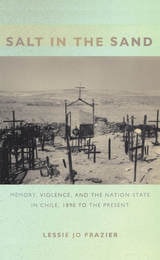
Salt in the Sand
Memory, Violence, and the Nation-State in Chile, 1890 to the PresentLessie Jo Frazier
Duke University Press, 2007
Analyzing multiple memories of state violence, Frazier innovatively shapes social and cultural theory to interpret a range of sources, including local and national government archives, personal papers, popular literature and music, interviews, architectural and ceremonial commemorations, and her ethnographic observations of civic associations, women's and environmental groups, and human rights organizations. A masterful integration of extensive empirical research with sophisticated theoretical analysis, Salt in the Sand is a significant contribution to interdisciplinary scholarship on human rights, democratization, state formation, and national trauma and reconciliation.
Salt
PoetrySusan Elizabeth Howe
Signature Books, 2013
Howe’s poems are Western but unmistakably modern, drawn from the astute observation of humanity of both rural and urban settings. Her weekly commute from the heart of Sanpete County to Utah Valley causes her to reflect on her culture and to contemplate recent events as she winds through the long, broad canyons. She sees an occasional deer chased from the road, pinyon jays, and magpies. She thinks about death, marriage, blood, and yes, even the dreamy (and occasionally steamy), country girl’s attraction to men.
In her verse, she journeys into the psyche of several women: Charles Dickens’s wife Catherine; Charlotte Brontë; an Argentine woman who unknowingly carried a fetus for several years; a woman whose pet snake tried to squeeze her to death. She recalls the rhododendrons of Kew Gardens, the house of Shakespeare’s grandmother, the sheep of Ireland, and the dogs of the Sierra Madres, but mostly she writes about the Mountain West and her home there.
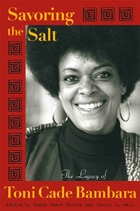
Savoring the Salt
The Legacy of Toni Cade Bambaraedited by Linda Janet Holmes and Cheryl A. Wall
Temple University Press, 2007
Admiring readers have kept Bambara's fiction in print since her first collection of stories, Gorilla, My Love, was published in 1972. She continued to write -- and her audience and reputation continued to grow -- until her untimely death in 1995. Savoring the Salt includes excerpts from her published and unpublished writings, along with interviews and photos of Bambara. The mix of poets and scholars, novelists and critics, political activists and filmmakers represented here testifies to the ongoing importance and enduring appeal of her work.