Results by title
4 books match the query 'Salter, Anastasia'
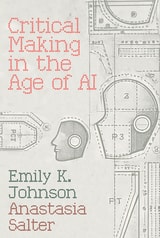
Critical Making in the Age of AI
Emily Johnson and Anastasia Salter
Amherst College Press, 2025
The book’s eight patterns are especially appropriate for those just beginning to explore digital scholarly methods, and one goal of Critical Making in the Age of AI is to provide structure for work that is both meaningful and achievable with limited resources and time. By centering critical making through a design-justice and feminist lens, the coauthors model how inclusive and expansive approaches to making in research and teaching are vital to shaping the humanities of the future.
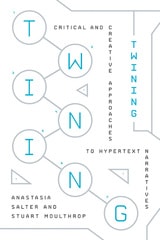
Twining
Critical and Creative Approaches to Hypertext NarrativesAnastasia Salter
Amherst College Press, 2021
"While there have certainly been attempts to study Twine historically and theoretically... no single publication has provided such a detailed account of it. And no publication has even attempted to situate Twine amongst its many different conversations and traditions, something this book does masterfully." —James Brown, Rutgers University, Camden

Undertale
Can a Game Give Hope?Anastasia Salter
University of Chicago Press, 2025
A powerful exploration of the importance and social complexity of the indie gaming sensation
On the surface, the 2015 game Undertale didn’t seem like much, supported by fan funding and with minimalist retro graphics. But despite its pixelated monsters and dated role-playing mechanics, Undertale invited fans and players to rethink their very relationship with gaming and game characters. Players encountered an extraordinary range of possible play experiences, with paths through the game’s unassuming world leading to both empathy and extreme violence, offering room for reflection and growth. Players could befriend (sometimes queer) monsters or kill them, for instance, appealing to each monster’s unique personality to negotiate survival and find community.
Contextualizing this game’s success in the wake of the Gamergate online harassment campaign and meditating on questions of violence and authenticity, writer and game scholar Anastasia Salter offers a profound exploration of this game sensation and a personal story of hope at a time when Salter was otherwise “done” with games. Undertale’s unique structure helped make it synonymous with “indie” games, built outside of the studio as a passion project and inspiring similar passion among its many fans even a decade later. But Undertale’s story also speaks to an auteur dream: What game developer Toby Fox and his collaborators accomplished on a small budget, with relatively simple tools, has left people replaying, arguing, and creating in its wake.
As we enter a cultural moment where intense interest is shifting towards flashy creativity, powered by generative artificial intelligence, Undertale reminds fans and newcomers of the power of thoughtful and intentional human design.
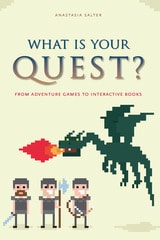
What Is Your Quest?
From Adventure Games to Interactive BooksAnastasia Salter
University of Iowa Press, 2014
One of the earliest models for this new way of telling stories was the adventure game, the kind of game centered on quests in which the characters must overcome obstacles and puzzles. After they fell out of fashion in the 1990s, fans made strenuous efforts to keep them alive and to create new games in the genre. Such activities highlight both the convergence of game and story and the collapsing distinction between reader and author. Continually defying the forces of obsolescence, fans return abandoned games to a playable state and treat stories as ever-evolving narratives. Similarly, players of massive multiplayer games become co-creators of the game experience, building characters and creating social networks that recombine a reading and gaming community.
The interactions between storytellers and readers, between programmers and creators, and among fans turned world-builders are essential to the development of innovative ways of telling stories. And at the same time that fan activities foster the convergence of digital gaming and storytelling, new and increasingly accessible tools and models for interactive narrative empower a broadening range of storytellers. It is precisely this interactivity among a range of users surrounding these new platforms that is radically reshaping both e-books and games and those who read and play with them.