Results by title
5 books match the query 'Salvatore, Ricardo D.'
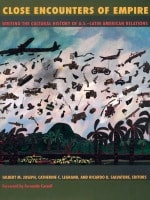
Close Encounters of Empire
Writing the Cultural History of U.S.-Latin American RelationsGilbert M. Joseph, Catherine C. LeGrand, and Ricardo D. Salvatore, eds.
Duke University Press, 1998
Exploring a variety of nineteenth- and twentieth-century encounters in Latin America, these theoretically engaged essays by distinguished U.S. and Latin American historians and anthropologists illuminate a wide range of subjects. From the Rockefeller Foundation’s public health initiatives in Central America to the visual regimes of film, art, and advertisements; these essays grapple with new ways of conceptualizing public and private spheres of empire. As such, Close Encounters of Empire initiates a dialogue between postcolonial studies and the long-standing scholarship on colonialism and imperialism in the Americas as it rethinks the cultural dimensions of nationalism and development.
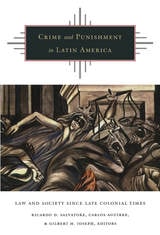
Crime and Punishment in Latin America
Law and Society Since Late Colonial TimesRicardo D. Salvatore, Carlos Aguirre, and Gilbert M. Joseph, eds.
Duke University Press, 2001
While disassociating law from a strictly legalist approach, the volume showcases a number of highly original studies on topics such as the role of law in processes of state formation and social and political conflict, the resonance between legal and cultural phenomena, and the contested nature of law-enforcing discourses and practices. Treating law as an ambiguous and malleable arena of struggle, the contributors to this volume—scholars from North and Latin America who represent the new wave in legal history that has emerged in recent years-- demonstrate that law not only produces and reformulates culture, but also shapes and is shaped by larger processes of political, social, economic, and cultural change. In addition, they offer valuable insights about the ways in which legal systems and cultures in Latin America compare to those in England, Western Europe, and the United States.
This volume will appeal to scholars in Latin American studies and to those interested in the social, cultural, and comparative history of law and legal phenomena.
Contributors. Carlos Aguirre, Dain Borges, Lila Caimari, Arlene J. Díaz, Luis A. Gonzalez, Donna J. Guy, Douglas Hay, Gilbert M. Joseph, Juan Manuel Palacio, Diana Paton, Pablo Piccato, Cristina Rivera Garza, Kristin Ruggiero, Ricardo D. Salvatore, Charles F. Walker
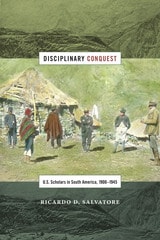
Disciplinary Conquest
U.S. Scholars in South America, 1900–1945Ricardo D. Salvatore
Duke University Press, 2016
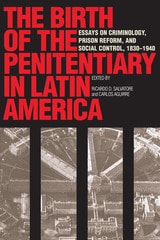
The Birth of the Penitentiary in Latin America
Essays on Criminology, Prison Reform, and Social Control, 1830-1940Edited by Ricardo D. Salvatore and Carlos Aguirre
University of Texas Press, 1996
Opening a new area in Latin American studies, The Birth of the Penitentiary in Latin America showcases the most recent historical outlooks on prison reform and criminology in the Latin American context. The essays in this collection shed new light on the discourse and practice of prison reform, the interpretive shifts induced by the spread of criminological science, and the links between them and competing discourses about class, race, nation, and gender. The book shows how the seemingly clear redemptive purpose of the penitentiary project was eventually contradicted by conflicting views about imprisonment, the pervasiveness of traditional forms of repression and control, and resistance from the lower classes.
The essays are unified by their attempt to view the penitentiary (as well as the variety of representations conveyed by the different reform movements favoring its adoption) as an interpretive moment, revealing of the ideology, class fractures, and contradictory nature of modernity in Latin America. As such, the book should be of interest not only to scholars concerned with criminal justice history, but also to a wide range of readers interested in modernization, social identities, and the discursive articulation of social conflict. The collection also offers an up-to-date sampling of new historical approaches to the study of criminal justice history, illuminates crucial aspects of the Latin American modernization process, and contrasts the Latin American cases with the better known European and North American experiences with prison reform.

Wandering Paysanos
State Order and Subaltern Experience in Buenos Aires during the Rosas EraRicardo D. Salvatore
Duke University Press, 2003
Drawing extensively on judicial and military records, Salvatore reveals the state’s files on individual prisoners and recruits to be surprisingly full of personal stories directly solicited from paysanos. While consistently attentive to the fragmented and mediated nature of these archival sources, he chronicles how peons and peasants spoke to power figures—judges, police officers, and military chiefs—about issues central to their lives and to the emerging nation. They described their families and their wanderings across the countryside in search of salaried work, memories and impressions of the civil wars, and involvement with the Federalist armies. Their lamentations about unpaid labor, disrespectful government officials, the meaning of poverty, and the dignity of work provide vital insights into the contested nature of the formation of the Argentine Confederation. Wandering Paysanos discloses a complex world until now obscured—that of rural Argentine subalterns confronting the state.