Results by title

2 books match the query 'Sambas'
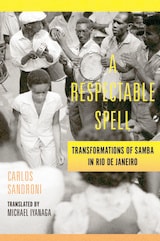
cover of A Respectable Spell: Transformations of Samba in Rio de Janeiro

A Respectable Spell

Transformations of Samba in Rio de Janeiro

Carlos Sandroni

University of Illinois Press, 2021

A landmark in Brazilian music scholarship, A Respectable Spell introduces English-speaking readers to the rich history of samba from its nineteenth century origins to its emergence as a distinctive genre in the 1930s. Merging storytelling with theory, Carlos Sandroni profiles performers, composers, and others while analyzing the complex ideologies their music can communicate in their lyrics and rhythms, and how the meaning of songs and musical genres can vary depending on social and historical context. He also delves into lundu, modinha, maxixe, and many other genres of Brazilian music; presents the little-heard voices and perspectives of marginalized Brazilians like the African-descended sambistas; and presents a study in step with the types of decolonial approaches to ethnomusicology that have since emerged, treating the people being studied not only as makers of music but also of knowledge.

Incisive and comprehensive, A Respectable Spell tells the compelling story of an iconic Brazilian musical genre.
[more]
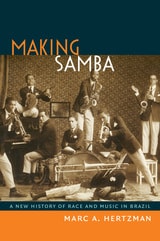
cover of Making Samba: A New History of Race and Music in Brazil

Making Samba

A New History of Race and Music in Brazil

Marc A. Hertzman

Duke University Press, 2013

In November 1916, a young Afro-Brazilian musician named Donga registered sheet music for the song "Pelo telefone" ("On the Telephone") at the National Library in Rio de Janeiro. This apparently simple act—claiming ownership of a musical composition—set in motion a series of events that would shake Brazil's cultural landscape. Before the debut of "Pelo telephone," samba was a somewhat obscure term, but by the late 1920s, the wildly popular song had helped to make it synonymous with Brazilian national music.

The success of "Pelo telephone" embroiled Donga in controversy. A group of musicians claimed that he had stolen their work, and a prominent journalist accused him of selling out his people in pursuit of profit and fame. Within this single episode are many of the concerns that animate Making Samba, including intellectual property claims, the Brazilian state, popular music, race, gender, national identity, and the history of Afro-Brazilians in Rio de Janeiro. By tracing the careers of Rio's pioneering black musicians from the late nineteenth century until the 1970s, Marc A. Hertzman revises the histories of samba and of Brazilian national culture.

[more]