Results by title
20 books match the query 'Same-sex marriage'

Accidental Activists
Mark Phariss, Vic Holmes, and Their Fight for Marriage Equality in TexasDavid Collins
University of North Texas Press, 2017
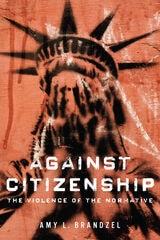
Against Citizenship
The Violence of the NormativeAmy L. Brandzel
University of Illinois Press, 2016
Brandzel's focus on three legal case studies--same-sex marriage law, hate crime legislation, and Native Hawaiian sovereignty and racialization--exposes how citizenship confounds and obscures the mutual processes of settler colonialism, racism, sexism, and heterosexism. In this way, Brandzel argues that citizenship requires anti-intersectionality, that is, strategies that deny the mutuality and contingency of race, class, gender, sexuality, and nation--and how, oftentimes, progressive left activists and scholars follow suit.
Against Citizenship is an impassioned plea for a queer, decolonial, anti-racist coalitional stance against the systemized human de/valuing and anti-intersectionalities of citizenship.
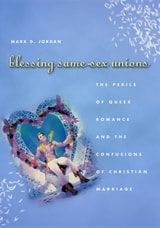
Blessing Same-Sex Unions
The Perils of Queer Romance and the Confusions of Christian MarriageMark D. Jordan
University of Chicago Press, 2005
Why then, asks noted gay commentator Mark D. Jordan, are so many churches vehemently opposed to blessing same-sex unions? In this incisive work, Jordan shows how carefully selected ideals of Christian marriage have come to dominate recent debates over same-sex unions. Opponents of gay marriage, he reveals, too often confuse simplified ideals of matrimony with historical facts. They suppose, for instance, that there has been a stable Christian tradition of marriage across millennia, when in reality Christians have quarreled among themselves for centuries about even the most basic elements of marital theology, authorizing experiments like polygamy and divorce.
Jordan also argues that no matter what the courts do, Christian churches will have to decide for themselves whether to bless same-sex unions. No civil compromise can settle the religious questions surrounding gay marriage. And queer Christians, he contends, will have to discover for themselves what they really want out of marriage. If they are not just after legal recognition as a couple or a place at the social table, do they really seek the blessing of God? Or just the garish melodrama of a white wedding? Posing trenchant questions such as these, Blessing Same-Sex Unions will be a must-read for both sides of the debate over gay marriage in America today.
Contraception and Persecution
Charles E. Rice
St. Augustine's Press, 2014
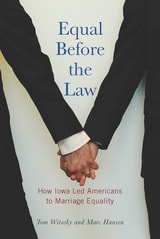
Equal Before the Law
How Iowa Led Americans to Marriage EqualityTom Witosky, Marc Hansen
University of Iowa Press, 2015
The court’s decision in Varnum v. Brien made Iowa only the third state in the nation to permit same-sex couples to wed—moderate, midwestern Iowa, years before such left-leaning coastal states as California and New York. And unlike the earlier decisions in Massachusetts and Connecticut, Varnum v. Brien was unanimous and unequivocal. It catalyzed the unprecedented and rapid shift in law and public opinion that continues today.
Equal Before the Law tells the stories behind this critical battle in the fight for marriage equality and traces the decision’s impact. The struggle began in 1998 with the easy passage of Iowa’s Defense of Marriage Act and took a turn, surprising to many, in 2005, when six ordinary Iowa couples signed on to Lambda Legal’s suit against the law. Their triumph in 2009 sparked a conservative backlash against the supreme court justices, three of whom faced tough retention elections that fall.
Longtime, award-winning reporters Tom Witosky and Marc Hansen talked with and researched dozens of key figures, including opponent Bob Vander Plaats, proponents Janelle Rettig and Sharon Malheiro, attorneys Roger Kuhle, Dennis Johnson, and Camilla Taylor, and politicians Matt McCoy, Mary Lundby, and Tom Vilsack, who had to weigh their careers against their convictions. Justice Mark Cady, who wrote the decision, explains why the court had to rule in favor of the plaintiffs. At the center of the story are the six couples who sacrificed their privacy to demand public respect for their families.
Through these voices, Witosky and Hansen show that no one should have been surprised by the 2009 decision. Iowans have a long history of leadership on civil rights. Just a year after Iowa became a state, its citizens adopted as their motto the phrase, “Our liberties we prize and our rights we will maintain.” And they still do today.
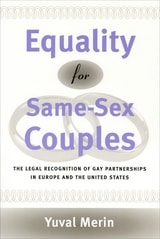
Equality for Same-Sex Couples
The Legal Recognition of Gay Partnerships in Europe and the United StatesYuval Merin
University of Chicago Press, 2002
Merin begins by providing a historical overview of the transformation of marriage from antiquity to the present. He then identifies and critically compares four principal models for the legal regulation and recognition of same-sex partnerships: civil marriage, registered partnership, domestic partnership, and cohabitation. Merin concludes that all of the models except civil marriage discriminate against gays and lesbians just as the "separate but equal" doctrine discriminated against African Americans; thus, so-called alternatives to marriage, even if they provide the same rights and benefits as marriage, are inherently unequal and therefore unconstitutional.
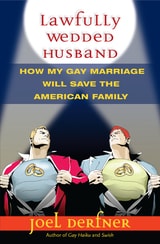
Lawfully Wedded Husband
How My Gay Marriage Will Save the American FamilyJoel Derfner
University of Wisconsin Press, 2013
Add to the mix a reality show whose director forces them to keep signing and notarizing applications for a wedding license until the cameraman gets a shot she likes; a family marriage history that includes adulterers, arms smugglers, and poisoners; and discussions of civil rights, Sophocles, racism, grammar, and homemade Ouija boards—coupled with Derfner's gift for getting in his own way—and what results is a story not just of gay marriage and the American family but of what it means to be human.
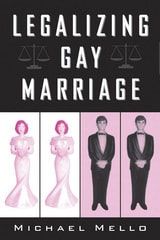
Legalizing Gay Marriage
Vermont And The National DebateMichael Mello, foreword by David Chambers
Temple University Press, 2004
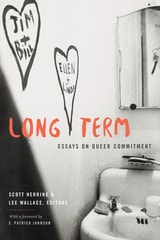
Long Term
Essays on Queer CommitmentScott Herring and Lee Wallace, editors
Duke University Press, 2021
Contributors. Lisa Adkins, Maryanne Dever, Carla Freccero, Elizabeth Freeman, Scott Herring, Annamarie Jagose, Amy Jamgochian, E. Patrick Johnson, Jaya Keaney, Heather Love, Sally R. Munt, Kane Race, Amy Villarejo, Lee Wallace
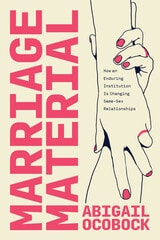
Marriage Material
How an Enduring Institution Is Changing Same-Sex RelationshipsAbigail Ocobock
University of Chicago Press, 2024
It is no secret that marriage rates in the United States are at an all-time low. Despite this significant decline, the institution of marriage endures in our society amid historic changes to its meaning and practice. How does the continuing strength of marriage impact the relationships of same-sex couples after the legalization of same-sex marriage?
Drawing on over one hundred interviews with LGBTQ+ people, Marriage Material reveals the transformative impact marriage equality has had on same-sex relationships. Sociologist Abigail Ocobock looks to same-sex couples across a wide age range to illuminate the complex ways institutional mechanisms work in tandem to govern the choices and behaviors of individuals with different marriage experiences. Ocobock examines both the influence of marriage on the dynamics of same-sex relationships and how LGBTQ+ people challenge heteronormative assumptions about marriage, highlighting the complex interplay between institutional constraint and individual agency.
Marriage Material presents a bold challenge to dominant scholarly and popular ideas about the decline of marriage, making clear that gaining access to legal marriage has transformed same-sex relationships, both for better and for worse.
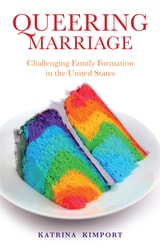
Queering Marriage
Challenging Family Formation in the United StatesKimport, Katrina
Rutgers University Press, 2013
Co-Winner of the 2015 Charles Tilly Award for Best Book of the Collective Behavior and Social Movements section from the American Sociological Association
Over four thousand gay and lesbian couples married in the city of San Francisco in 2004. The first large-scale occurrence of legal same-sex marriage, these unions galvanized a movement and reignited the debate about whether same-sex marriage, as some hope, challenges heterosexual privilege or, as others fear, preserves that privilege by assimilating queer couples.
In Queering Marriage, Katrina Kimport uses in-depth interviews with participants in the San Francisco weddings to argue that same-sex marriage cannot be understood as simply entrenching or contesting heterosexual privilege. Instead, she contends, these new legally sanctioned relationships can both reinforce as well as disrupt the association of marriage and heterosexuality.
During her deeply personal conversations with same-sex spouses, Kimport learned that the majority of respondents did characterize their marriages as an opportunity to contest heterosexual privilege. Yet, in a seeming contradiction, nearly as many also cited their desire for access to the normative benefits of matrimony, including social recognition and legal rights. Kimport’s research revealed that the pattern of ascribing meaning to marriage varied by parenthood status and, in turn, by gender. Lesbian parents were more likely to embrace normative meanings for their unions; those who are not parents were more likely to define their relationships as attempts to contest dominant understandings of marriage.
By posing the question—can queers “queer” marriage?—Kimport provides a nuanced, accessible, and theoretically grounded framework for understanding the powerful effect of heterosexual expectations on both sexual and social categories.
Reattachment Theory
Queer Cinema of RemarriageLee Wallace
Duke University Press, 2020
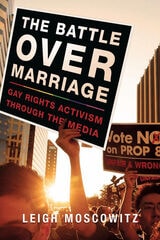
The Battle over Marriage
Gay Rights Activism through the MediaLeigh Moscowitz
University of Illinois Press, 2013
The Limits to Union
Same-Sex Marriage and the Politics of Civil RightsJonathan Goldberg-Hiller
University of Michigan Press, 2004
"The Limits to Union is a superb book about the complexities of recent political struggles over same-sex marriage. Goldberg-Hiller offers a sophisticated account of egalitarian rights advocacy and the reaction it has generated from established majorities animated by a 'new common sense' of exclusionary sovereign authority. The author's analysis is multidimensional and nuanced, but the core argument is bold, important, and well-supported. I recommend it very highly to everyone interested in understanding the character, possibilities, and constraints of civil rights amid our contemporary culture wars."
-Michael McCann, author of Rights at Work: Pay Equity Reform and the Politics of Legal Mobilization
"In this excellent book, Goldberg-Hiller uses Hawaii's experience to examine the interaction between courts and the political system. . . . Relying on briefs, legislative statements, and interviews with activists from both sides of the question, he views this familiar debate . . . through the unfamiliar prism of gay marriage, which allows him to gauge the viability and the pliability of the American civil rights ideal, and how gay and lesbian issues fit (or don't fit) within that ideal."
-Willian Heinzen, New York Law Journal
"Goldberg-Hiller presents the history of the same-sex marriage question since it first sparked debate in Hawaii. He follows the shifting debate through court cases, state propositions, and state and federal legislatures, considering questions about the constitutionality of the Defense of Marriage Act and the concept of equal protection under the law for gays and lesbians. This detailed treatment of the legal issues surrounding same-sex marriages is highly recommended."
-R. L. Abbott, University of Evansville
"[A] valuable contribution to the field, situating the gay marriage debate in broader contexts of theory, law and practice. [S]ame-sex marriage is an important issue...that finds itself caught in the friction points of much larger debates over the nature of rights, the limits of sovereignty and the proper role of courts and law in a democratic society. The Limits to Union should therefore be of interest even to those who do not think of themselves as interested in gay and lesbian rights issues."
-Evan Gerstmann, Loyola Marymount University, Law and Politics Book Review
The Marrying Kind?
Debating Same-Sex Marriage within the Lesbian and Gay MovementMary Bernstein
University of Minnesota Press, 2013
As the fight for same-sex marriage rages across the United States and lesbian and gay couples rush to marriage license counters, the goal of marriage is still fiercely questioned within the LGBT movement. Rarely has an objective so central to a social movement’s political agenda been so controversial within the movement itself. While antigay forces work to restrict marriage to one man and one woman, lesbian and gay activists are passionately arguing about the desirability, viability, and social consequences of same-sex marriage.
The Marrying Kind? is the first book to draw on empirical research to examine these debates and how they are affecting marriage equality campaigns. The essays in this volume analyze the rhetoric, strategies, and makeup of the LGBT social movement organizations pushing for same-sex marriage, and address the dire predictions of some LGBT commentators that same-sex marriage will spell the end of queer identity and community. Case studies from California, Connecticut, Massachusetts, New Jersey, Oklahoma, Vermont, and Canada illuminate the complicated politics of same-sex marriage, making clear that the current disagreements among LGBT activists over whether marriage is conforming or transformative are far too simplistic. Instead, the impact of the marriage equality movement is complex and often contradictory, neither fully assimilationist nor fully oppositional.
Contributors: Ellen Ann Andersen, U of Vermont; Mary C. Burke, U of Vermont; Adam Isaiah Green, U of Toronto; Melanie Heath, McMaster U, Ontario; Kathleen E. Hull, U of Minnesota; Katrina Kimport, U of California, San Francisco; Jeffrey Kosbie; Katie Oliviero, U of Colorado, Boulder; Kristine A. Olsen; Timothy A. Ortyl; Arlene Stein, Rutgers U; Amy L. Stone, Trinity U; Nella Van Dyke, U of California, Merced.
The Nuptial Deal
Same-Sex Marriage and Neo-Liberal GovernanceJaye Cee Whitehead
University of Chicago Press, 2011
The Politics of Same-Sex Marriage
Edited by Craig A. Rimmerman and Clyde Wilcox
University of Chicago Press, 2007
Same-sex marriage emerged in 2004 as one of the hottest issues of the campaign season. But in a severe blow to gay rights advocates, all eleven states that had the issue on the ballot passed amendments banning the practice, and the subject soon dropped off the media’s radar. This pattern of waxing and waning in the public eye has characterized the debate over same-sex marriage since 1996 and the passing of the Defense of Marriage Act. Since then, court rulings and local legislatures have kept the issue alive in the political sphere, and conservatives and gay rights advocates have made the issue a key battlefield in the culture wars.
The Politics of Same-Sex Marriage brings together an esteemed list of scholars to explore all facets of this heated issue, including the ideologies and strategies on both sides of the argument, the public’s response, the use of the issue in political campaigns, and how same-sex marriage fits into the broad context of policy cycles and windows of political opportunity. With comprehensive coverage from a variety of different approaches, this volume will be a vital sourcebook for activists, politicians, and scholars alike.
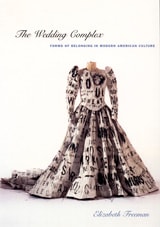
The Wedding Complex
Forms of Belonging in Modern American CultureElizabeth Freeman
Duke University Press, 2002
Freeman draws on queer theory and social history to focus on a range of texts where weddings do not necessarily lead to legal marriage but instead reflect yearnings for intimate arrangements other than long-term, state-sanctioned, domestic couplehood. Beginning with a look at the debates over gay marriage, she proceeds to consider literary works by Nathaniel Hawthorne, William Faulkner, Carson McCullers, Vladimir Nabokov, and Edgar Allan Poe, along with such Hollywood films as Father of the Bride, The Graduate, and The Godfather. She also discusses less well-known texts such as Su Friedrich’s experimental film First Comes Love and the off-Broadway, interactive dinner play Tony ‘n’ Tina’s Wedding.
Offering bold new ways to imagine attachment and belonging, and the public performance and recognition of social intimacy, The Wedding Complex is a major contribution to American studies, queer theory, and cultural studies.
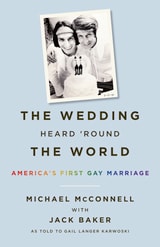
The Wedding Heard 'Round the World
America's First Gay MarriageMichael McConnell
University of Minnesota Press, 2016
At the dawn of the modern gay movement (while New York’s Stonewall riots and San Francisco’s emerging political activism bloomed), these two young men insisted on making their commitment a legal reality. They were already crusaders for gay rights: Jack had twice been elected the University of Minnesota’s student president—the first openly gay university student president in the country, an election reported by Walter Cronkite on network TV news. They were featured in Look magazine’s special issue about the American family and received letters of support from around the world.
The couple navigated complex procedures to obtain a state-issued marriage license. Their ceremony was conducted by a Methodist minister in a friend’s tiny Minneapolis apartment. Wearing matching white pantsuits, exchanging custom-designed rings, and sharing a tiered wedding cake, Michael and Jack celebrated their historic marriage. After reciting their vows, they sealed their promise to love and honor each other with a kiss and a signed marriage certificate.
Repercussions were immediate: Michael’s job offer at the University of Minnesota was rescinded, leading him to wage a battle against job discrimination with the help of the Minnesota Civil Liberties Union. The couple eventually reached the U.S. Supreme Court with two precedent-setting cases.
Michael and Jack have retired from the public spotlight, but after four decades their marriage is still their joy and comfort. Living quietly in a Minneapolis bungalow, they exemplify a contemporary version of the American dream. Only now, with marriage equality in the headlines and the Supreme Court decision to make love the law of the land, are they willing to tell the entire story of their groundbreaking experiences. TIME magazine listed the twenty-five most influential marriages of all time and included Michael and Jack, and they were recently profiled in a cover story in the Sunday New York Times. Their long campaign for marriage equality and insistence on equal rights for all citizens is a model for advocates of social justice and an inspiration for everyone who struggles for acceptance in a less-than-equal world.
Winning Marriage
The Inside Story of How Same-Sex Couples Took on the Politicians and Pundits—and WonMarc Solomon
University Press of New England, 2015