Results by title
59 books match the query 'San Francisco' and 4 start with a
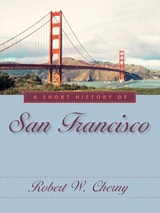
A Short History of San Francisco
Robert W. Cherny
University of Nevada Press, 2026
When British explorer George Vancouver arrived at the San Francisco presidio in 1792, he described it as resembling a “compound for cattle”—hardly the opulent outpost he had expected of Spanish California. Today San Francisco is a bustling metropolis with picturesque neighborhoods, dramatic engineering feats such as the Golden Gate Bridge, and innovative tech companies. How did we get here? To answer that question, A Short History of San Francisco moves from the first Ohlone settlements to the Spanish missions and Gold Rush mansions, to the glaring inequalities of the Gilded Age and the turbulent labor politics of the early and mid-twentieth century, to the birth of the counterculture and the rise of the tech companies that now define the region. Concise yet packed with information, this book is vital reading for anyone who wants to understand the city at the Golden Gate.
[more]

A Time of Youth
San Francisco, 1966–1967William Gedney
Duke University Press, 2021
A year before 1967's famed Summer of Love, documentary photographer William Gedney set out for San Francisco on a Guggenheim Fellowship to record “aspects of our culture which I believe significant and which I hope will become, in time, part of the visual record of American history.” A Time of Youth brings together eighty-seven of the more than two thousand photographs Gedney took in San Francisco's Haight-Ashbury neighborhood between October 1966 and January 1967. In these photographs Gedney documents the restless and intertwined lives of the disenchanted youth who flocked to what became the epicenter of 1960s counterculture. Gedney lived among these young people in their communal homes, where he captured the intimate and varied contours of everyday life: solitude and companionship, joyous celebration and somber quiet, cramped rooms and spacious parks, recreation and contemplation. In these images Gedney presents a portrait of a San Francisco counterculture that complicates popular depictions of late 1960s youth as carefree flower children. The book also includes facsimiles of handwritten descriptions of the scenes Gedney photographed, his thoughts on organizing the book, and other ephemera.
[more]
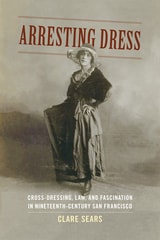
Arresting Dress
Cross-Dressing, Law, and Fascination in Nineteenth-Century San FranciscoClare Sears
Duke University Press, 2015
In 1863, San Francisco’s Board of Supervisors passed a law that criminalized appearing in public in “a dress not belonging to his or her sex.” Adopted as part of a broader anti-indecency campaign, the cross-dressing law became a flexible tool for policing multiple gender transgressions, facilitating over one hundred arrests before the century’s end. Over forty U.S. cities passed similar laws during this time, yet little is known about their emergence, operations, or effects. Grounded in a wealth of archival material, Arresting Dress traces the career of anti-cross-dressing laws from municipal courtrooms and codebooks to newspaper scandals, vaudevillian theater, freak-show performances, and commercial “slumming tours.” It shows that the law did not simply police normative gender but actively produced it by creating new definitions of gender normality and abnormality. It also tells the story of the tenacity of those who defied the law, spoke out when sentenced, and articulated different gender possibilities.
[more]
addicted.pregnant.poor
Kelly Ray Knight
Duke University Press, 2015
For the addicted, pregnant, and poor women living in daily-rent hotels in San Francisco's Mission district, life is marked by battles against drug cravings, housing debt, and potential violence. In this stunning ethnography Kelly Ray Knight presents these women in all their complex humanity and asks what kinds of futures are possible for them given their seemingly hopeless situation. During her four years of fieldwork Knight documented women’s struggles as they traveled from the street to the clinic, jail, and family court, and back to the hotels. She approaches addicted pregnancy as an everyday phenomenon in these women's lives and describes how they must navigate the tension between pregnancy's demands to stay clean and the pull of addiction and poverty toward drug use and sex work. By creating the space for addicted women's own narratives and examining addicted pregnancy from medical, policy, and social science perspectives, Knight forces us to confront and reconsider the ways we think about addiction, trauma, health, criminality, and responsibility.
[more]