Results by title
9 books match the query 'Satellites'

Cultures in Orbit
Satellites and the TelevisualLisa Parks
Duke University Press, 2005
Roaming across the disciplines of media studies, geography, and science and technology studies, Parks examines uses of satellites by broadcasters, military officials, archaeologists, and astronomers. She looks at Our World, a live intercontinental television program that reached five hundred million viewers in 1967, and Imparja tv, an Aboriginal satellite tv network in Australia. Turning to satellites’ remote-sensing capabilities, she explores the U.S. military’s production of satellite images of the war in Bosnia as well as archaeologists’ use of satellites in the excavation of Cleopatra’s palace in Alexandria, Egypt. Parks’s reflections on how Western fantasies of control are implicated in the Hubble telescope’s views of outer space point to a broader concern: that while satellite uses promise a “global village,” they also cut and divide the planet in ways that extend the hegemony of the post-industrial West. In focusing on such contradictions, Parks highlights how satellites cross paths with cultural politics and social struggles.
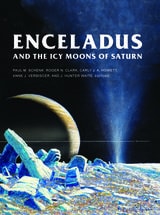
Enceladus and the Icy Moons of Saturn
Edited by Paul M. Schenk, Roger N. Clark, Carly J. A. Howett, Anne J. Verbiscer, and J. Hunter Waite
University of Arizona Press, 2018
As a new volume in the Space Science Series, Enceladus and the Icy Moons of Saturn brings together nearly eighty of the world’s top experts writing more than twenty chapters to set the foundation for what we currently understand, while building the framework for the highest-priority questions to be addressed through ongoing spacecraft exploration. Topics include the physics and processes driving the geologic and geophysical phenomena of icy worlds, including, but not limited to, ring-moon interactions, interior melting due to tidal heating, ejection and reaccretion of vapor and particulates, ice tectonics, and cryovolcanism.
By contextualizing each topic within the profusion of puzzles beckoning from among Saturn’s many dozen moons, Enceladus and the Icy Moons of Saturn synthesizes planetary processes on a broad scale to inform and propel both seasoned researchers and students toward achieving new advances in the coming decade and beyond.
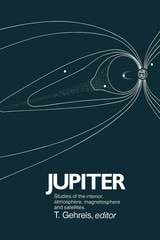
Jupiter
Studies of the interior, atmosphere, magnestosphere and satellitesTom Gehrels
University of Arizona Press, 1976
When Jupiter was first published in August, 1976, editor T. Gehrels wrote, "we may never do a better book."
Summarizing the research and data following the first flyby of Jupiter in December 1973, this work brings together the knowledge of the best scientists in the fields at the time of it's publication. The work covers the origin of Jupiter, origin and structure of the satellites, models of Jupiter, comparison of those models, and much more.
Origin and Evolution of Planetary and Satellite Atmospheres
Edited by S. K. Atreya, J. B. Pollack, and M.S. Matthews
University of Arizona Press, 1989
Planetary Satellites
Joseph A. Burns
University of Arizona Press, 1977
Satellites
Edited by Joseph A. Burns and Mildred Shapley Mathews
University of Arizona Press, 1986
Satellites of Jupiter
David Morrison
University of Arizona Press, 1982
From the original publication:
The findings of Voyager have brought Jupiter's moons out from the shadows. Now as much of interest to geologists as to astronomers, these satellites are brought under closer scrutiny by more than 50 international authorities in this volume. Included is research on thermal evolution, surface composition, cratering time scales, and other subjects; but also key chapters focusing on the satellite Io's volcanic eruptions, thermodynamics, phase composition and more. These 24 contributions constitute a reference that will stand as the decade's definitive work on Jupiter's satellites and a springboard to further hypotheses.
Sidereus Nuncius, or The Sidereal Messenger
Galileo Galilei
University of Chicago Press, 2015
Albert Van Helden’s beautifully rendered and eminently readable translation is based on the Venice 1610 edition’s original Latin text. An introduction, conclusion, and copious notes place the book in its historical and intellectual context, and a new preface, written by Van Helden, highlights recent discoveries in the field, including the detection of a forged copy of Sidereus Nuncius, and new understandings about the political complexities of Galileo’s work.

Telescopes, Tides, and Tactics
A Galilean Dialogue about The Starry Messenger and Systems of the WorldStillman Drake
University of Chicago Press, 1983
Drake has revised his earlier abridged translation of the Starry Messenger, and for the first time the entire work is presented here in modern English. No other edition or translation of this famous work has analyzed Galileo's recorded observations in detail, compared them with modern calculations, or explained the later use he made of them. In the accompanying fictional dialogue, Salviati, Sagredo, and Sarpi reread the Starry Messenger in 1613 and discuss events and issues raised in the three years since its publication. Much of the dialogue is based on archival materials not previously cited in English. Drake has unearthed a wealth of information that will interest the lay reader as well as the historian and the scientist—descriptions of the various and occasionally bizarre critics of Galileo, a reconstruction of Galileo's promised book on the system of the world, his tables of observations and calculations of satellite motions, and evidence for an early tide theory. It was this theory explaining tides by motions of the earth, rather than the influence of Platonic metaphysics, Drake argues that played a major role in Galileo's acceptance of Copernican astronomy.
Telescopes, Tides, and Tactics is a thorough portrait of Galileo as a working astronomer. Offering much more than a commentary on the Starry Messenger, Drake has written a novel and absorbing contribution to the history of physics and astronomy and the study of the Scientific Revolution.