Results by title
13 books match the query 'Scale'

Bigger Than Life
The Close-Up and Scale in the CinemaMary Ann Doane
Duke University Press, 2021
In Bigger Than Life Mary Ann Doane examines how the scalar operations of cinema, especially those of the close-up, disturb and reconfigure the spectator's sense of place, space, and orientation. Doane traces the history of scalar transformations from early cinema to the contemporary use of digital technology. In the early years of cinema, audiences regarded the monumental close-up, particularly of the face, as grotesque and often horrifying, even as it sought to expose a character's interiority through its magnification of detail and expression. Today, large-scale technologies such as IMAX and surround sound strive to dissolve the cinematic frame and invade the spectator's space, “immersing” them in image and sound. The notion of immersion, Doane contends, is symptomatic of a crisis of location in technologically mediated space and a reconceptualization of position, scale, and distance. In this way, cinematic scale and its modes of spatialization and despatialization have shaped the modern subject, interpolating them into the incessant expansion of commodification.
[more]
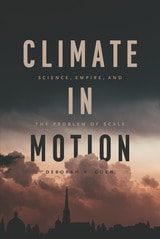
Climate in Motion
Science, Empire, and the Problem of ScaleDeborah R. Coen
University of Chicago Press, 2018
Today, predicting the impact of human activities on the earth’s climate hinges on tracking interactions among phenomena of radically different dimensions, from the molecular to the planetary. Climate in Motion shows that this multiscalar, multicausal framework emerged well before computers and satellites. Extending the history of modern climate science back into the nineteenth century, Deborah R. Coen uncovers its roots in the politics of empire-building in central and eastern Europe. She argues that essential elements of the modern understanding of climate arose as a means of thinking across scales in a state—the multinational Habsburg Monarchy, a patchwork of medieval kingdoms and modern laws—where such thinking was a political imperative. Led by Julius Hann in Vienna, Habsburg scientists were the first to investigate precisely how local winds and storms might be related to the general circulation of the earth’s atmosphere as a whole. Linking Habsburg climatology to the political and artistic experiments of late imperial Austria, Coen grounds the seemingly esoteric science of the atmosphere in the everyday experiences of an earlier era of globalization. Climate in Motion presents the history of modern climate science as a history of “scaling”—that is, the embodied work of moving between different frameworks for measuring the world. In this way, it offers a critical historical perspective on the concepts of scale that structure thinking about the climate crisis today and the range of possibilities for responding to it.
[more]
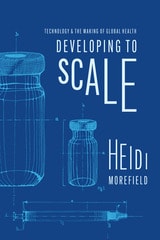
Developing to Scale
Technology and the Making of Global HealthHeidi Morefield
University of Chicago Press, 2023
The first critical book on “appropriate technology,” Developing to Scale shows how global health came to be understood as a problem to be solved with the right technical interventions.
In 1973, economist E. F. Schumacher published Small Is Beautiful, which introduced a mainstream audience to his theory of “appropriate technology”: the belief that international development projects in the Global South were most sustainable when they were small-scale, decentralized, and balanced between the traditional and the modern. His theory gained widespread appeal, as cuts to the foreign aid budget, the national interests of nations seeking greater independence, postcolonial activism, and the rise of the United States’ tech sector drove stakeholders across public and private institutions toward cheaper tools. In the ensuing decades, US foreign assistance shifted away from massive modernization projects, such as water treatment facilities, toward point-of-use technologies like village water pumps and oral rehydration salts. This transition toward the small scale had massive implications for the practice of global health.
Developing to Scale tells the history of appropriate technology in international health and development, relating the people, organizations, and events that shaped this consequential idea. Heidi Morefield examines how certain technologies have been defined as more or less “appropriate” for the Global South based on assumptions about gender, race, culture, and environment. Her study shows appropriate technology to be malleable, as different constituencies interpreted its ideas according to their own needs. She reveals how policymakers wielded this tool to both constrain aid to a scale that did not threaten Western interests and to scale the practice of global health through the development and distribution of technical interventions.
[more]
Developing to Scale
Technology and the Making of Global HealthHeidi Morefield
University of Chicago Press, 2023
This is an auto-narrated audiobook version of this book.
The first critical book on “appropriate technology,” Developing to Scale shows how global health came to be understood as a problem to be solved with the right technical interventions.
In 1973, economist E. F. Schumacher published Small Is Beautiful, which introduced a mainstream audience to his theory of “appropriate technology”: the belief that international development projects in the Global South were most sustainable when they were small-scale, decentralized, and balanced between the traditional and the modern. His theory gained widespread appeal, as cuts to the foreign aid budget, the national interests of nations seeking greater independence, postcolonial activism, and the rise of the United States’ tech sector drove stakeholders across public and private institutions toward cheaper tools. In the ensuing decades, US foreign assistance shifted away from massive modernization projects, such as water treatment facilities, toward point-of-use technologies like village water pumps and oral rehydration salts. This transition toward the small scale had massive implications for the practice of global health.
Developing to Scale tells the history of appropriate technology in international health and development, relating the people, organizations, and events that shaped this consequential idea. Heidi Morefield examines how certain technologies have been defined as more or less “appropriate” for the Global South based on assumptions about gender, race, culture, and environment. Her study shows appropriate technology to be malleable, as different constituencies interpreted its ideas according to their own needs. She reveals how policymakers wielded this tool to both constrain aid to a scale that did not threaten Western interests and to scale the practice of global health through the development and distribution of technical interventions.
[more]

From Small Talk to Microaggression
A History of ScaleMichael Lempert
University of Chicago Press, 2024
A provocative and eye-opening history of how we have studied and theorized social interaction.
In this ambitious, wide-ranging book, anthropologist Michael Lempert offers a conceptual history that explores how, why, and with what effects we have come to think of interactions as “scaled.” Focusing on the sciences of interaction in midcentury America, Lempert traces how they harnessed diverse tools and media technologies, from dictation machines to 16mm film, to study communication “microscopically.” In looking closely, many hoped to transform interaction: to improve efficiency, grow democracy, curb racism, and much else. Yet their descent into a microworld created troubles, with some critics charging that these scientists couldn’t see the proverbial forest for the trees. Exploring talk therapy and group dynamics studies, social psychology and management science, conversation analysis, “micropolitics,” and more, Lempert shows how scale became a defining problem across the behavioral sciences.
Ultimately, he argues, if we learn how our objects of study have been scaled in advance, we can better understand how we think and interact with them—and with each other—across disciplinary and ideological divides. Even as once-fierce debates over micro and macro have largely subsided, Lempert shows how scale lives on and continues to affect the ethics and politics of language and communication today.
[more]
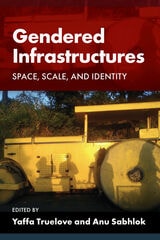
Gendered Infrastructures
Space, Scale, and IdentityYaffa Truelove
West Virginia University Press, 2024
Brings together feminist and geographical approaches to the gendered dimensions of various types of infrastructure across the globe.
The first book to take a feminist geographical approach to infrastructure, Gendered Infrastructures delves into the complex relationships between identity, social relations, and infrastructure. By drawing on feminist scholarship to enable new frameworks for critical study, this edited volume explores the gendered nature of infrastructures as diverse as Senegal’s waste disposal, Vietnam’s cement industry, and Lilongwe’s water kiosks. The chapters consider how infrastructural assemblages rework and shape gendered relations, identities, and meanings across space, while tracing the intersectionality of relations and uneven geographies that surround infrastructure. Ultimately, the contributors show how gender is always present in the quotidian building blocks that organize the socio-material world and daily life.
Edited by Yaffa Truelove and Anu Sabhlok, and the third book in Amy Trauger and Jennifer Fluri’s Gender, Feminism, and Geography series, the original essays in Gendered Infrastructures respond to and build upon a “new infrastructural turn in critical scholarship”—one that has helped enliven studies of identity across scale. The volume is relevant to geographers, anthropologists, architects, sociologists, urban researchers, and other interdisciplinary scholars interested in the gendered and social dimensions of infrastructure.
[more]

Prostitution and the Ends of Empire
Scale, Governmentalities, and Interwar IndiaStephen Legg
Duke University Press, 2014
Officially confined to red-light districts, brothels in British India were tolerated until the 1920s. Yet, by this time, prostitution reform campaigns led by Indian, imperial, and international bodies were combining the social scientific insights of sexology and hygiene with the moral condemnations of sexual slavery and human trafficking. These reformers identified the brothel as exacerbating rather than containing "corrupting prostitutes" and the threat of venereal diseases, and therefore encouraged the suppression of brothels rather than their urban segregation. In this book, Stephen Legg tracks the complex spatial politics surrounding brothels in the interwar period at multiple scales, including the local, regional, national, imperial, and global. Campaigns and state policies against brothels did not just operate at different scales but made scales themselves, forging new urban, provincial, colonial, and international formations. In so doing, they also remade the boundary between the state and the social, through which the prostitute was, Legg concludes, "civilly abandoned."
[more]

Scale
Edited by Jennifer L. Roberts
Terra Foundation for American Art, 2016
Scale is perhaps the most spectacularly overlooked aspect of artistic production. As photographic and digital reproductions have essentially dematerialized art, critical and historical research dealing with scale—both within the American critical tradition and abroad—has become scattered and insufficiently theorized. However, by posing a specific challenge, such research forces a heightened recognition of both the properties of materials and the deep technical knowledge of makers. A reconsideration of scalar relationships in American art and visual culture therefore reveals original insights.
Scale is the second volume in the Terra Foundation Essays series. With eighty color illustrations and a wealth of new research from Glenn Adamson, Wendy Bellion, Wouter Davidts, Darcy Grimaldo Grigsby, Christopher P. Heuer, Joshua G. Stein, and Jason Weems, it explores viewers’ physical relationship to Barnett Newman’s abstract canvases, the arduous engineering behind the creation of Mount Rushmore, and the charged significance of liberty poles in the landscape of eighteenth-century New York, among other topics that range from studies of specific works of art to significant conceptual and theoretical concerns.
Scale is the second volume in the Terra Foundation Essays series. With eighty color illustrations and a wealth of new research from Glenn Adamson, Wendy Bellion, Wouter Davidts, Darcy Grimaldo Grigsby, Christopher P. Heuer, Joshua G. Stein, and Jason Weems, it explores viewers’ physical relationship to Barnett Newman’s abstract canvases, the arduous engineering behind the creation of Mount Rushmore, and the charged significance of liberty poles in the landscape of eighteenth-century New York, among other topics that range from studies of specific works of art to significant conceptual and theoretical concerns.
[more]

Scale
Nathan McClain
Four Way Books, 2017
Scale is about a relationship between a father and a son. These poems consider the importance of acknowledging the past as well as the dangers in doing so.
[more]

The Cosmic Zoom
Scale, Knowledge, and MediationZachary Horton
University of Chicago Press, 2021
In The Powers of Ten by Charles and Ray Eames, a view of two people enjoying a picnic zooms up and away to show their surroundings, moving progressively farther into space, then zooms back in for a close-up of the hand of the picnicker, travelling deep into the microscopic realm. This is one of the most iconic examples of the “cosmic zoom,” a trope that has influenced countless media forms over the past seventy years.
Horton uses the cosmic zoom as a starting point to develop a cross-disciplinary theory of scale as mediated difference. He considers the origins of our notions of scale, how scalar mediation functions differently in analog and digital modes, and how cosmic zoom media has influenced scientific and popular views of the world. Analyzing literature, film, digital media, and database history, Horton establishes a much-needed framework for thinking about scale across multiple domains and disciplines.
Horton uses the cosmic zoom as a starting point to develop a cross-disciplinary theory of scale as mediated difference. He considers the origins of our notions of scale, how scalar mediation functions differently in analog and digital modes, and how cosmic zoom media has influenced scientific and popular views of the world. Analyzing literature, film, digital media, and database history, Horton establishes a much-needed framework for thinking about scale across multiple domains and disciplines.
[more]
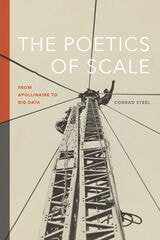
The Poetics of Scale
From Apollinaire to Big DataConrad Steel
University of Iowa Press, 2024
Since the start of the twentieth century, poets have been irresistibly drawn to the image of the poem as a kind of data-handling, a way of mediating between the divergent scales of aesthetics and infrastructure, language and technology. Conrad Steel shows how the history of poetry—with its particular formal affordances, and the particular hopes and fears we invest it with—has always been bound up with our changing logistics of macroscale representation.
The Poetics of Scale takes us back to the years before the First World War in Paris, where the poet Guillaume Apollinaire claimed to have invented a new mode of poetry large enough to take on the challenges of the coming twentieth century. This history follows Apollinaire’s ideas across the Atlantic and examines how and why his work became such a vital source of inspiration for American poets through the era of intensive American economic expansion and up to the present day. Threading together Apollinaire’s work in the 1910s with three of his American successors—Louis Zukofsky in the 1930s, Allen Ginsberg in the 1950s, and Alice Notley from the 1970s onward—it shows how poetry as a cultural technique became the crucial test case for the scale of our collective imagination.
The Poetics of Scale takes us back to the years before the First World War in Paris, where the poet Guillaume Apollinaire claimed to have invented a new mode of poetry large enough to take on the challenges of the coming twentieth century. This history follows Apollinaire’s ideas across the Atlantic and examines how and why his work became such a vital source of inspiration for American poets through the era of intensive American economic expansion and up to the present day. Threading together Apollinaire’s work in the 1910s with three of his American successors—Louis Zukofsky in the 1930s, Allen Ginsberg in the 1950s, and Alice Notley from the 1970s onward—it shows how poetry as a cultural technique became the crucial test case for the scale of our collective imagination.
[more]
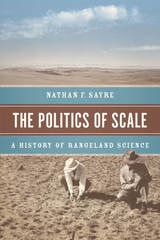
The Politics of Scale
A History of Rangeland ScienceNathan F. Sayre
University of Chicago Press, 2017
Rangelands are vast, making up one quarter of the United States and forty percent of the Earth’s ice-free land. And while contemporary science has revealed a great deal about the environmental impacts associated with intensive livestock production—from greenhouse gas emissions to land and water degradation—far less is known about the historic role science has played in rangeland management and politics. Steeped in US soil, this first history of rangeland science looks to the origins of rangeland ecology in the late nineteenth-century American West, exploring the larger political and economic forces that—together with scientific study—produced legacies focused on immediate economic success rather than long-term ecological well being.
During the late 1880s and early 1890s, a variety of forces—from the Homestead Act of 1862 to the extermination of bison, foreign investment, and lack of government regulation—promoted free-for-all access to and development of the western range, with disastrous environmental consequences. To address the crisis, government agencies turned to scientists, but as Nathan F. Sayre shows, range science grew in a politically fraught landscape. Neither the scientists nor the public agencies could escape the influences of bureaucrats and ranchers who demanded results, and the ideas that became scientific orthodoxy—from fire suppression and predator control to fencing and carrying capacities—contained flaws and blind spots that plague public debates about rangelands to this day. Looking at the global history of rangeland science through the Cold War and beyond, The Politics of Scale identifies the sources of past conflicts and mistakes and helps us to see a more promising path forward, one in which rangeland science is guided less by capital and the state and more by communities working in collaboration with scientists.
During the late 1880s and early 1890s, a variety of forces—from the Homestead Act of 1862 to the extermination of bison, foreign investment, and lack of government regulation—promoted free-for-all access to and development of the western range, with disastrous environmental consequences. To address the crisis, government agencies turned to scientists, but as Nathan F. Sayre shows, range science grew in a politically fraught landscape. Neither the scientists nor the public agencies could escape the influences of bureaucrats and ranchers who demanded results, and the ideas that became scientific orthodoxy—from fire suppression and predator control to fencing and carrying capacities—contained flaws and blind spots that plague public debates about rangelands to this day. Looking at the global history of rangeland science through the Cold War and beyond, The Politics of Scale identifies the sources of past conflicts and mistakes and helps us to see a more promising path forward, one in which rangeland science is guided less by capital and the state and more by communities working in collaboration with scientists.
[more]

The Scale of Imprisonment
Franklin E. Zimring and Gordon J. Hawkins
University of Chicago Press, 1991
Two of the nation's foremost criminal justice scholars present a comprehensive assessment of the factors behind the growth and subsequent overcrowding of American prisons. By critiquing the existing scholarship on prison scale from sociology and history to correctional forecasting and economics, they both reveal that explicit policy changes have had little influence on the increases in imprisonment in recent years and analyze whether it is possible to place limits effectively on prison population.
"The Scale of Imprisonment has an exceptionally well designed literature review of interest to public policy, criminal justice, and public law scholars. Its careful review, analysis, and critique of research is stimulating and inventive."—American Political Science Review
"The authors fram our thoughts about the soaring use of imprisonment and stimulate our thinking about the best way we as criminologists can conduct rational analysis and provide meaningful advice."—Susan Guarino-Ghezzi, Journal of Quantitative Criminology
"Zimring and Hawkins bring a long tradition of excellent criminological scholarship to the seemingly intractable problems of prisons, prison overcrowding, and the need for alternative forms of punishment."—J. C. Watkins, Jr., Choice
[more]