Results by title
3 books match the query 'Scapegoat'
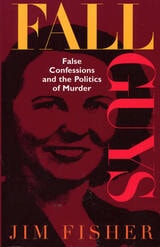
Fall Guys
False Confessions and the Politics of MurderJim Fisher
Southern Illinois University Press, 1996
Jim Fisher, criminal justice professor and former FBI agent, reveals how he uncovered the framing of two boys in a pair of unrelated murders committed in 1956 and 1958.
In the first of the cases, eleven-year-old Charlie Zubryd confessed that at the age of eight, he had murdered his widowed mother by driving a hatchet into her skull. The crime was committed in the basement of the modest Zubryd home in a rural section of Sewickley Township in western Pennsylvania, an area not far from Pittsburgh. Following intense police questioning, young Zubryd confessed to the crime in March 1959, a full twenty-eight months after the bloody murder of his mother.
Too young to prosecute, Charlie Zubryd was adopted after his confession and a brief stay in a mental ward. A childless couple gave Zubryd a new name and identity. It would be twenty years before Charlie Zubryd—now going by the name Chuck Duffy—would have any contact with his biological family.
When Zubryd/Duffy made an effort to get his real family back, he was rejected because his relatives still believed he had murdered his mother. In fact, until Fisher began to investigate the case in 1989, Chuck Duffy himself was not sure he had not killed his mother during some kind of mental blackout.
The second murder occurred in 1958, two years after the Zubryd case. Thirteen-year-old Jerry Pacek endured forty-one hours of police grilling before he confessed to raping and killing fifty-year-old Lillian Steveck as she walked home one evening from a bus stop in Breckenridge, Pennsylvania. Pacek told the same Allegheny County homicide detective who had framed Charlie Zubryd that he had killed the woman with a variety of blunt objects, none of which were ever found. The thirteen-year-old boy was tried and convicted of the murder the following spring. He was sent to Camp Hill Prison, where he remained incarcerated for ten years.
Fisher’s investigation cleared the names of both the wrongfully accused boys. Because of his investigation, the Zubryd case was reopened, which led to the identification of a vicious killer. In 1991, Fisher’s investigative efforts convinced the governor of Pennsylvania to grant a full pardon to Jerry Pacek, who as a teenager had served ten years in an adult prison for a murder he had not committed.
Jim Fisher and the Zubryd and Pacek stories have been featured on a number of nationally broadcast television programs.
Flesh Becomes Word
A Lexicography of the Scapegoat or, the History of an IdeaDavid Dawson
Michigan State University Press, 2013
Scapegoat
The Impact of Death-Fear on an American FamilyEric Bermann
University of Michigan Press, 1973
Roscoe A. was eight years old when psychologist Eric Bermann first met him and his family. In kindergarten, Roscoe was considered highly creative, but his teachers also evaluated him as a potentially dangerous and destructive child capable of uncontrolled aggression toward other children. His parents denied the report. To them, Roscoe was a quiet, well-behaved boy.
In the second grade, over the objections and confusion of his parents, Roscoe was finally removed from public school and admitted to a day treatment facility where he could receive psychotherapy. Progress was minimal. After a year of effort, there was still no agreement on "Roscoe's problems." Mental health professionals despaired. They deemed his parents "unworkable" and labeled them "deniers" of their son's destructive behaviors. In turn, the parents blamed the professionals for therapeutic incompetencies and failure to help Roscoe, who, after all, "was never a problem at home."
The only alternative to terminating the therapeutic effort was to obtain new data and fresh insights into the dilemma. It was at this point that Dr. Bermann, a clinical researcher embarked on the study of family interaction, was consulted. He immediately arranged to visit them at home, where he could observe their interactions in situ. He hoped that, with them, he might shed some light on the discrepancy between reports of Roscoe's behavior.
Dr. Bermann visited the family and recorded his observations regularly and in detail throughout the next year. His analysis of these observations has resulted in this startling book--a research account that is both stunning in the originality of its method and searing in its documentation of an American family in crisis.