Results by title
2 books match the query 'Scarcity'
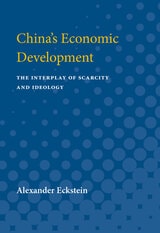
China's Economic Development
The Interplay of Scarcity and IdeologyAlexander Eckstein
University of Michigan Press, 1975
China's Economic Development: The Interplay of Scarcity and Ideology by Alexander Eckstein provides a comprehensive analysis of China's economic growth and transformation from a socialist economy. Eckstein examines the unique challenges China faced in addressing its economic backwardness, such as scarcity of resources and ideological constraints, and compares its industrialization to other countries. The book explores how Maoist ideology and policy initiatives impacted the country's economic strategies, leading to a fluctuating development pattern characterized by rapid expansion in the 1950s and stagnation in the 1960s. Key themes include the dichotomy between scarcity and ideology, the influence of historical factors on economic structures, and the adaptation to Soviet models. Eckstein sheds light on how China navigated its unique size, population pressures, and low per capita income, arguing that understanding these dynamics is crucial for both development theory and policy design. This volume, part of the Michigan Studies on China series, compiles essays and research that contribute to a nuanced understanding of China's economic systems, with particular focus on the tensions between ideological aspirations and economic realities.
[more]
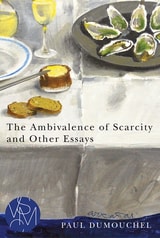
The Ambivalence of Scarcity and Other Essays
Paul Dumouchel
Michigan State University Press, 2014
First published in French in 1979, “The Ambivalence of Scarcity” was a groundbreaking work on mimetic theory. Now expanded upon with new, specially written, and never-before-published conference texts and essays, this revised edition explores René Girard’s philosophy in three sections: economy and economics, mimetic theory, and violence and politics in modern societies. The first section argues that though mimetic theory is in many ways critical of modern economic theory, this criticism can contribute to the enrichment of economic thinking. The second section explores the issues of nonviolence and misrecognition (méconnaissance), which have been at the center of many discussions of Girard’s work. The final section proposes mimetic analyses of the violence typical of modern societies, from high school bullying to genocide and terrorist attacks. Politics, Dumouchel argues, is a violent means of protecting us from our own violent tendencies, and it can at times become the source of the very savagery from which it seeks to protect us. The book’s conclusion analyzes the relationship between ethics and economics, opening new avenues of research and inviting further exploration. Dumouchel’s introduction reflects on the importance of René Girard’s work in relation to ongoing research, especially in social sciences and philosophy.
[more]