Results by title
5 books match the query 'Scarlet'
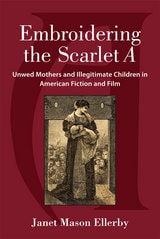
Embroidering the Scarlet A
Unwed Mothers and Illegitimate Children in American Fiction and FilmJanet Mason Ellerby
University of Michigan Press, 2015
Embroidering the Scarlet A traces the evolution of the “fallen woman” from the earliest novels to recent representations in fiction and film, including The Scarlet Letter, The Sound and the Fury, The Color Purple, and Love Medicine, and the films Juno and Mother and Child. Interweaving her own experience as a pregnant teen forced to surrender her daughter and pledge secrecy for decades, Ellerby interrogates “out-of-wedlock” motherhood, mapping the ways archetypal scarlet women and their children have been exiled as social pariahs, pardoned as blameless pawns, and transformed into empowered women. Drawing on narrative, feminist, and autobiographical theory, the book examines the ways that the texts have affirmed, subverted, or challenged dominant thinking and the prevailing moral standards as they have shifted over time. Using her own life experience and her uniquely informed perspective, Ellerby assesses the effect these stories have on the lives of real women and children. By inhabiting the space where ideology meets narrative, Ellerby questions the constricting historical, cultural, and social parameters of female sexuality and permissible maternity.
As a feminist cultural critique, a moving autobiographical journey, and an historical investigation that addresses both fiction and film, Embroidering the Scarlet A will appeal to students and scholars of literature, history, sociology, psychology, women’s and gender studies, and film studies. The book will also interest general readers, as it relates the experience of surrendering a child to adoption at a time when birthmothers were still exiled, birth records were locked away, and secrecy was still mandatory. It will also appeal to those concerned with adoption or the cultural shifts that have changed our thinking about illegitimacy.
[more]
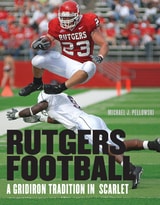
Rutgers Football
A Gridiron Tradition in ScarletPellowski, Michael J
Rutgers University Press, 2007
Thirteen seconds remaining, score tied at 25, fourth and seven for Rutgers at Louisville's 27. Against the third ranked team in the nation, on a perfect autumn evening, the Scarlet Knights stormed back from 18 down, with Coach Greg Schiano's vaunted defense shutting down Louisville's passing attack. As Jeremy Ito's kick cleared the uprights with seconds on the clock, the Scarlet Knights announced their arrival as one of the most fearsome teams in the nation.
Rutgers Football: A Gridiron Tradition in Scarlet is a richly illustrated history of one of the most storied programs in all of college football. From the first intercollegiate contest against Princeton in 1869, which started college football as we know it, through the years that Paul Robeson suited up for the team, the famous undefeated season of 1976, and right up to the Schiano era, former Scarlet Knight Michael Pellowski takes you on a fascinating journey that chronicles the highlights of the first 137 years of Rutgers football. He makes special mention of the Scarlet Knights who have gone on to successful careers in the NFL-Brian Leonard, Mike McMahon, L.J. Smith, Gary Brackett, Ray Lucas, Deron Cherry, among others-and includes a complete listing of letter winners.
Now, with the Empire State Building being lit red in the team's honor, and fans believing that a national championship is within reach, Rutgers Football: A Gridiron Tradition in Scarlet provides the indispensable backstory for this team as it "chops" its way to future greatness.
[more]
Scarlet and Black, Volume Three
Making Black Lives Matter at Rutgers, 1945-2020Miya Carey
Rutgers University Press, 2021
The 250th anniversary of the founding of Rutgers University is a perfect moment for the Rutgers community to reconcile its past, and acknowledge its role in the enslavement and debasement of African Americans and the disfranchisement and elimination of Native American people and culture. Scarlet and Black, Volume Three, concludes this groundbreaking documentation of the history of Rutgers’s connection to slavery, which was neither casual nor accidental—nor unusual. Like most early American colleges, Rutgers depended on slaves to build its campuses and serve its students and faculty; it depended on the sale of black people to fund its very existence. This final of three volumes concludes the work of the Committee on Enslaved and Disenfranchised Population in Rutgers History. This latest volume includes essays about Black and Puerto Rican students' experiences; the development of the Black Unity League; the Conklin Hall takeover; the divestment movement against South African apartheid; anti-racism struggles during the 1990s; and the Don Imus controversy and the 2007 Scarlet Knights women's basketball team. To learn more about the work of the Committee on Enslaved and Disenfranchised Population in Rutgers History, visit the project's website at http://scarletandblack.rutgers.edu.
[more]
Scarlet and Black, Volume Two
Constructing Race and Gender at Rutgers, 1865-1945Kendra Boyd
Rutgers University Press, 2020
The 250th anniversary of the founding of Rutgers University is a perfect moment for the Rutgers community to reconcile its past, and acknowledge its role in the enslavement and debasement of African Americans and the disfranchisement and elimination of Native American people and culture. Scarlet and Black, Volume 2, continues to document the history of Rutgers’s connection to slavery, which was neither casual nor accidental—nor unusual. Like most early American colleges, Rutgers depended on slaves to build its campuses and serve its students and faculty; it depended on the sale of black people to fund its very existence. This second of a planned three volumes continues the work of the Committee on Enslaved and Disenfranchised Population in Rutgers History. This latest volume includes: an introduction to the period studied (from the end of the Civil War through WWII) by Deborah Gray White; a study of the first black students at Rutgers and New Brunswick Theological Seminary; an analysis of African-American life in the City of New Brunswick during the period; and profiles of the earliest black women to matriculate at Douglass College.
To learn more about the work of the Committee on Enslaved and Disenfranchised Population in Rutgers History, visit the project's website at http://scarletandblack.rutgers.edu
To learn more about the work of the Committee on Enslaved and Disenfranchised Population in Rutgers History, visit the project's website at http://scarletandblack.rutgers.edu
[more]
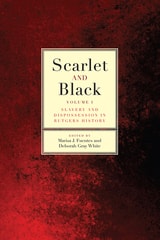
Scarlet and Black
Slavery and Dispossession in Rutgers HistoryFuentes, Marisa J
Rutgers University Press, 2016
The 250th anniversary of the founding of Rutgers University is a perfect moment for the Rutgers community to reconcile its past, and acknowledge its role in the enslavement and debasement of African Americans and the disfranchisement and elimination of Native American people and culture.
Scarlet and Black documents the history of Rutgers’s connection to slavery, which was neither casual nor accidental—nor unusual. Like most early American colleges, Rutgers depended on slaves to build its campuses and serve its students and faculty; it depended on the sale of black people to fund its very existence. Men like John Henry Livingston, (Rutgers president from 1810–1824), the Reverend Philip Milledoler, (president of Rutgers from 1824–1840), Henry Rutgers, (trustee after whom the college is named), and Theodore Frelinghuysen, (Rutgers’s seventh president), were among the most ardent anti-abolitionists in the mid-Atlantic.
Scarlet and black are the colors Rutgers University uses to represent itself to the nation and world. They are the colors the athletes compete in, the graduates and administrators wear on celebratory occasions, and the colors that distinguish Rutgers from every other university in the United States. This book, however, uses these colors to signify something else: the blood that was spilled on the banks of the Raritan River by those dispossessed of their land and the bodies that labored unpaid and in bondage so that Rutgers could be built and sustained. The contributors to this volume offer this history as a usable one—not to tear down or weaken this very renowned, robust, and growing institution—but to strengthen it and help direct its course for the future.
The work of the Committee on Enslaved and Disenfranchised Population in Rutgers History.
Visit the project's website at http://scarletandblack.rutgers.edu
[more]