Results by title
3 books match the query 'Scenic byways'
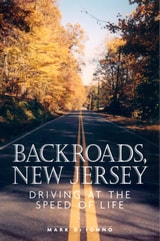
Backroads, New Jersey
Driving at the Speed of LifeDi Ionno, Mark
Rutgers University Press, 2002
Mark Di Ionno is a Jersey guy through and through. He’s lived in fifteen different towns in six different New Jersey counties. He’s been a journalist for the state’s top newspapers, currently the Star-Ledger, where his first job was to go out and write about things that were “interesting.” Who better to take readers on a personal tour of the backroads of New Jersey?
In Backroads, New Jersey, Di Ionno leads readers off the congested interstates with their commonplace scenery to the seldom-explored secondary roads, where the real life of the state can be found. These inter-county or 500 series roads are a 6,788-mile network of mostly one-lane highways. Marked by blue-and-yellow five-sided shields bearing county names, they make up more than 20 percent of New Jersey’s public roads. They are never the fastest or most direct way to get anywhere, but when you break out of the towns and hit the country, they are a pleasure to drive.
Travel with Di Ionno as he takes readers to see the state’s amazing beauty¾from the dizzying cliffs of the Palisades, to the blunted peaks of the Highlands and Kittatinny Ridges, to the rolling hills of Morris, Hunterdon, and Somerset counties, to the topsoil-wealthy agricultural belts of Monmouth and the southern counties, to the flat, sandy beaches of the 127-mile Jersey Shore. Travel with him as he shows us the homes of New Jersey’s culturally diverse population, whose men and women work at everything from farms to pharmacies, from banks to auto assembly lines. And travel with him as he recounts the history made along the back country roads in towns like Rocky Hill, where George Washington wrote his farewell orders. Di Ionno calls New Jersey “a place of infinite natural beauty, a place of intricate human patterns. A place where you can see a lot in a little time. This is, simply put, the overriding theme of this book. New Jersey is a restless state for restless people. A state for wanderers to explore.” Backroads, New Jersey is a rare chance to see it all through the eyes of a well-traveled Jerseyan. Happy wandering!
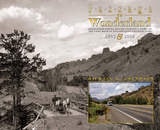
Passage to Wonderland
Rephotographing Joseph Stimson's Views of the Cody Road to Yellowstone National Park, 1903 and 2008Michael A. Amundson
University Press of Colorado, 2012
Amundson examines the physical changes along "the most scenic fifty miles in America" and explores the cultural and natural history behind them. This careful analysis of the paired images make Passage to Wonderland more than a "then and now" photography book--it is a unique exploration of the interconnectedness between the Old West and the New West. It will be a wonderful companion for those touring the Cody Road as well as those armchair tourists who can follow the road on Google Earth using the provided GPS coordinates.
The University Press of Colorado gratefully acknowledges the generous support of the Charles Redd Center for Western Studies at Brigham Young University toward the publication of this book.
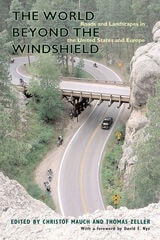
The World beyond the Windshield
Roads and Landscapes in the United States and EuropeChristof Mauch
Ohio University Press, 2008
For better or worse, the view through a car’s windshield has redefined how we see the world around us. In some cases, such as the American parkway, the view from the road was the be-all and end-all of the highway; in others, such as the Italian autostrada, the view of a fast, efficient transportation machine celebrating either Fascism or its absence was the goal. These varied environments are neither necessary nor accidental but the outcomes of historical negotiations, and whether we abhor them or take delight in them, they have become part of the fabric of human existence.
The World beyond the Windshield: Roads and Landscapes in the United States and Europe is the first systematic, comparative look at these landscapes. By looking at examples from the United States and Europe, the chapters in this volume explore the relationship between the road and the landscape thatit traverses, cuts through, defines, despoils, and enhances. The authors analyze the Washington Beltway and the Blue Ridge Parkway, as well as iconic roads in Italy, Nazi Germany, East Germany, and Great Britain. This is a story of the transatlantic exchange of ideas about environment and technology and of the national and nationalistic appropriations of such landscaping.