Results by title
14 books match the query 'Scharnhorst, Gary'

American Literary Scholarship, 1995, Volume 93
Gary Scharnhorst
Duke University Press, 0
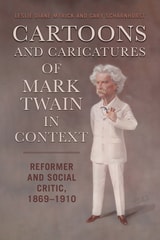
Cartoons and Caricatures of Mark Twain in Context
Reformer and Social Critic, 1869–1910Leslie Diane Myrick and Gary Scharnhorst
University of Alabama Press, 2023
Cartoons and Caricatures of Mark Twain in Context: Reformer and Social Critic, 1869–1910 examines the production, reception, and history of Twain’s reputation as a social and political satirist. Myrick and Scharnhorst trace the evolution of Twain’s depiction throughout his life, career, and even death and across more than seventy illustrations—from portrayals of the famous author as a court jester adorned with cap and bells, to a regally haloed king with a royal train—offering a new perspective on his influence and reputation. Although he was among the most photographed figures of the nineteenth century, Myrick and Scharnhorst focus on a medium that Twain, an expert ofself-promotion and brand management, could not control. As a result, Myrick and Scharnhorst have compiled an innovative and incisive visual reception history.
Cartoons and Caricatures of Mark Twainin Context illustrates the popular and often critical response to many famous and infamous episodes in his career, such as the storm of controversy that surrounded the publication of his anti-imperialist writings at the turn of the twentieth century. Routinely depicted with hair like a fright wig, a beak-like nose, and a cigar in hand, no matter the context or the costume, Twain was instantly recognizable. Yet it was not merely the familiarity of his image that made him a regular feature in visual commentary, but also his willingness to speak out against corruption and to insert himself into controversies of his day.

Charlotte Perkins Gilman and Her Contemporaries
Literary and Intellectual ContextsEdited by Cynthia J. Davis and Denise D. Knight
University of Alabama Press, 2004
Considers Gilman’s place in American literary and social history by examining her relationships to other prominent intellectuals of her era
By placing Charlotte Perkins Gilman in the company of her contemporaries, this collection seeks to correct misunderstandings of the feminist writer and lecturer as an isolated radical. Gilman believed and preached that no life is ever led in isolation; indeed, the cornerstone of her philosophy was the idea that “humanity is a relation.”Gilman's highly public and combative stances as a critic and social activist brought her into contact and conflict with many of the major thinkers and writers of the period, including Mary Austin, Margaret Sanger, Ambrose Bierce, Grace Ellery Channing, Lester Ward, Inez Haynes Gillmore, William Randolph Hearst, Karen Horney, William Dean Howells, Catharine Beecher, George Bernard Shaw, and Owen Wister. Gilman wrote on subjects as wide ranging as birth control, eugenics, race, women's rights and suffrage, psychology, Marxism, and literary aesthetics. Her many contributions to social, intellectual, and literary life at the turn of the 20th century raised the bar for future discourse, but at great personal and professional cost.
Charlotte Perkins Gilman and a Woman's Place in America
Edited by Jill Bergman
University of Alabama Press, 2017
Charlotte Perkins Gilman and a Woman’s Place in America is a pioneering collection that probes how depictions of space, confinement, and liberation establish both the difficulty and necessity of female empowerment. Turning Victorian notions of propriety and a woman’s place on its ear, this finely crafted essay collection studies Gilman’s writings and the manner in which they push back against societal norms and reject male-dominated confines of space.
The contributors present fascinating and innovative readings of some of Gilman’s most significant works. By examining the settings in “The Yellow Wallpaper” and Herland, for example, the volume analyzes Gilman’s construction of place, her representations of male dominance and female subjugation, and her analysis of the rules and obligations that women feel in conforming to their assigned place: the home.
Additionally, this volume delineates female resistance to this conformity. Contributors highlight how Gilman’s narrators often choose resistance over obedient captivity, breaking free of the spaces imposed upon them in order to seek or create their own habitats. Through biographical interpretations of Gilman’s work that focus on the author’s own renouncement of her “natural” role of wife and mother, contributors trace her relocation to the American West in an attempt to appropriate the masculinized spaces of work and social organization.
Engaging, well-researched, and deftly written, the essays in this collection will appeal to scholars of Gilman, literature, and gender issues alike.
Julian Hawthorne
The Life of a Prodigal SonGary Scharnhorst
University of Illinois Press, 2014
Julian Hawthorne (1846-1934), Nathaniel Hawthorne's only son, lived a long and influential life marked by bad circumstances and worse choices. Raised among luminaries such as Thoreau, Emerson, and the Beecher family, Julian became a promising novelist in his twenties, but his writing soon devolved into mediocrity.
What talent the young Hawthorne had was spent chasing across the changing literary and publishing landscapes of the period in search of a paycheck, writing everything from potboilers to ad copy. Julian was consistently short of funds because--as biographer Gary Scharnhorst is the first to reveal--he was supporting two households: his wife in one and a longtime mistress in the other.
The younger Hawthorne's name and work ethic gave him influence in spite of his haphazard writing. Julian helped to found Cosmopolitan and Collier's Weekly. As a Hearst stringer, he covered some of the era's most important events: McKinley's assassination, the Galveston hurricane, and the Spanish-American War, among others.
When Julian died at age 87, he had written millions of words and more than 3,000 pieces, out-publishing his father by a ratio of twenty to one. Gary Scharnhorst, after his own long career including works on Mark Twain, Oscar Wilde, and other famous writers, became fascinated by the leaps and falls of Julian Hawthorne. This biography shows why.
Mark Twain at Home
How Family Shaped Twain’s FictionMichael J. Kiskis, Foreword by Laura Skandera Trombley, Afterword by Gary Scharnhorst
University of Alabama Press, 2016
Mark Twain was the child of a loveless marriage and a homelife over which hovered the constant specter of violence. Informed by his difficult childhood, orthodox readings of The Adventures of Tom Sawyer and Adventures of Huckleberry Finn frame these canonical literary figures as nostalgic—autobiographical fables of heroic individualists slipping the bonds of domestic life.
Kiskis, however, presents a wealth of biographical details about Samuel Clemens and his family that reinterpret Twain’s work as a robust affirmation of domestic spheres of life. Among Kiskis’s themes are that, as the nineteenth century witnessed high rates of orphanhood and childhood mortality, Clemens’s work often depicted unmoored children seeking not escape from home but rather seeking the redemption and safety available only in familial structures. Similarly, Mark Twain at Home demonstrates that, following the birth of his first daughter, Twain began to exhibit in his writing an anxiety with social ills, notably those that affected children.
In vigorous and accessible descriptions of Twain’s life as it became reflected in his prose, Kiskis offers a compelling and fresh understanding of this work of this iconic American author.
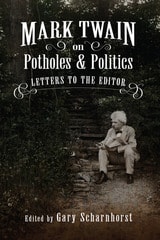
Mark Twain on Potholes and Politics
Letters to the EditorEdited by Gary Scharnhorst
University of Missouri Press, 2014
A frequent outlet for Twain’s wit was in letters to the editors of various newspapers and periodicals. Sharing his thoughts and opinions on topical issues ranging from national affairs to local social events, with swipes along the way at woman suffrage, potholes, literary piracy and other scams, slow mail delivery, police corruption, capital punishment, and the removal of Huck Finn from libraries, Twain never hesitated to speak his mind. And now thanks to Gary Scharnhorst, more than a hundred of these letters are available in one place for us to enjoy.
From his opinions on the execution of an intellectually brilliant murderer, to his scathing review of a bureau he perceived as “a pack of idiots” running on a currency of doughnuts, Twain’s pure, unbridled voice is evident throughout his letters. Mark Twain on Potholes and Politicsgives readers a chance to delve further than ever before into the musings of the most recognizable voice in American literature.
Mark Twain
The Complete InterviewsEdited by Gary Scharnhorst
University of Alabama Press, 2006
Mark Twain: The Complete Interviews is an annotated and indexed scholarly edition of every known interview with Mark Twain. In these interviews that span his entire career, Twain discusses matters as varied as his lecture style, his writings, and his bankruptcy, while holding forth on such timeless issues as human nature, politics, war and peace, government corruption, humor, race relations, imperialism, international copyright, the elite, and his impressions of other writers.
These interviews are oral performances in their own right and a new basis for evaluating contemporary responses to Twain’s writings. The interviews are records of verbal conversations rather than texts written in Twain’s hand. Four interviews are new to scholarship; fewer than a fifth have ever been reprinted.
.
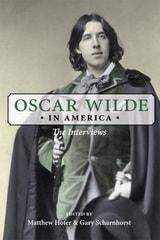
Oscar Wilde in America
The InterviewsEdited by Matthew Hofer and Gary Scharnhorst
University of Illinois Press, 2013
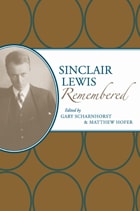
Sinclair Lewis Remembered
Gary Scharnhorst
University of Alabama Press, 2012
Sinclair Lewis Remembered is a collection of reminiscences and memoirs by contemporaries, friends, and associates of Lewis that offers a revealing and intimate portrait of this complex and significant Nobel Prize–winning American writer.
The Life of Mark Twain
The Early Years, 1835-1871Gary Scharnhorst
University of Missouri Press, 2018
With dozens of Mark Twain biographies available, what is left unsaid? On average, a hundred Clemens letters and a couple of Clemens interviews surface every year. Scharnhorst has located documents relevant to Clemens’s life in Missouri, along the Mississippi River, and in the West, including some which have been presumed lost. Over three volumes, Scharnhorst elucidates the life of arguably the greatest American writer and reveals the alchemy of his gifted imagination.

The Life of Mark Twain
The Final Years, 1891–1910Gary Scharnhorst
University of Missouri Press, 2022
In the final volume of his three-volume biography, Gary Scharnhorst chronicles the life of Samuel Langhorne Clemens from his family’s extended trip to Europe in 1891 to his death in 1910 at age 74. During these years Clemens grapples with bankruptcy, returns to the lecture circuit, and endures the loss of two daughters and his wife. It is also during this time that he writes some of his darkest, most critical works; among these include Pudd’nhead Wilson; Personal Recollections of Joan of Arc; Tom Sawyer Abroad; Tom Sawyer, Detective; Following the Equator; No. 44, the Mysterious Stranger; and portions of his Autobiography.
The Life of Mark Twain
The Middle Years, 1871–1891Gary Scharnhorst
University of Missouri Press, 2019
The second volume of Gary Scharnhorst’s three-volume biography chronicles the life of Samuel Langhorne Clemens between his move with his family from Buffalo to Elmira (and then Hartford) in spring 1871 and their departure from Hartford for Europe in mid-1891.
During this time he wrote and published some of his best-known works, including Roughing It, The Gilded Age, The Adventures of Tom Sawyer, A Tramp Abroad, The Prince and the Pauper, Life on the Mississippi,Adventures of Huckleberry Finn, and A Connecticut Yankee in King Arthur’s Court.
Significant events include his trips to England (1872–73) and Bermuda (1877); the controversy over his Whittier Birthday Speech in December 1877; his 1878–79 Wanderjahr on the continent; his 1882 tour of the Mississippi valley; his 1884–85 reading tour with George Washington Cable; his relationships with his publishers (Elisha Bliss, James R. Osgood, Andrew Chatto, and Charles L. Webster); the death of his son, Langdon, and the births and childhoods of his daughters Susy, Clara, and Jean; as well as the several lawsuits and personal feuds in which he was involved. During these years, too, Clemens expressed his views on racial and gender equality and turned to political mugwumpery; supported the presidential campaigns of Grover Cleveland; advocated for labor rights, international copyright, and revolution in Russia; founded his own publishing firm; and befriended former president Ulysses S. Grant, supervising the publication of Grant’s Memoirs.
The Life of Mark Twain is the first multi-volume biography of Samuel Clemens to appear in more than a century and has already been hailed as the definitive Twain biography.

Twain in His Own Time
A Biographical Chronicle of His Life, Drawn from Recollections, Interviews, and Memoirs by Family, Friends, and AssociatesGary Scharnhorst
University of Iowa Press, 2010
Never one to suffer fools gladly, especially if they wore crinolines, Mark Twain lost as many friends as he made, and he targeted them all indiscriminately. The first major American writer born west of the Mississippi River, he enjoys a reputation unrivaled in American literary history, and from the beginning of his career he tried to control that reputation by fiercely protecting his public persona. Not a debunking account of Twain’s life but refreshingly immune from his relentless image making, Gary Scharnhorst’s Twain in His Own Time offers an anecdotal version of Twain’s life over which the master spin-doctor had virtually no control.
The ninety-four recollections gathered in Twain in His Own Time form an unsanitized, collaborative biography designed to provide a multitude of perspectives on the iconic author. Opening with an interview with his mother that has never been reprinted, it includes memoirs by his daughters and by men who knew him when he was roughing it in Nevada and California, an interview with the pilot who taught him to navigate the Mississippi River, reminiscences from his illustrators E. M. Kemble and Dan Beard and two of his so-called adolescent angelfish, contributions from politicians and from such literary figures as Dan De Quille and George Bernard Shaw, and one of the most damning assessments of his character—by the author Frank Harris—ever published.
Each entry is introduced by a brief explanation of its historical and cultural context; explanatory notes provide further information about people and places; and Scharnhorst’s introduction and chronology of Twain’s eventful life are comprehensive and detailed. Dozens of lively primary sources published incrementally over more than eighty years, most recorded after his death, illustrate the complexities of this flamboyant, outspoken personality in a way that no single biographer could.