Results by title
4 books match the query 'Schmalzer, Sigrid'
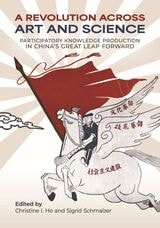
A Revolution Across Art and Science
Participatory Knowledge Production in China’s Great Leap ForwardEdited by Christine I. Ho and Sigrid Schmalzer
Hong Kong University Press, 2026
This volume examines the role of mass knowledge production—whether artistic, scientific, or technical—in China’s Great Leap Forward.
A Revolution Across Art and Science examines how laborers reimagined knowledge during a high point of radicalism in modern Chinese history. Encouraged to become curators, historians, writers, artists, technicians, scientists, and other kinds of experts, Chinese workers and peasants were mobilized to produce new knowledge in the humanities and sciences. Moving beyond the economic questions that have dominated most previous scholarship on the Great Leap Forward, this volume explores the cultural dimensions of the movement to establish the significance of mass knowledge production. Through ten case studies authored by emerging scholars, this volume offers a simultaneously empathetic and critical inquiry into PRC history and its impact on ongoing efforts to democratize knowledge around the world.

Red Revolution, Green Revolution
Scientific Farming in Socialist ChinaSigrid Schmalzer
University of Chicago Press, 2016
In Red Revolution, Green Revolution, Sigrid Schmalzer explores the intersection of politics and agriculture in socialist China through the diverse experiences of scientists, peasants, state agents, and “educated youth.” The environmental costs of chemical-intensive agriculture and the human costs of emphasizing increasing production over equitable distribution of food and labor have been felt as strongly in China as anywhere—and yet, as Schmalzer shows, Mao-era challenges to technocracy laid important groundwork for today’s sustainability and food justice movements. This history of “scientific farming” in China offers us a unique opportunity not only to explore the consequences of modern agricultural technologies but also to engage in a necessary rethinking of fundamental assumptions about science and society.

Science for the People
Documents from America's Movement of Radical ScientistsSigrid Schmalzer
University of Massachusetts Press, 2018
For the first time, this book compiles original documents from Science for the People, the most important radical science movement in U.S. history. Between 1969 and 1989, Science for the People mobilized American scientists, teachers, and students to practice a socially and economically just science, rather than one that served militarism and corporate profits. Through research, writing, protest, and organizing, members sought to demystify scientific knowledge and embolden “the people” to take science and technology into their own hands. The movement's numerous publications were crucial to the formation of science and technology studies, challenging mainstream understandings of science as “neutral” and instead showing it as inherently political. Its members, some at prominent universities, became models for politically engaged science and scholarship by using their knowledge to challenge, rather than uphold, the social, political, and economic status quo.
Highlighting Science for the People's activism and intellectual interventions in a range of areas—including militarism, race, gender, medicine, agriculture, energy, and global affairs—this volume offers vital contributions to today's debates on science, justice, democracy, sustainability, and political power.
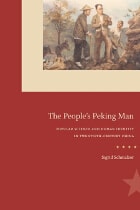
The People's Peking Man
Popular Science and Human Identity in Twentieth-Century ChinaSigrid Schmalzer
University of Chicago Press, 2008
The People’s Peking Man is a skilled social history of twentieth-century Chinese paleoanthropology and a compelling cultural—and at times comparative—history of assumptions and debates about what it means to be human. By focusing on issues that push against the boundaries of science and politics, The People’s Peking Man offers an innovative approach to modern Chinese history and the history of science.