Results by title
7 books match the query 'Schofield, Philip'
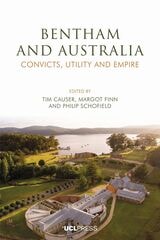
Bentham and Australia
Convicts, Utility and EmpireEdited by Tim Causer, Margot Finn, and Philip Schofield
University College London, 2022
This volume considers Jeremy Bentham’s Australian writings. In the first part of the volume, Bentham’s works are placed in their historical contexts, while the second part provides a critical assessment of the historical accuracy and plausibility of Bentham’s arguments against transportation from the British Isles. In the third part, attention turns to Bentham’s claim that New South Wales was founded illegally and to the imperial and colonial constitutional ramifications of that claim. The authors also discuss Bentham’s work of 1831 in which he supports the establishment of a free colony on the southern coast of Australia. In the final part, the authors shed light on the history of Bentham’s panopticon penitentiary scheme, his views on the punishment and reform of criminals and what role, if any, religion had to play in that regard, and discuss apparently panopticon-inspired institutions built in the Australian colonies.
This collection will appeal to readers interested in Bentham’s life and thought, the history of transportation from the British Isles and of British penal policy more generally, colonial and imperial history, Indigenous history, legal and constitutional history, and religious history.
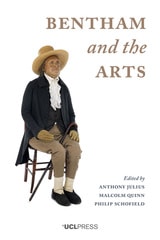
Bentham and the Arts
Edited by Anthony Julius, Malcolm Quinn, and Philip Schofield
University College London, 2020
Correspondence of Jeremy Bentham, Volume 13
July 1828 to June 1832Edited by Philip Schofield, Tim Causer, and Chris Riley
University College London, 2024
The Correspondence of Jeremy Bentham, Volume 13 contains authoritative and fully annotated texts of all known and publishable letters sent both to and from Bentham between 1st July 1828 and his death on 6th June 1832. In addition to 474 letters, the volume contains three memorandums concerning Bentham’s health shortly before his death, his last will and testament, and extracts from both the autobiography and the manuscript diaries of Bentham’s nephew George. Among the letters that have already been published, most are drawn from the edition of The Works of Jeremy Bentham, prepared under the superintendence of Bentham’s literary executor John Bowring. A small number of letters have been reproduced from newspapers and periodicals.
This volume publishes, for the first time, the entire extant correspondence between Bentham and Daniel O’Connell, the Irish Liberator. Other new acquaintances include the barrister and law reformer, Charles Sinclair Cullen, and the Real Property Commissioner, John Tyrrell. Throughout the period, Bentham maintained regular contact with old friends and connections, but he also engaged in sporadic correspondence with such leading figures in government as the Duke of Wellington, Robert Peel, and Henry Brougham. Further afield, Bentham corresponded, amongst others, with the Marquis de La Fayette in France, Edward Livingston in the United States of America, and José Del Valle in Guatemala.
Essays on Logic, Ethics, and Universal Grammar
Edited by Philip Schofield
University College London, 2025
Best known as the founder of the ethical theory of utilitarianism, Bentham’s philosophical contributions spanned political economy, judicial administration, prison reform, policing, religion, and many more fields. This new addition to The Collected Works of Jeremy Bentham deals with his ideas about logic, language, ethics, and grammar. Distributed across four essays written between 1814 and 1816 and an appendix, it includes discussions of methodization, ontology, real and fictitious entities, and propositions as the fundamental components of language. In addition to constituting a major contribution to the history of logic and language, this collection establishes the philosophical basis for classical utilitarianism and Chrestomathia, Bentham’s major work outlining his materialist theory of language.
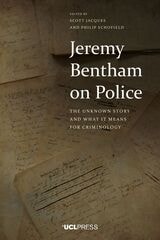
Jeremy Bentham on Police
The Unknown Story and What It Means for CriminologyEdited by Scott Jacques and Philip Schofield
University College London, 2021
Jeremy Bentham theorized the panopticon as modern policing emerged across the British Empire, yet while his theoretical writing became canonical in criminology, his perspective on the police remains obscure. Jeremy Bentham on Police recovers the reformer’s writings on policing alongside a series of essays that demonstrate their significance to the past, present, and future of criminology.
The Correspondence of Jeremy Bentham, Volume 14
Supplementary LettersEdited by Philip Schofield, Tim Causer, and Chris Riley
University College London, 2026
Over 250 letters and other materials by the philosopher and reformer Jeremy Bentham, published in full and in authoritative form for the first time.
This volume is a supplement to the chronological series The Correspondence of Jeremy Bentham. It contains over 250 letters offering new biographical information and deepens our knowledge of Bentham’s relationship with his family, with the panopticon penitentiary scheme, and with notable “disciples” such as Étienne Dumont, Henry Bickersteth, and Leicester Stanhope. Additionally, this volume deepens our understanding of Bentham’s relationship with his younger brother, Samuel Bentham, and provides a detailed account of Samuel's journey to and sojourn in the Russian Empire.
The Panopticon Versus "New South Wales" and Other Writings on Australia
Tim Causer and Philip Schofield
University College London, 2021
Jeremy Bentham conceived the panopticon, in part, as an alternative to criminal transportation to Australia. This latest volume in The Collected Works of Jeremy Bentham series draws out these connections by collecting both Bentham’s fragmentary and extended comments on Australian governance and colonization. These writings include a fragment headed “New Wales” (1792) correspondence with William Wilberforce (1802), three letters to Lord Pelham (1802), a “Plea for the Constitution” (1802–3), and “Colonization Company Proposal” (1831)—the majority published here for the first time. Although Bentham’s most famous ideas emerged from his opposition to colonization, these writings demonstrate how the reformer became a vocal advocate for settler colonization near the end of his life.