Results by title
9 books match the query 'Scholasticism'
Andreas Capellanus, Scholasticism, and the Courtly Tradition
Don A. Monson
Catholic University of America Press, 2005
God's Knowledge of the World
Medieval Theories of Divine Ideas from Bonaventure to OckhamCarl A. Vater
Catholic University of America Press, 2022
Individuals and Institutions in Medieval Scholasticism
Edited by Antonia Fitzpatrick and John Sabapathy
University of London Press, 2020
Introduction to Scholastic Theology
Ulrich G. Leinsle
Catholic University of America Press, 2010
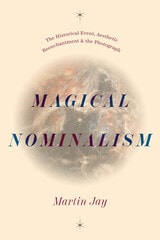
Magical Nominalism
The Historical Event, Aesthetic Reenchantment, and the PhotographMartin Jay
University of Chicago Press, 2025
In this magisterial new book, intellectual historian Martin Jay traces the long-standing competition between two versions of nominalism—the “conventional” and the “magical.” Since at least William of Ockham, according to Jay, the conventional form of nominalism has contributed to the disenchantment of the world, by viewing general terms as nothing more than mere names we use to group particular objects together, rejecting the idea that they refer to a further, “higher” reality. Magical nominalism, instead, performs a reenchanting function, by investing proper names, disruptive events, and singular objects with an auratic power of their own. Drawing in part on Jewish theology, it challenges the elevation of the constitutive subject resulting from Ockham’s reliance on divine will in his critique of real universals.
Starting with the fourteenth-century revolution of nominalism against Scholastic realism, Jay unpacks various “counterrevolutions” against nominalism itself, including a magical alternative to its conventional form. Focusing on fundamental debates over the relationship between language, thought, and reality, Jay illuminates connections across thinkers, disciplines, and vast realms of human experience. Ranging from theology and philosophy of history to aesthetics and political theory, this book engages with a range of artists and thinkers, including Adorno, Ankersmit, Badiou, Barthes, Bataille, Benjamin, Blumenberg, Derrida, Duchamp, Foucault, Kracauer, Kripke, and Lyotard. Ultimately, Magical Nominalism offers a strikingly original way to understand humanity’s intellectual path to modernity.
Pre-Modern Philosophy Defended
Josef Kleutgen
St. Augustine's Press, 2014
“Pre-modern philosophy” means the line of reflection that started with Plato andvAristotle, passed through Augustine and Boethius, and reached its acme in Aquinas, Scotus, and Suarez. The whole line was harshly judged by Descartes, then mocked by the empiricsts of the 18th Century. Why, then, did Pope Leo XII make a determined effort to revive it? And, more importantly, why was the revival a stunning success by the middle of the 20th Century?
The answers to both questions are found in a famous German book, Philosophie der Vorzeit by Josef Kleutgen, now available for the first time in English. Pre-ModernPhilosophy Defended shaped and strengthened Pope Leo’s resolve. It showed how inaccurate the harsh judgments had been and how sadly inferior the modern replacements from Descartes to Hegel had turned out to be in many respects.
Not in all. Kleutgen was no knee-jerk reactionary. He made no bones about the obsolete status of pre-Newtonian physics and cosmology. Rather, he focused on the central boast of “modern” thought, namely, that it had turned at least to the “subject” and had provided a long-needed thing called a “critique of knowledge.”
This book is must reading for intellectual historians and for philosophers working today in epistemology. But most of all, it is essential reading for laity and clergy concerned about revivals of modernism in the church. What was modernism, after all, but an attempt to make the Church revise her theology in the “light” of Kant or Hegel? This is why every Modernist knew Kleutgen’s name and hated this book.
Here is the first English translation (from the German) of the master work of Josef Kleutgen, the nineteenth century social philosopher whose thought lies at, or near, the heart of Catholic Social Thought. Kleutgen is widely and rightly seen as the shadow author of the social encyclicals of Leo XII. Leo’s Rerum Novarum remains the origin and constant reference point of all Catholic Social Teaching. And Popes since have dated their own social encyclicals from Rerum Novarum – hence, Quadragesimo anno and Centesimus annus. —Gerard V. Bradley, University of Notre Dame
Pre-Modern Philosophy Defended is must reading for intellectual historians and for philosophers working today in epistemology. And it is essential reading for laity and clergy concerned about revivals of modernism in the church. What was modernism, after all, but an attempt to make the Church revise her theology in the ‘light’ of Kant or Hegel? This is why every Modernist knew Kleutgen's name and hated Philosophie der Vorzeit (Pre-Modern Philosophy Defended).
Scholastic Meditations
Nicholas Rescher
Catholic University of America Press, 2005
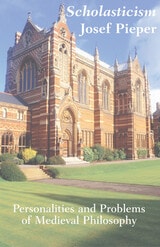
Scholasticism
Personalities & Problems Medieval PhilosophyJosef Pieper
St. Augustine's Press, 2001
The account is broken by the gradual replacement of the synthesis of faith and reason that had been achieved in the early Middle Ages by a new one that made use of Aristotle. Pieper gives a thorough and lively account of the struggle between Aristotelians and anti-Aristotelians, and the famous condemnations that put the effort of Saint Thomas Aquinas at risk. But the Summa theologiae is regarded by Pieper as the unique achievement of the period.
If the early centuries, the medieval period, can be seen as moving toward the thirteenth and Thomas's unique achievement, subsequent centuries saw the decline of scholasticism and theappearance of harbingers of modern philosophy.
The book closes with Pieper's thoughts on the permanent philosophical and theological significance of scholasticism and the Middle Ages. Once again, wearing his learning lightly, writing with a clarity that delights, Josef Pieper has taken the field from stuffier and more extended accounts.
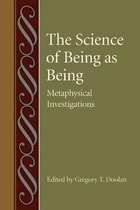
The Science of Being as Being
Metaphysical InvestigationsGregory T. Doolan
Catholic University of America Press, 2012