Results by title
4 books match the query 'Scholem, Gershom'
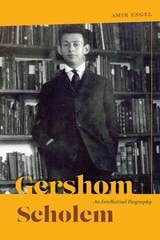
Gershom Scholem
An Intellectual BiographyAmir Engel
University of Chicago Press, 2017
Gershom Scholem (1897–1982) was ostensibly a scholar of Jewish mysticism, yet he occupies a powerful role in today’s intellectual imagination, having influential contact with an extraordinary cast of thinkers, including Hans Jonas, Martin Buber, Walter Benjamin, Hannah Arendt, and Theodor Adorno. In this first biography of Scholem, Amir Engel shows how Scholem grew from a scholar of an esoteric discipline to a thinker wrestling with problems that reach to the very foundations of the modern human experience.
As Engel shows, in his search for the truth of Jewish mysticism Scholem molded the vast literature of Jewish mystical lore into a rich assortment of stories that unveiled new truths about the modern condition. Positioning Scholem’s work and life within early twentieth-century Germany, Palestine, and later the state of Israel, Engel intertwines Scholem’s biography with his historiographical work, which stretches back to the Spanish expulsion of Jews in 1492, through the lives of Rabbi Isaac Luria and Sabbatai Zevi, and up to Hasidism and the dawn of the Zionist movement. Through parallel narratives, Engel touches on a wide array of important topics including immigration, exile, Zionism, World War One, and the creation of the state of Israel, ultimately telling the story of the realizations—and failures—of a dream for a modern Jewish existence.
As Engel shows, in his search for the truth of Jewish mysticism Scholem molded the vast literature of Jewish mystical lore into a rich assortment of stories that unveiled new truths about the modern condition. Positioning Scholem’s work and life within early twentieth-century Germany, Palestine, and later the state of Israel, Engel intertwines Scholem’s biography with his historiographical work, which stretches back to the Spanish expulsion of Jews in 1492, through the lives of Rabbi Isaac Luria and Sabbatai Zevi, and up to Hasidism and the dawn of the Zionist movement. Through parallel narratives, Engel touches on a wide array of important topics including immigration, exile, Zionism, World War One, and the creation of the state of Israel, ultimately telling the story of the realizations—and failures—of a dream for a modern Jewish existence.
[more]
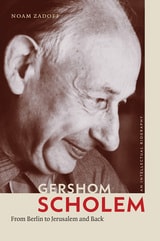
Gershom Scholem
From Berlin to Jerusalem and BackNoam Zadoff
Brandeis University Press, 2017
German-born Gerhard (Gershom) Scholem (1897–1982), the preeminent scholar of Jewish mysticism, delved into the historical analysis of kabbalistic literature from late antiquity to the twentieth century. His writings traverse Jewish historiography, Zionism, the phenomenology of mystical religion, and the spiritual and political condition of contemporary Judaism and Jewish civilization. Scholem famously recounted rejecting his parents’ assimilationist liberalism in favor of Zionism and immigrating to Palestine in 1923, where he became a central figure in the German Jewish immigrant community that dominated the nation’s intellectual landscape in Mandatory Palestine. Despite Scholem’s public renunciation of Germany for Israel, Zadoff explores how the life and work of Scholem reflect ambivalence toward Zionism and his German origins.
[more]
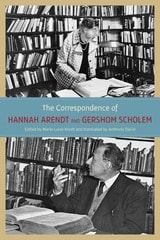
The Correspondence of Hannah Arendt and Gershom Scholem
Hannah Arendt and Gershom Scholem
University of Chicago Press, 2017
Few people thought as deeply or incisively about Germany, Jewish identity, and the Holocaust as Hannah Arendt and Gershom Scholem. And, as this landmark volume reveals, much of that thinking was developed in dialogue, through more than two decades of correspondence.
Arendt and Scholem met in 1932 in Berlin and quickly bonded over their mutual admiration for and friendship with Walter Benjamin. They began exchanging letters in 1939, and their lively correspondence continued until 1963, when Scholem’s vehement disagreement with Arendt’s Eichmann in Jerusalem led to a rupture that would last until Arendt’s death a dozen years later. The years of their friendship, however, yielded a remarkably rich bounty of letters: together, they try to come to terms with being both German and Jewish, the place and legacy of Germany before and after the Holocaust, the question of what it means to be Jewish in a post-Holocaust world, and more. Walter Benjamin is a constant presence, as his life and tragic death are emblematic of the very questions that preoccupied the pair. Like any collection of letters, however, the book also has its share of lighter moments: accounts of travels, gossipy dinner parties, and the quotidian details that make up life even in the shadow of war and loss.
In a world that continues to struggle with questions of nationalism, identity, and difference, Arendt and Scholem remain crucial thinkers. This volume offers us a way to see them, and the development of their thought, anew.
[more]
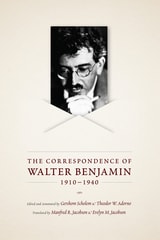
The Correspondence of Walter Benjamin, 1910-1940
Walter Benjamin
University of Chicago Press, 1994
A powerful, mesmerizing collection of letters from one of the most important intellectuals and writers of the twentieth century
Called “the most important critic of his time” by Hannah Arendt, Walter Benjamin has only become more influential over the years, as his work has assumed a crucial place in current debates over the interactions of art, culture, and meaning. A “natural and extraordinary talent for letter writing was one of the most captivating facets of his nature,” writes Gershom Scholem in his Foreword to this volume; and Benjamin's correspondence reveals the evolution of some of his most powerful ideas, while also offering an intimate picture of Benjamin himself and the times in which he lived.
Writing at length to Scholem and Theodor Adorno, and exchanging letters with Rainer Maria Rilke, Hannah Arendt, Max Brod, and Bertolt Brecht, Benjamin elaborates on his ideas about metaphor and language. He reflects on literary figures from Kafka to Karl Kraus, and expounds his personal attitudes toward such subjects as Marxism and French national character. Providing an indispensable tool for any scholar wrestling with Benjamin’s work, The Correspondence of Walter Benjamin is a revelatory look at the man behind much of the twentieth century’s most significant criticism.
[more]