Results by title

6 books match the query 'School Desegregation'
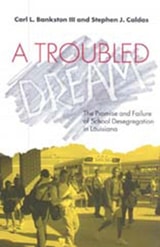
cover of A Troubled Dream: The Promise and Failure of School Desegregation in Louisiana

A Troubled Dream

The Promise and Failure of School Desegregation in Louisiana

Carl L. Bankston

Vanderbilt University Press, 2002

Winner, Louisiana Literary Award 2003

Fifty years after Brown v. Board of Education, the United States still has a long way to go to attain true integration of our educational system.

Using extensive interviews and a wealth of statistical information, Bankston and Caldas examine the failed desegregation efforts in Louisiana as a case study to show how desegregation has followed the same unsuccessful pattern across the United States. Strong supporters of the dream of integration, Bankston and Caldas show that the practical difficulty with desegregation is that academic environments are created by all the students in a school from the backgrounds that all the students bring with them. Unfortunately, the disadvantages that minority children have to overcome affect schools more than schools can help remedy these disadvantages.
[more]
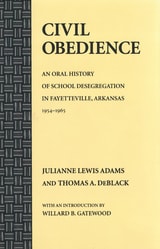
cover of Civil Obedience: An Oral History of School Desegregation in Fayetteville, Arkansas, 1954–1965

Civil Obedience

An Oral History of School Desegregation in Fayetteville, Arkansas, 1954–1965

Julianne Lewis Adams

University of Arkansas Press, 1994

Among the many changes that have occurred in our country in the last forty years, few have been as significant as those heralded by the Supreme Court's decision in the Brown vs. Board of Education case in 1954. By declaring racially segregated public schools unconstitutional, the court set in motion forces that resulted in the dismantling of the legal structure of Jim Crowism. The impact of the Brown decision was national in scope, but in no other region was its impact more far-reaching and traumatic than in the South. In Arkansas, as in other Southern states, racial segregation was not merely a well-stablished way of life, it was firmly imbedded in law.

While school desegregation generated much noise and some violence elsewhere in the South, the city of Fayetteville, Arkansas confronted the issue and resolved it with a good deal of dignity and grace, becoming the first Southern city to accommodate the Brown decision.

Through this fascinating collection of interviews with those who were involved in the desegregation process—students, teachers, administrators, civic leaders, and members of local groups—we learn of the determination of citizens to obey the law of the land and to see that freedom and equality took priority over their commitment to a school system that patently discriminated against one group of citizens.

In our continuing efforts to create a society in which all races and cultures can coexist, Civil Obedience is a story worthy of our full attention.

 
[more]
cover of Fifty-Eight Lonely Men: Southern Federal Judges and School Desegregation

Fifty-Eight Lonely Men

Southern Federal Judges and School Desegregation

J. W. Peltason

University of Illinois Press, 1971
Originally published in 1961, this still timely book illustrates the role of the judiciary in the solution of a social and political problem. It is unequaled in its description of the plight of federal judges who are charged with carrying out the decisions of the Supreme Court against segregation but who are under constant pressure--social, political, and personal--to speak for the white South. Some have been ostracized by their communities as traitors; others have joined their state legislatures and local school boards in developing elaborate delay strategy to circumvent the Supreme Court's decisions. In his introduction to the first edition former Senator Paul H. Douglas wrote: ". . . a clear and comprehensive account of the legal struggles in the federal courts over segregation and desegregation in the public schools of the nation. It gets behind the newspaper headlines and gives a play-by-play account. . . . This book is indeed full proof of the delays and difficulties of the law and the pressures of local public opinion."
[more]
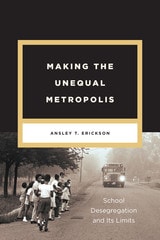
cover of Making the Unequal Metropolis: School Desegregation and Its Limits

Making the Unequal Metropolis

School Desegregation and Its Limits

Ansley T. Erickson

University of Chicago Press, 2016

In a radically unequal United States, schools are often key sites in which injustice grows. Ansley T. Erickson’s Making the Unequal Metropolis presents a broad, detailed, and damning argument about the inextricable interrelatedness of school policies and the persistence of metropolitan-scale inequality. While many accounts of education in urban and metropolitan contexts describe schools as the victims of forces beyond their control, Erickson shows the many ways that schools have been intertwined with these forces and have in fact—via land-use decisions, curricula, and other tools—helped sustain inequality.

Taking Nashville as her focus, Erickson uncovers the hidden policy choices that have until now been missing from popular and legal narratives of inequality. In her account, inequality emerges not only from individual racism and white communities’ resistance to desegregation, but as the result of long-standing linkages between schooling, property markets, labor markets, and the pursuit of economic growth. By making visible the full scope of the forces invested in and reinforcing inequality, Erickson reveals the complex history of, and broad culpability for, ongoing struggles in our schools.
[more]
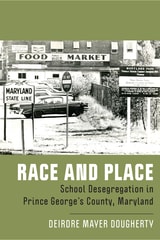
cover of Race and Place: School Desegregation in Prince George's County, Maryland

Race and Place

School Desegregation in Prince George's County, Maryland

Deirdre Mayer Dougherty

Rutgers University Press, 2025
Race and Place considers the everyday experiences of community members throughout the process of school desegregation and how race, place, and truth came to matter in this process in Prince George’s County, Maryland, from 1945 through 1973. The book is organized around several successive policies that emerged in this time: school equalization, school choice, neighborhood schools, school construction, school closure, busing for racial integration, and school discipline. Dougherty shows how these policies contained and reinforced assumptions about place and created new racial truths about people and schooling.
 
[more]
cover of The Political Use of Racial Narratives: School Desegregation in Mobile, Alabama, 1954-97

The Political Use of Racial Narratives

School Desegregation in Mobile, Alabama, 1954-97

Richard A. Pride

University of Illinois Press, 2002

Arguing that politics is essentially a contest for meaning and that telling a story is an elemental political act, Richard A. Pride lays bare the history of school desegregation in Mobile, Alabama, to demonstrate the power of narrative in cultural and political change. This book describes the public, personal, and meta-narratives of racial inequality that have competed for dominance in Mobile. Pride begins with a white liberal's quest to desegregate the city's public schools in 1955 and traces which narratives--those of biological inferiority, white oppression, the behavior and values of blacks, and others--came to influence public policy and opinion over four decades. Drawing on contemporaneous sources, he reconstructs the stories of demonstrations, civic forums, court cases, and school board meetings as citizens of Mobile would have experienced them, inviting readers to trace the story of desegregation in Mobile through the voices of politicians, protestors, and journalists and to determine which narratives were indeed most powerful.

Exploring who benefits and who pays when different narratives are accepted as true, Pride offers a step-by-step account of how Mobile's culture changed each time a new and more forceful narrative was used to justify inequality. More than a retelling of Mobile's story of desegregation, The Political Use of Racial Narratives promotes the value of rhetorical and narrative analysis in the social sciences and history.

[more]