Results by title
4 books match the query 'School closings'

Exit Strategy
A PlayIke Holter
Northwestern University Press, 2018
Righteously angry, riotously funny, and wise to the tensions between abstract policy and lived experience, Ike Holter's play Exit Strategy centers on vivid, unforgettable characters struggling to maintain faith in a vocation that is being determinedly undermined.
Drawing from the headlines, Exit Strategy is set in Chicago and tells the story of a fictional public high school slated for closure at the end of the year. Despite funding cuts, bureaucrats run amok, apathy, and a rodent infestation, a small, multiracial group of teachers launch a last-minute effort to save the school, and put their careers, futures, and safety in the hands of a fast-talking administrator who may be in over his head. The tenuous situation also raises fears and anxieties among students, and within the volcanic neighborhood that is home to the school.
Holter has said that Exit Strategy was inspired by the 2013 mass closure of forty-nine Chicago public schools, which displaced nearly 12,000 children—the majority of directly impacted students were African American and Latinx. Hailed as "riveting," "sharp," and "richly metaphoric" by critics, the play indicts how we educate our children in big American cities, and shows why gaps between haves and have-nots continue to grow.
Exit Strategy is one of seven plays in Ike Holter's cycle of works set in Chicago or Chicago-inspired neighborhoods.
[more]
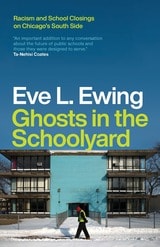
Ghosts in the Schoolyard
Racism and School Closings on Chicago's South SideEve L. Ewing
University of Chicago Press, 2018
“Failing schools. Underprivileged schools. Just plain bad schools.”
That’s how Eve L. Ewing opens Ghosts in the Schoolyard: describing Chicago Public Schools from the outside. The way politicians and pundits and parents of kids who attend other schools talk about them, with a mix of pity and contempt.
But Ewing knows Chicago Public Schools from the inside: as a student, then a teacher, and now a scholar who studies them. And that perspective has shown her that public schools are not buildings full of failures—they’re an integral part of their neighborhoods, at the heart of their communities, storehouses of history and memory that bring people together.
Never was that role more apparent than in 2013 when Mayor Rahm Emanuel announced an unprecedented wave of school closings. Pitched simultaneously as a solution to a budget problem, a response to declining enrollments, and a chance to purge bad schools that were dragging down the whole system, the plan was met with a roar of protest from parents, students, and teachers. But if these schools were so bad, why did people care so much about keeping them open, to the point that some would even go on a hunger strike?
Ewing’s answer begins with a story of systemic racism, inequality, bad faith, and distrust that stretches deep into Chicago history. Rooting her exploration in the historic African American neighborhood of Bronzeville, Ewing reveals that this issue is about much more than just schools. Black communities see the closing of their schools—schools that are certainly less than perfect but that are theirs—as one more in a long line of racist policies. The fight to keep them open is yet another front in the ongoing struggle of black people in America to build successful lives and achieve true self-determination.
[more]
Lost Classroom, Lost Community
Catholic Schools' Importance in Urban AmericaMargaret F. Brinig and Nicole Stelle Garnett
University of Chicago Press, 2014
In the past two decades in the United States, more than 1,600 Catholic elementary and secondary schools have closed, and more than 4,500 charter schools—public schools that are often privately operated and freed from certain regulations—have opened, many in urban areas. With a particular emphasis on Catholic school closures, Lost Classroom, Lost Community examines the implications of these dramatic shifts in the urban educational landscape.
More than just educational institutions, Catholic schools promote the development of social capital—the social networks and mutual trust that form the foundation of safe and cohesive communities. Drawing on data from the Project on Human Development in Chicago Neighborhoods and crime reports collected at the police beat or census tract level in Chicago, Philadelphia, and Los Angeles, Margaret F. Brinig and Nicole Stelle Garnett demonstrate that the loss of Catholic schools triggers disorder, crime, and an overall decline in community cohesiveness, and suggest that new charter schools fail to fill the gaps left behind.
This book shows that the closing of Catholic schools harms the very communities they were created to bring together and serve, and it will have vital implications for both education and policing policy debates.
[more]
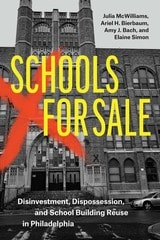
Schools for Sale
Disinvestment, Dispossession, and School Building Reuse in PhiladelphiaJulia McWilliams, Ariel H. Bierbaum, Amy J. Bach and Elaine Simon
University of Chicago Press, 2026
A surprising look at what happens to the actual school buildings in the wake of school closures.
School districts across the United States have closed thousands of schools since 2000 to cope with chronic underfunding and budget crises, declining enrollment, and poorly maintained buildings. Our knowledge about school closures has focused on battles over closure decision-making and the impacts of closing schools on communities of color in the immediate aftermath of these decisions. But what of the large, sometimes magisterial, formerly public spaces once at the center of community life? How do these now vacant buildings change daily life in the surrounding neighborhood?
In Schools for Sale, Julia McWilliams, Ariel H. Bierbaum, Amy J. Bach, and Elaine Simon examine how school closures change the spatial and social arrangements of neighborhoods. Following a series of school closures in Philadelphia, the authors draw from research in urban studies, education, planning, and geography to explain how race, place, and capital merge to influence the trajectory of closed schools in Black and Brown communities and their surrounding neighborhoods. Some closed schools are repurposed as charter schools, upending the role those buildings have historically played in bringing communities together. Other buildings are sold for commercial development, caught up in cycles of gentrification even as developers foster programs to support community members. Others are left vacant or are demolished in the heart of their neighborhoods, decisions that reflect not only disinvestment in Black communities but the sobering reality of environmental racism.
Drawing needed attention to one of the significant consequences of school closures, Schools for Sale imparts a deeper understanding of the connections between place, race, and education amid broader urban transformations, prompting us to consider how school districts can work toward a new vision for public education and community development.
[more]