Results by title
4 books match the query 'Schrecker, Ellen'
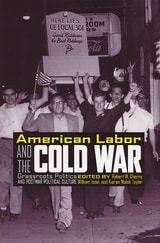
American Labor and the Cold War
Grassroots Politics and Postwar Political CultureCherny, Robert
Rutgers University Press, 2004
The American labor movement seemed poised on the threshold of unparalleled success at the beginning of the post-World War II era. Fourteen million strong in 1946, unions represented thirty five percent of non-agricultural workers. Why then did the gains made between the 1930s and the end of the war produce so few results by the 1960s?
This collection addresses the history of labor in the postwar years by exploring the impact of the global contest between the United States and the Soviet Union on American workers and labor unions. The essays focus on the actual behavior of Americans in their diverse workplaces and communities during the Cold War. Where previous scholarship on labor and the Cold War has overemphasized the importance of the Communist Party, the automobile industry, and Hollywood, this book focuses on politically moderate, conservative workers and union leaders, the medium-sized cities that housed the majority of the population, and the Roman Catholic Church. These are all original essays that draw upon extensive archival research and some upon oral history sources.
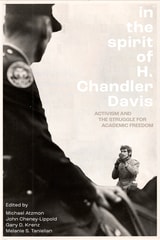
In the Spirit of H. Chandler Davis
Activism and the Struggle for Academic FreedomEdited by Michael Atzmon, John Cheney-Lippold , Gary D. Krenz, and Melanie S. Tanielian
Disobedience Press, 2026
The essays collected in this book honor H. Chandler Davis (1926-2022), a University of Michigan faculty member who became a symbol of principled dissent when suspended and fired in 1954 for refusing to testify about his political affiliations to the House Un-American Activities Committee. Invoking academic freedom and First Amendment protection, Davis was convicted of contempt of Congress. He served six months in prison before moving to Canada, where he established himself as a brilliant mathematician, prolific writer, and ardent and much beloved advocate for justice.
At a time when a new McCarthyism has come roaring back to threaten free inquiry everywhere, the 12 contributors to this book argue against censorship, the suppression of protest, the policed and surveilled campus, the self-silencing of "institutional neutrality," and other enemies of academic freedom. Also included in this volume is posthumously published work by Davis and by his late wife, the historian Natalie Zemon Davis, which reflects on the importance of facing, and not accepting, authoritarian threats.
Inspired by Chandler Davis’ courage, integrity, and devotion to the struggle against oppression, injustice, and the persecution of speech, these essays offer crucial insights into the importance of defending intellectual independence, institutional autonomy, and the right to free expression.
Contributors: Michael Bérubé, Juan Cole, H. Chandler Davis, Stefan Hanß, Marjorie Heins, Dima Khalidi, Gene Nichol, Henry Reichman, Ellen Schrecker, Joan Scott, Catharine R. Stimpson, Alan Wald, Silke-Maria Weineck, and Natalie Zemon Davis.
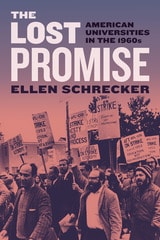
The Lost Promise
American Universities in the 1960sEllen Schrecker
University of Chicago Press, 2021
The 1950s through the early 1970s are widely seen as American academia’s golden age, when universities—well-funded and viewed as essential for national security, economic growth, and social mobility—embraced an egalitarian mission. Swelling in size, schools attracted new types of students and professors, including radicals who challenged their institutions’ calcified traditions. But that halcyon moment soon came to a painful and confusing end, with consequences that still afflict the halls of ivy. In The Lost Promise, Ellen Schrecker—our foremost historian of both the McCarthy era and the modern American university—delivers a far-reaching examination of how and why it happened.
Schrecker illuminates how US universities’ explosive growth intersected with the turmoil of the 1960s, fomenting an unprecedented crisis where dissent over racial inequality and the Vietnam War erupted into direct action. Torn by internal power struggles and demonized by conservative voices, higher education never fully recovered, resulting in decades of underfunding and today’s woefully inequitable system. As Schrecker’s magisterial history makes blazingly clear, the complex blend of troubles that disrupted the university in that pivotal period haunts the ivory tower to this day.

Widows' Words
Women Write on the Experience of Grief, the First Year, the Long Haul, and Everything in BetweenRutgers University Press, 2019
Some were widowed young, while others were married for decades. Some cared for their late partners through long terminal illnesses, while others lost their partners suddenly. Some had male partners, while others had female partners. Yet each of these women faced the same basic dilemma: how to go on living when a part of you is gone.
Widows’ Words is arranged chronologically, starting with stories of women preparing for their partners’ deaths, followed by the experiences of recent widows still reeling from their fresh loss, and culminating in the accounts of women who lost their partners many years ago but still experience waves of grief. Their accounts deal honestly with feelings of pain, sorrow, and despair, and yet there are also powerful expressions of strength, hope, and even joy. Whether you are a widow yourself or have simply experienced loss, you will be sure to find something moving and profound in these diverse tales of mourning, remembrance, and resilience.