Results by title
10 books match the query 'Science, Medieval'
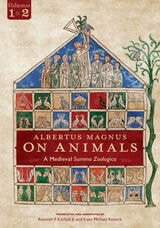
Albertus Magnus On Animals V1 2
A Medieval Summa Zoologica Revised EditionKenneth F. Kitchell Jr.and Irven Michael Resnick
The Ohio State University Press, 2018
In his work De animalibus, Albert integrated the vast amount of information on nature that had come down to him in previous centuries: the exposition of Michael Scotus’s translation from the Arabic of Aristotle’s books on the natural world (Books 1–19), Albert’s own revisions to Aristotle’s teachings (Books 20–21), and a “dictionary” of animals appropriated largely from the De natura rerum of Thomas of Cantimpré (Books 22–26). Albert’s comprehensive treatise on living things was acknowledged as the reputable authority in biology for almost five hundred years.
In this translated and annotated edition, Kenneth F. Kitchell Jr. and Irven Michael Resnick illuminate the importance of this work, allowing Albert’s magnum opus to be better understood and more widely appreciated than ever before. Broken into two volumes (Books 1–10 and 11–26),Albertus Magnus On Animals is a veritable medieval scientific encyclopedia, ranging in topics from medicine, embryology, and comparative anatomy to women, hunting and everyday life, commerce, and much more—an essential work for historians, medievalists, scientists, and philosophers alike.
Artisan/Practitioners and the Rise of the New Sciences, 1400-1600
Pamela O. Long
Oregon State University Press, 2011
Questions concerning Aristotle's On Animals (The Fathers of the Church, Mediaeval Continuation, Volume 9)
Irven M. Albert the Great
Catholic University of America Press, 2008
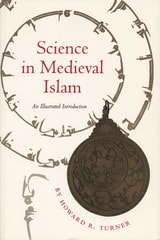
Science in Medieval Islam
An Illustrated IntroductionBy Howard R. Turner
University of Texas Press, 1997
During the Golden Age of Islam (seventh through seventeenth centuries A.D.), Muslim philosophers and poets, artists and scientists, princes and laborers created a unique culture that has influenced societies on every continent. This book offers a fully illustrated, highly accessible introduction to an important aspect of that culture—the scientific achievements of medieval Islam.
Howard Turner opens with a historical overview of the spread of Islamic civilization from the Arabian peninsula eastward to India and westward across northern Africa into Spain. He describes how a passion for knowledge led the Muslims during their centuries of empire-building to assimilate and expand the scientific knowledge of older cultures, including those of Greece, India, and China. He explores medieval Islamic accomplishments in cosmology, mathematics, astronomy, astrology, geography, medicine, natural sciences, alchemy, and optics. He also indicates the ways in which Muslim scientific achievement influenced the advance of science in the Western world from the Renaissance to the modern era. This survey of historic Muslim scientific achievements offers students and general readers a window into one of the world's great cultures, one which is experiencing a remarkable resurgence as a religious, political, and social force in our own time.
Science in the Medieval World
Book of the Categories of NationsBy Sa`id al-Andalusi
University of Texas Press, 1991
During the Middle Ages, a thriving center for learning and research was Muslim Spain, where students gathered to consult Arabic manuscripts of earlier scientific works and study with famous teachers. One of these teachers was Sa'id al-Andalusi, who in 1068 wrote Kitab Tabaqat al-'Umam, or "Book of the Categories of Nations," which recorded the contributions to science of all known nations. Today, it is one of few surviving medieval Spanish Muslim texts, and this is its first English translation.
Science ('ulum), as used by Sa'id and other scholars of that period, is a broad term covering virtually all aspects of human knowledge. After initial discussions of the categories of nations that did or did not cultivate science, Sa'id details the specific contribution of nine nations or peoples-India, Persia, Chaldea, Greece, Rome, Egypt, the Arab Orient, al-Andalus, and the Hebrews. He includes the names of many individual scientists and scholars and describes their various contributions to knowledge, making his book a significant work of reference as well as history.
Science in the Middle Ages
Edited by David C. Lindberg
University of Chicago Press, 1980
The book is not encylopedic, for it does not attempt to provide all relevant factual data; rather, it attempts to interpret major developments in each of the disciplines that made up the medieval scientific world. Data are not absent, but their function is to support and illustrate generalizations about the changing shape of medieval science. The editor, David C. Lindberg, has written a Preface in which he discusses the growth of scholarship in this field in the twentieth century.
The Beginnings of Western Science
The European Scientific Tradition in Philosophical, Religious, and Institutional Context, 600 B.C. to A.D. 1450David C. Lindberg
University of Chicago Press, 1992
Lindberg surveys all the most important themes in the history of ancient and medieval science, including developments in cosmology, astronomy, mechanics, optics, alchemy, natural history, and medicine. He synthesizes a wealth of information in superbly organized, clearly written chapters designed to serve students, scholars, and nonspecialists alike. In addition, Lindberg offers an illuminating account of the transmission of Greek science to medieval Islam and subsequently to medieval Europe. And throughout the book he pays close attention to the cultural and institutional contexts within which scientific knowledge was created and disseminated and to the ways in which the content and practice of science were influenced by interaction with philosophy and religion. Carefully selected maps, drawings, and photographs complement the text.
Lindberg's story rests on a large body of important scholarship produced by historians of science, philosophy, and religion over the past few decades. However, Lindberg does not hesitate to offer new interpretations and to hazard fresh judgments aimed at resolving long-standing historical disputes. Addressed to the general educated reader as well as to students, his book will also appeal to any scholar whose interests touch on the history of the scientific enterprise.
The Beginnings of Western Science
The European Scientific Tradition in Philosophical, Religious, and Institutional Context, Prehistory to A.D. 1450, Second EditionDavid C. Lindberg
University of Chicago Press, 2008
The Beginnings of Western Science is a landmark, the best book to ever to present a unified account of both ancient and medieval science in a single volume. Chronicling the development of scientific ideas, practices, and institutions from pre-Socratic Greek philosophy to late-Medieval scholasticism, David C. Lindberg surveys all the most important themes in the history of science, including developments in cosmology, astronomy, mechanics, optics, alchemy, natural history, and medicine. In addition, he offers an illuminating account of the transmission of Greek science to medieval Islam and subsequently to medieval Europe.
The Nature of Natural Philosophy in the Late Middle Ages (Studies in Philosophy and the History of Philosophy, Volume 52)
Edward Grant
Catholic University of America Press, 2010

The Scientific Enterprise in Antiquity and Middle Ages
Readings from IsisEdited by Michael H. Shank
University of Chicago Press, 2001
Contributors include Francesca Rochberg, David Pingree, G. E. R. Lloyd, Heinrich von Staden, Martin Bernal, Alexander Jones, Bernard Goldstein, Alan Bowen, Owsei Temkin, David Lindberg, Steven McCluskey, Linda Voigts, Edward Grant, Bernard Goldstein, Victor Roberts, Lynn Thorndike, Helen Lemay, William Newman, A. Mark Smith, Nancy Siraisi, Michael McVaugh, and Brian P. Copenhaver.