Results by title
3 books match the query 'Science, Renaissance'
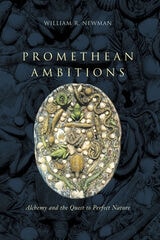
Promethean Ambitions
Alchemy and the Quest to Perfect NatureWilliam R. Newman
University of Chicago Press, 2004
In an age when the nature of reality is complicated daily by advances in bioengineering, cloning, and artificial intelligence, it is easy to forget that the ever-evolving boundary between nature and technology has long been a source of ethical and scientific concern: modern anxieties about the possibility of artificial life and the dangers of tinkering with nature more generally were shared by opponents of alchemy long before genetic science delivered us a cloned sheep named Dolly.
In Promethean Ambitions, William R. Newman ambitiously uses alchemy to investigate the thinning boundary between the natural and the artificial. Focusing primarily on the period between 1200 and 1700, Newman examines the labors of pioneering alchemists and the impassioned—and often negative—responses to their efforts. By the thirteenth century, Newman argues, alchemy had become a benchmark for determining the abilities of both men and demons, representing the epitome of creative power in the natural world. Newman frames the art-nature debate by contrasting the supposed transmutational power of alchemy with the merely representational abilities of the pictorial and plastic arts—a dispute which found artists such as Leonardo da Vinci and Bernard Palissy attacking alchemy as an irreligious fraud. The later assertion by the Paracelsian school that one could make an artificial human being—the homunculus—led to further disparagement of alchemy, but as Newman shows, the immense power over nature promised by the field contributed directly to the technological apologetics of Francis Bacon and his followers. By the mid-seventeenth century, the famous "father of modern chemistry," Robert Boyle, was employing the arguments of medieval alchemists to support the identity of naturally occurring substances with those manufactured by "chymical" means.
In using history to highlight the art-nature debate, Newman here shows that alchemy was not an unformed and capricious precursor to chemistry; it was an art founded on coherent philosophical and empirical principles, with vocal supporters and even louder critics, that attracted individuals of first-rate intellect. The historical relationship that Newman charts between human creation and nature has innumerable implications today, and he ably links contemporary issues to alchemical debates on the natural versus the artificial.
[more]
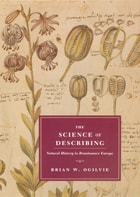
The Science of Describing
Natural History in Renaissance EuropeBrian W. Ogilvie
University of Chicago Press, 2006
Out of the diverse traditions of medical humanism, classical philology, and natural philosophy, Renaissance naturalists created a new science devoted to discovering and describing plants and animals. Drawing on published natural histories, manuscript correspondence, garden plans, travelogues, watercolors, and drawings, The Science of Describing reconstructs the evolution of this discipline of description through four generations of naturalists.
In the late fifteenth and early sixteenth centuries, naturalists focused on understanding ancient and medieval descriptions of the natural world, but by the mid-sixteenth century naturalists turned toward distinguishing and cataloguing new plant and animal species. To do so, they developed new techniques of observing and recording, created botanical gardens and herbaria, and exchanged correspondence and specimens within an international community. By the early seventeenth century, naturalists began the daunting task of sorting through the wealth of information they had accumulated, putting a new emphasis on taxonomy and classification.
Illustrated with woodcuts, engravings, and photographs, The Science of Describing is the first broad interpretation of Renaissance natural history in more than a generation and will appeal widely to an interdisciplinary audience.
[more]
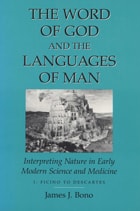
Word Of God & The Languages Of Man
Interpreting Nature In Early Modern Science And Medicine Volume I, Ficino To DescartesJames J. Bono
University of Wisconsin Press, 1995
This remarkably ambitious work relates changes in scientific and medical thought during the Scientific Revolution (circa 1500–1700) to the emergence of new principles and practices for interpreting language, texts, and nature. An invaluable history of ideas about the nature of language during this period, The Word of God and the Languages of Man also explores the wider cultural origins and impact of these ideas. Its broad and deeply complex picture of a profound sociocultural and intellectual transformation will alter our definition of the scientific revolution.
James J. Bono shows how the new interpretive principles and scientific practices of the sixteenth and seventeenth centuries evolved in response to new views of the relationship between the “Word of God” and the “Languages of Man” fostered by Renaissance Humanism, Neoplatonism, magic, and both the reformed and radical branches of Protestantism. He traces the cultural consequences of these ideas in the thought and work of major and minor actors in the scientific revolution—from Ficino and Paracelsus to Francis Bacon and Descartes. By considering these natural philosophers in light of their own intellectual, religious, philosophical, cultural, linguistic, and especially narrative frameworks, Bono suggests a new way of viewing the sociocultural dynamics of scientific change in the pre–modern period—and ultimately, a new way of understanding the nature and history of scientific thought. The narrative configuration he proposes provides a powerful alternative to the longstanding “revolutionary” metaphor of the history of the scientific revolution.
James J. Bono shows how the new interpretive principles and scientific practices of the sixteenth and seventeenth centuries evolved in response to new views of the relationship between the “Word of God” and the “Languages of Man” fostered by Renaissance Humanism, Neoplatonism, magic, and both the reformed and radical branches of Protestantism. He traces the cultural consequences of these ideas in the thought and work of major and minor actors in the scientific revolution—from Ficino and Paracelsus to Francis Bacon and Descartes. By considering these natural philosophers in light of their own intellectual, religious, philosophical, cultural, linguistic, and especially narrative frameworks, Bono suggests a new way of viewing the sociocultural dynamics of scientific change in the pre–modern period—and ultimately, a new way of understanding the nature and history of scientific thought. The narrative configuration he proposes provides a powerful alternative to the longstanding “revolutionary” metaphor of the history of the scientific revolution.
[more]