Results by title
18 books match the query 'Science fiction films'
Afrofuturisms
Ecology, Humanity, and Francophone Cultural ExpressionsIsaac Vincent Joslin
Ohio University Press, 2023

Aliens R Us
The Other in Science Fiction CinemaEdited by Ziauddin Sardar and Sean Cubitt
Pluto Press, 2002

Arrival
David Roche
University of Texas Press, 2024
A study of Denis Villeneuve’s genre-transcendent film.
In Denis Villeneuve’s Arrival (2016), scientists must decipher the language of and peacefully communicate with aliens who have landed on Earth before the world’s military attacks. In this first book-length study of the film, scholar David Roche argues that it is one of the most important films of this century, and the most brilliant science fiction film since Blade Runner. Roche posits Arrival as a blockbuster with artistic ambitions—an argument supported by the film’s several Academy Award nominations—and looks closely at how the film engages with theoretical questions posed by contemporary film studies and philosophy alike. Each section explores a central aspect of the film: its status as an auteur adaptation; its relation to the science fiction genre; its themes of communication on narrative and meta-narrative levels; its aesthetics of time and space; and the political and ethical questions it raises. Ultimately, Roche declares Arrival a unique, multifaceted experience in the world of hard science fiction films, placing it in context with works like 2001: A Space Odyssey, Close Encounters of the Third Kind, and Contact while also examining how it bridges the gap between genre and art house cinema.
Black Space
Imagining Race in Science Fiction FilmBy Adilifu Nama
University of Texas Press, 2008
Winner, Rollins Book Award, Southwest Texas Popular Culture Association/American Culture Association, 2008
Science fiction film offers its viewers many pleasures, not least of which is the possibility of imagining other worlds in which very different forms of society exist. Not surprisingly, however, these alternative worlds often become spaces in which filmmakers and film audiences can explore issues of concern in our own society. Through an analysis of over thirty canonic science fiction (SF) films, including Logan's Run, Star Wars, Blade Runner, Back to the Future, Gattaca, and Minority Report, Black Space offers a thorough-going investigation of how SF film since the 1950s has dealt with the issue of race and specifically with the representation of blackness.
Setting his study against the backdrop of America's ongoing racial struggles and complex socioeconomic histories, Adilifu Nama pursues a number of themes in Black Space. They include the structured absence/token presence of blacks in SF film; racial contamination and racial paranoia; the traumatized black body as the ultimate signifier of difference, alienness, and "otherness"; the use of class and economic issues to subsume race as an issue; the racially subversive pleasures and allegories encoded in some mainstream SF films; and the ways in which independent and extra-filmic productions are subverting the SF genre of Hollywood filmmaking.
The first book-length study of African American representation in science fiction film, Black Space demonstrates that SF cinema has become an important field of racial analysis, a site where definitions of race can be contested and post-civil rights race relations (re)imagined.
Cinematic Prophylaxis
Globalization and Contagion in the Discourse of World HealthKirsten Ostherr
Duke University Press, 2005
Ostherr presents the first in-depth analysis of the public health films produced between World War II and the 1960s that popularized the ideals of world health and taught viewers to imagine the presence of invisible contaminants all around them. She considers not only the content of specific films but also their techniques for making invisible contaminants visible. By identifying the central aesthetic strategies in films produced by the World Health Organization, the Centers for Disease Control, and other institutions, she reveals how ideas about racial impurity and sexual degeneracy underlay messages ostensibly about world health. Situating these films in relation to those that preceded and followed them, Ostherr shows how, during the postwar era, ideas about contagion were explicitly connected to the global circulation of bodies. While postwar public health films embraced the ideals of world health, they invoked a distinct and deeply anxious mode of representing the spread of disease across national borders.

Close Encounters
Film, Feminism, and Science FicitonConstance Penley, Elisabeth Lyon, Lynn Spigel, and Janet Bergstrom, Editors
University of Minnesota Press, 1991
Close Encounters was first published in 1991. Minnesota Archive Editions uses digital technology to make long-unavailable books once again accessible, and are published unaltered from the original University of Minnesota Press editions.
Offers new critical approaches to science fiction as represented in film, television, fan culture, and other non-literary media. Addresses the way conventional notions of sexual difference are reworked by science fiction film. Includes the complete script of Peter Wollen's 1987 film Friendship's Death.
Contributors: Raymond Bellour, Janet Bergstrom, Roger Dadoun, Harvey R. Greenberg, M.D., Henry Jenkins III, Enno Patalas, Constance Penley, Vivian Sobchak, Lynn Spigel, and Peter Wollen.
Fantastic Planets, Forbidden Zones, and Lost Continents
The 100 Greatest Science-Fiction FilmsBy Douglas Brode
University of Texas Press, 2015
Whether you judge by box office receipts, industry awards, or critical accolades, science fiction films are the most popular movies now being produced and distributed around the world. Nor is this phenomenon new. Sci-fi filmmakers and audiences have been exploring fantastic planets, forbidden zones, and lost continents ever since George Méliès’ 1902 film A Trip to the Moon. In this highly entertaining and knowledgeable book, film historian and pop culture expert Douglas Brode picks the one hundred greatest sci-fi films of all time.
Brode’s list ranges from today’s blockbusters to forgotten gems, with surprises for even the most informed fans and scholars. He presents the movies in chronological order, which effectively makes this book a concise history of the sci-fi film genre. A striking (and in many cases rare) photograph accompanies each entry, for which Brode provides a numerical rating, key credits and cast members, brief plot summary, background on the film’s creation, elements of the moviemaking process, analysis of the major theme(s), and trivia. He also includes fun outtakes, including his top ten lists of Fifties sci-fi movies, cult sci-fi, least necessary movie remakes, and “so bad they’re great” classics—as well as the ten worst sci-fi movies (“those highly ambitious films that promised much and delivered nil”). So climb aboard spaceship Brode and journey to strange new worlds from Metropolis (1927) to Guardians of the Galaxy (2014).
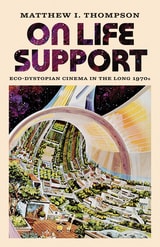
On Life Support
Eco-Dystopian Cinema in the Long 1970sMatthew I Thompson
University of Minnesota Press, 2026
Finding strategies for today’s environmental movement in classic science fiction films
What can science fiction film tell us about the course of the modern ecological movement? On Life Support traces how the environmental concerns of the 1970s were embedded in the eco-dystopian cinema of the era—and considers its implications for ecological thought and activism today.
Illuminating the patterns that shape our thinking about nonhuman nature, Matthew I. Thompson pairs iconic films such as Soylent Green and Silent Running with the transformational environmentalist texts that inspired them and kick-started the modern environmental movement, including Rachel Carson’s Silent Spring and Buckminster Fuller’s Operating Manual for Spaceship Earth. Thompson examines this confluence of literature and cinema to show how, as they translated environmentalism for Hollywood’s audiences, these movies distilled the movement’s concepts into a form that revealed their inherent contradictions.
A sensitive analysis of the tensions that complicate environmentalist praxis—especially between desire and fear in the activist impulse—On Life Support offers a timely critique of the politics of environmental containment and control, calling instead for a politics of interconnection and contamination. It is, after all, by inviting complexity and chaos that we begin to undermine the myth of human mastery, letting nature flourish on its own terms.
Retail e-book files for this title are screen-reader friendly with images accompanied by short alt text and/or extended descriptions.

Paranoia, the Bomb, and 1950s Science Fiction Films
Cyndy Hendershot
University of Wisconsin Press, 1999
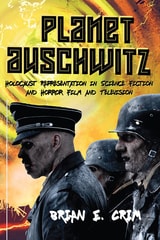
Planet Auschwitz
Holocaust Representation in Science Fiction and Horror Film and TelevisionBrian E. Crim
Rutgers University Press, 2020
Planet Auschwitz website (https://planetauschwitz.com)
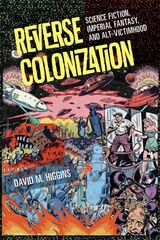
Reverse Colonization
Science Fiction, Imperial Fantasy, and Alt-victimhoodDavid M. Higgins
University of Iowa Press, 2021
Higgins shows that this reverse colonization stance depends upon a science fictional logic that achieved dominance within imperial fantasy during the 1960s and has continued to gain momentum ever since. By identifying with fantastic forms of victimhood, subjects who already enjoy social hegemony are able to justify economic inequality, expansions of police and military power, climatological devastation, new articulations of racism, and countless other forms of violence—all purportedly in the name of security, self-defense, and self-protection.
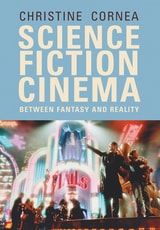
Science Fiction Cinema
Between Fantasy and RealityCornea, Christine
Rutgers University Press, 2007
Offering a broad historical and theoretical reassessment of science fiction, Christine Cornea explores the development of this popular genre in cinema from its very beginnings to the present day. Each chapter offers analyses of particular films, situating them within a wider historical/cultural context while also highlighting a specific key thematic issue. Cornea provides vital and unique perspectives on the genre, including discussions of the relevance of psychedelic imagery, race, the “new woman of science,” generic performance, and the prevalence of “techno-orientalism” in recent films. Enriching the book are new interviews with some of the main practitioners in the field, such as Roland Emmerich, Paul Verhoeven, Ken Russell, Stan Winston, William Gibson, Brian Aldiss, Joe Morton, Dean Norris, and Billy Gray. While American films are Cornea’s main focus, she also engages with a range of examples from other countries and explains why science fiction lends itself well to transnational reception.
Among the many films discussed are The Day the Earth Stood Still, The Body Snatchers, Forbidden Planet, The Quatermass Experiment, 2001: A Space Odyssey, Demon Seed, Star Trek: The Motion Picture, Star Wars, Altered States, Alien, Blade Runner, The Brother from Another Planet, Back to the Future, The Terminator, Predator, The One, Dark City, The Matrix, Fifth Element, and eXistenZ.
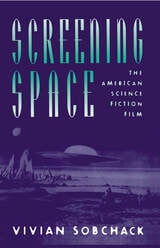
Screening Space
The American Science Fiction FilmSobchack, Vivian
Rutgers University Press, 1997
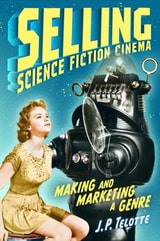
Selling Science Fiction Cinema
Making and Marketing a GenreJ. P. Telotte
University of Texas Press, 2023
How science fiction films in the 1950s were marketed and helped create the broader genre itself.
For Hollywood, the golden age of science fiction was also an age of anxiety. Amid rising competition, fluid audience habits, and increasing government regulation, studios of the 1950s struggled to make and sell the kinds of films that once were surefire winners. These conditions, the leading media scholar J. P. Telotte argues, catalyzed the incredible rise of science fiction.
Though science fiction films had existed since the earliest days of cinema, the SF genre as a whole continued to resist easy definition through the 1950s. In grappling with this developing genre, the industry began to consider new marketing approaches that viewed films as fluid texts and audiences as ever-changing. Drawing on trade reports, film reviews, pressbooks, trailers, and other archival materials, Selling Science Fiction Cinema reconstructs studio efforts to market a promising new genre and, in the process, shows how salesmanship influenced what that genre would become. Telotte uses such films as The Thing from Another World, Forbidden Planet, and The Blob, as well as the influx of Japanese monster movies, to explore the shifting ways in which the industry reframed the SF genre to market to no-longer static audience expectations. Science fiction transformed the way Hollywood does business, just as Hollywood transformed the meaning of science fiction.
Sound Design and Science Fiction
By William Whittington
University of Texas Press, 2007
Sound is half the picture, and since the 1960s, film sound not only has rivaled the innovative imagery of contemporary Hollywood cinema, but in some ways has surpassed it in status and privilege because of the emergence of sound design.
This in-depth study by William Whittington considers the evolution of sound design not only through cultural and technological developments during the last four decades, but also through the attitudes and expectations of filmgoers. Fans of recent blockbuster films, in particular science fiction films, have come to expect a more advanced and refined degree of film sound use, which has changed the way they experience and understand spectacle and storytelling in contemporary cinema.
The book covers recent science fiction cinema in rich and compelling detail, providing a new sounding of familiar films, while offering insights into the constructed nature of cinematic sound design. This is accomplished by examining the formal elements and historical context of sound production in movies to better appreciate how a film sound track is conceived and presented.Whittington focuses on seminal science fiction films that have made specific advances in film sound, including 2001: A Space Odyssey, THX 1138, Star Wars, Alien, Blade Runner (original version and director's cut), Terminator 2: Judgment Day and The Matrix trilogy and games—milestones of the entertainment industry's technological and aesthetic advancements with sound.
Setting itself apart from other works, the book illustrates through accessible detail and compelling examples how swiftly such advancements in film sound aesthetics and technology have influenced recent science fiction cinema, and examines how these changes correlate to the history, theory, and practice of contemporary Hollywood filmmaking.
The Cinematic Life of the Gene
Jackie Stacey
Duke University Press, 2010
Stacey examines the body-horror movies Alien: Resurrection and Species in light of Jean Baudrillard’s apocalyptic proclamations about cloning and “the hell of the same,” and she considers the art-house thrillers Gattaca and Code 46 in relation to ideas about imitation, including feminist theories of masquerade, postcolonial conceptualizations of mimicry, and queer notions of impersonation. Turning to Teknolust and Genetic Admiration, independent films by feminist directors, she extends Walter Benjamin’s theory of aura to draw an analogy between the replication of biological information and the reproducibility of the art object. Stacey suggests new ways to think about those who are not what they appear to be, the problem of determining identity in a world of artificiality, and the loss of singularity amid unchecked replication.
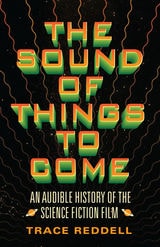
The Sound of Things to Come
An Audible History of the Science Fiction FilmTrace Reddell
University of Minnesota Press, 2018
A groundbreaking approach to sound in sci-fi films offers new ways of construing both sonic innovation and science fiction cinema
Including original readings of classics like The Day the Earth Stood Still, 2001: A Space Odyssey, Star Wars, and Blade Runner, The Sound of Things to Come delivers a comprehensive history of sound in science fiction cinema. Approaching movies as sound objects that combine cinematic apparatus and consciousness, Trace Reddell presents a new theory of sonic innovation in the science fiction film.
Reddell assembles a staggering array of movies from sixty years of film history—including classics, blockbusters, B-movies, and documentaries from the United States, Britain, France, Germany, Japan, and the Soviet Union—all in service to his powerful conception of sound making as a speculative activity in its own right. Reddell recasts debates about noise and music, while arguing that sound in the science fiction film provides a medium for alien, unknown, and posthuman sound objects that transform what and how we hear.
Avoiding genre criticism’s tendency to obsess over utopias, The Sound of Things to Come draws on film theory, sound studies, and philosophies of technology to advance conversations about the avant-garde, while also opening up opportunities to examine cinematic sounds beyond the screen.
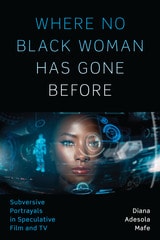
Where No Black Woman Has Gone Before
Subversive Portrayals in Speculative Film and TVBy Diana Adesola Mafe
University of Texas Press, 2018
When Lieutenant Uhura took her place on the bridge of the Starship Enterprise on Star Trek, the actress Nichelle Nichols went where no African American woman had ever gone before. Yet several decades passed before many other black women began playing significant roles in speculative (i.e., science fiction, fantasy, and horror) film and television—a troubling omission, given that these genres offer significant opportunities for reinventing social constructs such as race, gender, and class. Challenging cinema’s history of stereotyping or erasing black women on-screen, Where No Black Woman Has Gone Before showcases twenty-first-century examples that portray them as central figures of action and agency.
Writing for fans as well as scholars, Diana Adesola Mafe looks at representations of black womanhood and girlhood in American and British speculative film and television, including 28 Days Later, AVP: Alien vs. Predator, Children of Men, Beasts of the Southern Wild, Firefly, and Doctor Who: Series 3. Each of these has a subversive black female character in its main cast, and Mafe draws on critical race, postcolonial, and gender theories to explore each film and show, placing the black female characters at the center of the analysis and demonstrating their agency. The first full study of black female characters in speculative film and television, Where No Black Woman Has Gone Before shows why heroines such as Lex in AVP and Zoë in Firefly are inspiring a generation of fans, just as Uhura did.