Results by title
6 books match the query 'Scientific'
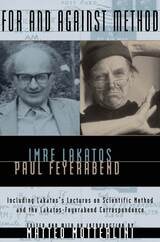
For and Against Method
Including Lakatos's Lectures on Scientific Method and the Lakatos-Feyerabend CorrespondenceImre Lakatos and Paul Feyerabend
University of Chicago Press, 1999
For and Against Method opens with an imaginary dialogue between Lakatos and Feyerabend, which Matteo Motterlini has constructed, based on their published works, to synthesize their positions and arguments. Part one presents the transcripts of the last lectures on method that Lakatos delivered. Part two, Feyerabend's response, consists of a previously published essay on anarchism, which began the attack on Lakatos's position that Feyerabend later continued in Against Method. The third and longest section consists of the correspondence Lakatos and Feyerabend exchanged on method and many other issues and ideas, as well as the events of their daily lives, between 1968 and Lakatos's death in 1974.
The delight Lakatos and Feyerabend took in philosophical debate, and the relish with which they sparred, come to life again in For and Against Method, making it essential and lively reading for anyone interested in these two fascinating and controversial thinkers and their immense contributions to philosophy of science.
"The writings in this volume are of considerable intellectual importance, and will be of great interest to anyone concerned with the development of the philosophical views of Lakatos and Feyerabend, or indeed with the development of philosophy of science in general during this crucial period."—Donald Gillies, British Journal for the Philosophy of Science (on the Italian edition)
"A stimulating exchange of letters between two philosophical entertainers."—Tariq Ali, The Independent
Imre Lakatos (1922-1974) was professor of logic at the London School of Economics. He was the author of Proofs and Refutations and the two-volume Philosophical Papers. Paul Feyerabend (1924-1994) was educated in Europe and held numerous teaching posts throughout his career. Among his books are Against Method; Science in a Free Society; Farewell to Reason; and Killing Time: The Autobiography of Paul Feyerabend, the last published by the University of Chicago Press.
Human Embryos, Human Beings
A Scientific and Philosophical ApproachSamuel B. Condic
Catholic University of America Press, 2018
Respectably Catholic and Scientific
Evolution and Birth Control Between the World WarsAlexander Pavuk
Catholic University of America Press, 2021

Selected Philosophical, Scientific, and Autobiographical Writings
Marie-Geneviève-Charlotte Thiroux d’Arconville
Iter Press, 2018
Edited and translated by Julie Candler Hayes
The Other Voice in Early Modern Europe: The Toronto Series, volume 58
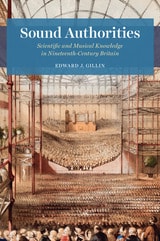
Sound Authorities
Scientific and Musical Knowledge in Nineteenth-Century BritainEdward J. Gillin
University of Chicago Press, 2021
Sound Authorities shows how experiences of music and sound played a crucial role in nineteenth-century scientific inquiry in Britain.
In Sound Authorities, Edward J. Gillin focuses on hearing and aurality in Victorian Britain, claiming that the development of the natural sciences in this era cannot be understood without attending to the study of sound and music.
During this time, scientific practitioners attempted to fashion themselves as authorities on sonorous phenomena, coming into conflict with traditional musical elites as well as religious bodies. Gillin pays attention to sound in both musical and nonmusical contexts, specifically the cacophony of British industrialization. Sound Authorities begins with the place of acoustics in early nineteenth-century London, examining scientific exhibitions, lectures, spectacles, workshops, laboratories, and showrooms. He goes on to explore how mathematicians mobilized sound in their understanding of natural laws and their vision of a harmonious ordered universe. In closing, Gillin delves into the era’s religious and metaphysical debates over the place of music (and humanity) in nature, the relationship between music and the divine, and the tensions between spiritualist understandings of sound and scientific ones.
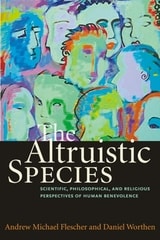
The Altruistic Species
Scientific, Philosophical, and Religious Perspectives of Human BenevolenceAndrew Michael Flescher
Templeton Press, 2008
What motivates altruism? How essential is the phenomenon of altruism to the human experience? Is altruism readily accessible to the ordinary person? In The Altruistic Species, Andrew Michael Flescher and Daniel L. Worthen explore these questions through the lenses of four disciplinary perspectives—biology, psychology, philosophy, and religion. In their investigation, they make an extended argument for the existence of altruism against competing theories that construe all ostensible cases of benevolence as self-interest in disguise. The authors consider theories of egoism; the role of genetics and evolutionary biology; the psychological that induce altruistic behavior; philosophical theories of altruism in normative ethics such as Kantian, utilitarian, and Aristotelian models of moral action; and accounts of love of the neighbor in Christianity and Buddhism. Additionally, they offer a new, comprehensive definition of altruism that includes the insights of each of these perspectives.
The Altruistic Species reinvigorates the debate over the prevalence of selfless motivation in human behavior—whether it is a rare or ubiquitous phenomenon—something considered exceptional or a capacity that members of any community could potentially develop. This noteworthy interdisciplinary examination of altruism balances science, virtue theory, and theology. It is ideal for ethics, human behavior, and evolutionary biology courses as an educational resource for other multidisciplinary studies and interested lay readers.