Results by title
6 books match the query 'Scientific applications'
Atmospheric Things
On the Allure of Elemental EnvelopmentDerek P. McCormack
Duke University Press, 2018
Documenting the World
Film, Photography, and the Scientific RecordEdited by Gregg Mitman and Kelley Wilder
University of Chicago Press, 2016
Documenting the World is about the material and social life of photographs and film made in the scientific quest to document the world. Drawing on scholars from the fields of art history, visual anthropology, and science and technology studies, the chapters in this book explore how this documentation—from the initial recording of images, to their acquisition and storage, to their circulation—has altered our lives, our ways of knowing, our social and economic relationships, and even our surroundings. Far beyond mere illustration, photography and film have become an integral, transformative part of the world they seek to show us.
Introduction to Sensors for Ranging and Imaging
Graham Brooker
The Institution of Engineering and Technology, 2009
Operational Images
From the Visual to the InvisualJussi Parikka
University of Minnesota Press, 2023
An in-depth look into the transformation of visual culture and digital aesthetics
First introduced by the German filmmaker Harun Farocki, the term operational images defines the expanding field of machine vision. In this study, media theorist Jussi Parikka develops Farocki’s initial concept by considering the extent to which operational images have pervaded today’s visual culture, outlining how data technologies continue to develop and disrupt our understanding of images beyond representation.
Charting the ways that operational images have been employed throughout a variety of fields and historical epochs, Parikka details their many roles as technologies of analysis, capture, measurement, diagramming, laboring, (machine) learning, identification, tracking, and destruction. He demonstrates how, though inextricable from issues of power and control, operational images extend their reach far beyond militaristic and colonial violence and into the realms of artificial intelligence, data, and numerous aspects of art, media, and everyday visual culture.
Serving as an extensive guide to a key concept in contemporary art, design, and media theory, Operational Images explores the implications of machine vision and the limits of human agency. Through a wealth of case studies highlighting the areas where imagery and data intersect, this book gives us unprecedented insight into the ever-evolving world of posthuman visuality.
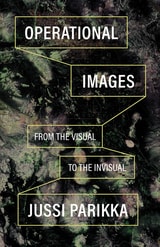
Cover alt text: Satellite photo on which white title words appear in yellow boxes. Yellow lines connect the boxes.
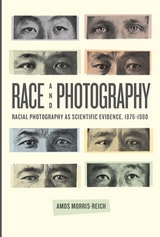
Race and Photography
Racial Photography as Scientific Evidence, 1876-1980Amos Morris-Reich
University of Chicago Press, 2015
Exploring the development of racial photography wherever it took place, including countries like France and England, Morris-Reich pays special attention to the German and Jewish contexts of scientific racism. Through careful reconstruction of individual cases, conceptual genealogies, and patterns of practice, he compares the intended roles of photography with its actual use in scientific argumentation. He examines the diverse ways it was used to establish racial ideologies—as illustrations of types, statistical data, or as self-evident record of racial signs. Altogether, Morris-Reich visits this troubling history to outline important truths about the roles of visual argumentation, imagination, perception, aesthetics, epistemology, and ideology within scientific study.
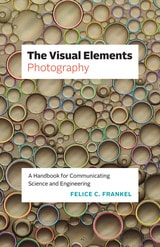
The Visual Elements—Photography
A Handbook for Communicating Science and EngineeringFelice C. Frankel
University of Chicago Press, 2023
Award-winning photographer Felice C. Frankel, whose work has graced the covers of Science, Nature, and Scientific American, among other publications, offers a quick guide for scientists and engineers who want to communicate—and better understand—their research by creating compelling photographs. Like all the books in the Visual Elements series, this short guide uses engaging examples to train researchers to learn visual communication. Distilling her celebrated books and courses to the essentials, Frankel shows scientists and engineers the importance of thinking visually. When she creates stunning images of scientific phenomena, she is not only interested in helping researchers to convey understanding to others in their research community or to gain media attention, but also in making these experts themselves “look longer” to understand more fully. Ideal for researchers who want a foothold for presenting and preparing their work for conferences, journal publications, and funding agencies, the book explains four tools that all readers can use—a phone, a camera, a scanner, and a microscope—and then offers important advice on composition and image manipulation ethics. The Visual Elements—Photography is an essential element in any scientist’s, engineer’s, or photographer’s library.