Results by title
4 books match the query 'Scientific literature'
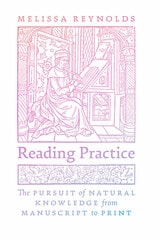
Reading Practice
The Pursuit of Natural Knowledge from Manuscript to PrintMelissa Reynolds
University of Chicago Press, 2024
Reading Practice tells the story of how ordinary people grew comfortable learning from commonplace manuscripts and printed books, such as almanacs, medical recipe collections, and herbals. From the turn of the fifteenth century to the close of the sixteenth century, these were the books English people read when they wanted to attend to their health or understand their place in the universe. Before then, these works had largely been the purview of those who could read Latin. Around 1400, however, medical and scientific texts became available in Middle English while manuscripts became less expensive. These vernacular manuscripts invited their readers into a very old and learned conversation: Hippocrates and Galen weren’t distant authorities whose word was law, they were trusted guides, whose advice could be excerpted, rearranged, recombined, and even altered to suit a manuscript compiler’s needs. This conversation continued even after the printing press arrived in England in 1476. Printers mined manuscripts for medical and scientific texts that they would publish throughout the sixteenth century, though the pressures of a commercial printing market encouraged printers to package these old texts in new ways. Without the weight of authority conditioning their reactions and responses to very old knowledge, and with so many editions of practical books to choose from, English readers grew into confident critics and purveyors of natural knowledge in their own right.
Melissa Reynolds reconstructs shifting attitudes toward medicine and science over two centuries of seismic change within English culture, attending especially to the effects of the Reformation on attitudes toward nature and the human body. Her study shows how readers learned to be discerning and selective consumers of knowledge gradually, through everyday interactions with utilitarian books.
Science in Print
Essays on the History of Science and the Culture of PrintEdited by Rima D. Apple, Gregory J. Downey, and Stephen L. Vaughn; Foreword by James A. Secord
University of Wisconsin Press, 2012
Ever since the threads of seventeenth-century natural philosophy began to coalesce into an understanding of the natural world, printed artifacts such as laboratory notebooks, research journals, college textbooks, and popular paperbacks have been instrumental to the development of what we think of today as “science.” But just as the history of science involves more than recording discoveries, so too does the study of print culture extend beyond the mere cataloguing of books. In both disciplines, researchers attempt to comprehend how social structures of power, reputation, and meaning permeate both the written record and the intellectual scaffolding through which scientific debate takes place.
Science in Print brings together scholars from the fields of print culture, environmental history, science and technology studies, medical history, and library and information studies. This ambitious volume paints a rich picture of those tools and techniques of printing, publishing, and reading that shaped the ideas and practices that grew into modern science, from the days of the Royal Society of London in the late 1600s to the beginning of the modern U.S. environmental movement in the early 1960s.
The Scientific Literature
A Guided TourEdited by Joseph E. Harmon and Alan G. Gross
University of Chicago Press, 2007
The scientific article has been a hallmark of the career of every important western scientist since the seventeenth century. Yet its role in the history of science has not been fully explored. Joseph E. Harmon and Alan G. Gross remedy this oversight with The Scientific Literature, a collection of writings—excerpts from scientific articles, letters, memoirs, proceedings, transactions, and magazines—that illustrates the origin of the scientific article in 1665 and its evolution over the next three and a half centuries.
Featuring articles—as well as sixty tables and illustrations, tools vital to scientific communication—that represent the broad sweep of modern science, The Scientific Literature is a historical tour through both the rhetorical strategies that scientists employ to share their discoveries and the methods that scientists use to argue claims of new knowledge. Commentaries that explain each excerpt’s scientific and historical context and analyze its communication strategy accompany each entry.
A unique anthology, The Scientific Literature will allow both the scholar and the general reader to experience first hand the development of modern science.
Understanding Scientific Prose
Edited by Jack Selzer
University of Wisconsin Press, 1993
Examining science as a rhetorical enterprise, this book seizes upon one scientific essay—"The Spandrels of San Marco and the Panglossian Paradigm: A Critique of the Adaptationist Programme"—and probes it from many angles. Written by prominent evolutionary theorists Stephen Jay Gould and Richard C. Lewontin and first published in the Proceedings of the Royal Society of London in 1979, the "Spandrels" article is both serious science and vivid prose. Applying methods inspired by Louis Althusser, Michel Foucault, Jacques Derrida, Ferdinand de Saussure, and others, the contributors employ a range of interpretive strategies. Stephen Jay Gould adds his own comments, and the full text of the essay "Spandrels" is reproduced as an appendix. Applying methods inspired by Louis Althusser, Michel Foucault, Jacques Derrida, Ferdinand de Saussure, and others, the contributors employ a range of interpretive strategies. Stephen Jay Gould adds his own comments, and the full text of the essay "Spandrels" is reproduced as an appendix.