Results by title
5 books match the query 'Scientist'
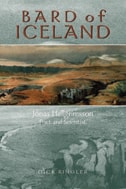
Bard of Iceland
Jonas Hallgrimsson, Poet and ScientistRichard Ringler
University of Wisconsin Press, 2002
Bard of Iceland makes available for the first time in any language other than Icelandic an extensive selection of works by Jónas Hallgrímsson (1807–1845), the most important poet of modern Iceland. Jónas was also Iceland’s first professionally trained geologist and an active contributor in a number of other scientific fields: geography, botany, zoology, and archaeology. He played a key role as well in Iceland’s struggle to gain independence from Denmark. "Descriptive power and fullness of spirit were the hallmarks of his soul," wrote a contemporary admirer.
Dick Ringler, one of the premier scholars of Icelandic literature in the world, offers a substantial biography of Jónas, a representative selection of his most important poems, and some of his prose work in science and belles lettres. Ringler also provides extended commentaries and an essay on Icelandic prosody.
The poems are translated into English equivalents of their original complex meters in Icelandic and Danish. As a poet Jónas was intimately familiar with his nation’s medieval literary inheritance—the sagas and eddas—and also with the groundbreaking work of contemporary German and Danish Romanticism (Chamisso, Heine, Oehlenschläger). A master of poetic form, Jónas not only exploited and enlarged the possibilities of traditional eddic and skaldic meters, but introduced the sonnet, triolet stanza, terza and ottava rima, and blank verse into the Icelandic metrical repertory.
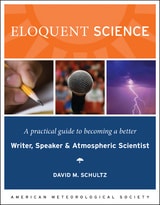
Eloquent Science
A Practical Guide to Becoming a Better Writer, Speaker and ScientistDavid M. Schultz
American Meteorological Society, 2009
Eloquent Science evolved from a workshop aimed at offering atmospheric science students formal guidance in communications, tailored for their eventual scientific careers. Drawing on advice from over twenty books and hundreds of other sources, this volume presents informative and often humorous tips for writing scientific journal articles, while also providing a peek behind the curtain into the operations of editorial boards and publishers of major journals. The volume focuses on writing, reviewing, and speaking and is aimed at the domain of the student or scientist at the start of her career. The volume offers tips on poster presentations, media communication, and advice for non-native speakers of English, as well as appendices on proper punctuation usage and commonly misunderstood meteorological concepts. A further reading section at the end of each chapter suggests additional sources for the interested reader, and sidebars written by experts in the field offer diverse viewpoints on reference topics.
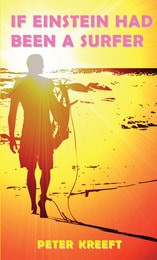
If Einstein Had Been a Surfer
A Surfer, a Scientist, and a Philosopher Discuss a "Universal Wave Theory" or "Theory of Everything"Peter Kreeft
St. Augustine's Press, 2009
In this book all three dimensions of consciousness not only speak about a “theory of everything” but speak to each other in dialog. The three voices are incarnated in three characters from an upcoming novel, An Ocean Full of Angels: Evan Jellema is a theoretical physicist (and a clumsy Dutchman), ’Isa Ben Adam is a philosophical Muslim (and cantankerously clear), and Libby Rawls is a poet, mystic, and surfer (and a sassy, classy Black feminist).
Isn’t “surfer” a bit of a stretch? Not at all. Actually, the papers reported last year that an amateur scientist has in fact finally discovered, or claimed to have discovered, the “theory of everything” that Einstein failed to find and that scientists have been searching for ever since – and he is a surfer! Perhaps this is no accident, but a natural connection: the mind of the “soul surfer,” having become one with the sea, has awakened its “third eye” which alone gives the scientist the binocular vision, the synoptic perspective, that he lacks. And perhaps only a philosopher can mediate the two other modes of vision, as Aquinas mediated and synthesized the science of Albert the Great and Aristotle with the poetry and symbolism of mystics like Augustine.
This lively trialog, full of irony, intellectual surprise, and humor, is a serious call for a post-medieval synthesis. It does not claim to have arrived anywhere near the end of a journey to a “Theory of Everything,” only to have begun it. Even that modest ambition will certainly be criticized a priori as impossibly ambitious. Does that tell you anything about the book, or does it tell you something about the critic?
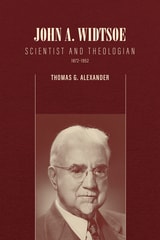
John A. Widtsoe
Scientist and Theologian, 1872-1952Alexander, Thomas G.
Signature Books, 2023
Born in Norway, John A. Widtsoe (1872–1952), was renowned for his expertise in irrigation and dry farming. His pioneering work pushed the boundaries of and contributed significantly to advancements in agricultural practices. Moreover, his forays into the field of biochemistry exemplified his relentless pursuit of scientific understanding.
Widtsoe’s journey came with challenges especially after he was called as an apostle in the Church of Jesus Christ of Latter-day Saints. As president of both Utah State Agricultural College (1907–16) and the University of Utah (1916–21), he faced controversies and obstacles head-on. Additionally, he played a significant role in overseeing the expansion of the LDS gospel in both Europe and the United States. He was highly esteemed within his church due to his ability to provide thorough and insightful explanations of various aspects of church doctrine and reconcile them with scientific truths. Throughout the early-to-mid-twentieth century, he symbolized to many members the successful integration of religious faith with secular knowledge, inspiring countless individuals to embrace both realms in harmony.

Linus Pauling
Scientist and PeacemakerClifford Mead
Oregon State University Press, 0