Results by title

4 books match the query 'Scots'
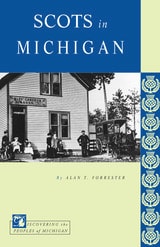
cover of Scots in Michigan

Scots in Michigan

Alan T. Forrester

Michigan State University Press, 2003

Scots began settling in North America in the earliest colonial days. They were heavily involved in the Great Lakes region’s major industries, as these evolved from fur trade to farming and lumbering to industry. From early settlement to the industrial revolution, Scots brought to the state a pioneer spirit and an extraordinary level of education. Though rendered almost invisible both by clustering under the umbrella of the British Commonwealth and by the fact that few Scottish traditions are considered whatsoever foreign, ethnic, or exotic, Scottish influences run deep in Michigan history and culture. From ice hockey to industry, much of what represents Michigan has roots that were embedded in Scotland. Although Alan T. Forrester notes that symbolic Scottish ethnicity—Highland Games, Scottish Festivals, and Burns Night Suppers—is practically the only obvious relic of Scottish heritage in Michigan, he illuminates how much more of this legacy is a part of this state.

[more]
cover of Scottish Mandarin: The Life and Times of Sir Reginald Johnston

Scottish Mandarin

The Life and Times of Sir Reginald Johnston

Shiona Airlie

Hong Kong University Press, 2012

Colonial administrator, writer, explorer, Buddhist, and friend to China's last emperor, Sir Reginald Johnston (1874–1938) was a distinguished sinologist with a tangled love and family life that he kept secret even from his closest friends. Born and educated in Edinburgh, he began his career in the colony of Hong Kong and eventually became Commissioner of the remote British leased territory of Weihai in northern China. He travelled widely and, during a break from colonial service, served as tutor and advisor to Puyi, the deposed emperor. As the only foreigner allowed to work in the Forbidden City, he wrote the classic account of the last days of the Qing Dynasty—Twilight in the Forbidden City. Granted unique access to Johnston's extensive personal papers, once thought to be lost, Shiona Airlie tells the life of a complex and sensitive character whose career made a deep impression on 20th-century China.
[more]
cover of The Packhorseman

The Packhorseman

Charles Hudson

University of Alabama Press, 2009
In April 1735, twenty-year-old William MacGregor, possessing little more than a bottle of Scotch whiskey and a set of Shakespeare’s plays, arrives in Charles Town, South Carolina, to make his fortune in the New World. The Scottish Highlands, while dear to his heart, were in steep economic decline and hopelessly entangled in dangerous political intrigue. With an uncle in Carolina, the long ocean voyage seemed his best chance for a new start. He soon discovers that the Jacobite politics of Scotland extend to Carolina, and when his mouth gets him in trouble with the Charles Town locals, dimming his employment opportunities, he seizes the one option still open for him and takes a job as a frontier packhorseman.
 
Soon young MacGregor is on the Cherokee trail to Indian country, where he settles in as a novice in the deerskin trade. Along the way William learns not only the arts of managing a pack train and trading with the Indians, but of reading the land and negotiating cultural differences with the Cherokee—whose clan system is much different from the Scottish clans of his homeland. William also learns that the Scottish enlightenment he so admires has not made much headway in the Carolina backcountry, where the real challenges are to survive, day to day, during the tense times after the Yamasee War and to remember that while in Indian country . . . it is their country.
 
A scholar of the native Southeast, Charles Hudson has turned his hand to this work of historical fiction, bringing to life the packhorsemen, Indian traders, and southeastern Indians of the early 18th-century Carolina. With a comfortable and engaging style, Hudson peoples the Carolina frontier with believable characters, all caught up in a life and time that is historically well-documented but little-known to modern popular readers.
[more]
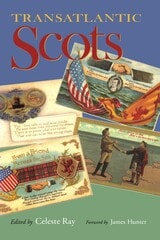
cover of Transatlantic Scots

Transatlantic Scots

Edited by Celeste Ray, foreword by James Hunter

University of Alabama Press, 2005

Examines the impact of the Scottish legacy on North American cultures and heritage
 
During the past four decades, growing interest in North Americans' cultural and ancestral ties to Scotland has produced hundreds of new Scottish clan and heritage societies.  Well over 300 Scottish Highland games and gatherings annually take place across the U.S. and Canada. 

Transatlantic Scots is a multidisciplinary collection that studies the regional organization and varied expressions of the Scottish Heritage movement in the Canadian Maritimes, the Great Lakes, New England, and the American South. From diverse perspectives, authorities in their fields consider the modeling of a Scottish identity that distances heritage celebrants from prevalent visions of whiteness. Considering both hyphenated Scots who celebrate centuries-old transmission of Scottish traditions and those for whom claiming or re-claiming a Scottish identity is recent and voluntary, this book also examines how diaspora themes and Highland imagery repeatedly surface in regional public celebrations and how traditions are continually reinvented through the accumulation of myths. The underlying theoretical message is that ethnicity and heritage survive because of the flexibility of history and tradition. 

This work is a lasting contribution to the study of ethnicity and identity, the renegotiation of history and cultural memory into heritage, and the public performance and creation of tradition.

 
[more]