Results by title
2 books match the query 'Scott, John Paul'
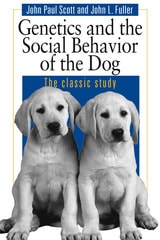
Genetics and the Social Behaviour of the Dog
John Paul Scott and John L. Fuller
University of Chicago Press, 1974
A classic study of dog behavior gathered into one volume, this is the single most important and comprehensive reference work on the behavior of dogs ever complied.
Scott and Fuller’s classic study of dog behavior gathers into one volume the authoritative information that came from their twenty years of research at the Jackson Laboratory. Central to their book is the role heredity plays in the development of behavior. Giving puppies an environment designed on the principles of a well-run school, Scott and Fuller tested five breeds representing the major dog groups and carried out a Mendelian experiment with two of the most different breeds: the basenji and the cocker spaniel.
They found that heredity affects almost every trait tested; that sex affects aggressiveness and the dominance order, but not trainability and problem-solving; that emotional traits profoundly influence performance; that, although breeds differ widely in emotional and motivational characteristics, none shows distinct superiority in problem solving; and that detailed statistical analyses indicate a highly complex pathway between primary gene action and its final effect on behavior.
Included is important information on:
• rearing methods
• the origin and history of dog breeds
• basic behavior patterns
• the physiological and behavioral development of puppies
[more]

Social Control and Social Change
Edited by John Paul Scott and Sarah F. Scott
University of Chicago Press, 1971
Social Control and Social Change is a unique and timely attempt to understand and elaborate the process of social control. An interdisciplinary study from the Center for Research on Social Behavior at Bowling Green University, this book develops some general theories of social control as it exists in human and nonhuman societies and indicates areas in which important new research can be done. The authors present not only theoretical discussions of the various aspects of control processes—biological, political, psychological, social, and social-psychological—but also include detailed research and indicate practical applications of the newer scientific perspectives of social control.
[more]