Results by title

6 books match the query 'Scribes'
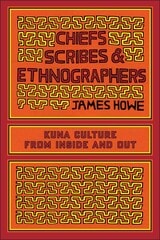
cover of Chiefs, Scribes, and Ethnographers: Kuna Culture from Inside and Out

Chiefs, Scribes, and Ethnographers

Kuna Culture from Inside and Out

By James Howe

University of Texas Press, 2009
The Kuna of Panama, today one of the best known indigenous peoples of Latin America, moved over the course of the twentieth century from orality and isolation towards literacy and an active engagement with the nation and the world. Recognizing the fascination their culture has held for many outsiders, Kuna intellectuals and villagers have collaborated actively with foreign anthropologists to counter anti-Indian prejudice with positive accounts of their people, thus becoming the agents as well as subjects of ethnography. One team of chiefs and secretaries, in particular, independently produced a series of historical and cultural texts, later published in Sweden, that today still constitute the foundation of Kuna ethnography. As a study of the political uses of literacy, of western representation and indigenous counter-representation, and of the ambivalent inter-cultural dialogue at the heart of ethnography, Chiefs, Scribes, and Ethnographers addresses key issues in contemporary anthropology. It is the story of an extended ethnographic encounter, one involving hundreds of active participants on both sides and continuing today.
[more]
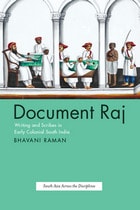
cover of Document Raj: Writing and Scribes in Early Colonial South India

Document Raj

Writing and Scribes in Early Colonial South India

Bhavani Raman

University of Chicago Press, 2012
Historians of British colonial rule in India have noted both the place of military might and the imposition of new cultural categories in the making of Empire, but Bhavani Raman, in Document Raj, uncovers a lesser-known story of power: the power of bureaucracy. Drawing on extensive archival research in the files of the East India Company’s administrative offices in Madras, she tells the story of a bureaucracy gone awry in a fever of documentation practices that grew ever more abstract—and the power, both economic and cultural, this created.
 
In order to assert its legitimacy and value within the British Empire, the East India Company was diligent about record keeping. Raman shows, however, that the sheer volume of their document production allowed colonial managers to subtly but substantively manipulate records for their own ends, increasingly drawing the real and the recorded further apart. While this administrative sleight of hand increased the company’s reach and power within the Empire, it also bolstered profoundly new orientations to language, writing, memory, and pedagogy for the officers and Indian subordinates involved. Immersed in a subterranean world of delinquent scribes, translators, village accountants, and entrepreneurial fixers, Document Raj maps the shifting boundaries of the legible and illegible, the legal and illegitimate, that would usher India into the modern world.
[more]
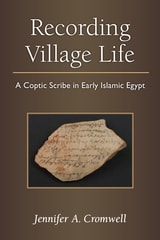
cover of Recording Village Life: A Coptic Scribe in Early Islamic Egypt

Recording Village Life

A Coptic Scribe in Early Islamic Egypt

Jennifer A. Cromwell

University of Michigan Press, 2017

Recording Village Life presents a close study of over 140 Coptic texts written between 724–756 CE by a single scribe, Aristophanes son of Johannes, of the village Djeme in western Thebes. These texts, which focus primarily on taxation and property concerns, yield a wealth of knowledge about social and economic changes happening at both the community and country-wide levels during the early years of Islamic rule in Egypt. Additionally, they offer a fascinating picture of the scribe’s role within this world, illuminating both the practical aspects of his work and the social and professional connections with clients for whom he wrote legal documents.

Papyrological analysis of Aristophanes’ documents, within the context of the textual record of the village, shows a new and divergent scribal practice that reflects broader trends among his contemporaries: Aristophanes was part of a larger, national system of administrative changes, enacted by the country’s Arab rulers in order to better control administrative practices and fiscal policies within the country. Yet Aristophanes’ dossier shows him not just as an administrator, revealing details about his life, his role in the community, and the elite networks within which he operated. This unique perspective provides new insights into both the micro-history of an individual’s experience of eighth-century Theban village life, and its reflection in the macro social, economic, and political trends in Egypt at this time.

This book will prove valuable to scholars of late antique studies, papyrology, philology, early Islamic history, social and economic history, and Egyptology.
[more]
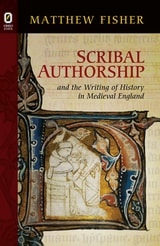
cover of Scribal Authorship and the Writing of History in Medieval England

Scribal Authorship and the Writing of History in Medieval England

Matthew Fisher

The Ohio State University Press, 2012

Based on new readings of some of the least-read texts by some of the best-known scribes of later medieval England, Scribal Authorship and the Writing of History in Medieval England reconceptualizes medieval scribes as authors, and the texts surviving in medieval manuscripts as authored. Culling evidence from history writing in later medieval England, Matthew Fisher concludes that we must reject the axiomatic division between scribe and author. Using the peculiarities of authority and intertextuality unique to medieval historiography, Fisher exposes the rich ambiguities of what it means for medieval scribes to “write” books. He thus frames the composition, transmission, and reception—indeed, the authorship—of some medieval texts as scribal phenomena.
 
History writing is an inherently intertextual genre: in order to write about the past, texts must draw upon other texts. Scribal Authorship demonstrates that medieval historiography relies upon quotation, translation, and adaptation in such a way that the very idea that there is some line that divides author from scribe is an unsustainable and modern critical imposition. Given the reality that a scribe’s work was far more nuanced than the simplistic binary of error and accuracy would suggest, Fisher completely overturns many of our assumptions about the processes through which manuscripts were assembled and texts (both canonical literature and the less obviously literary) were composed.
[more]
cover of Scribes, Script, and Books: The Book Arts from Antiquity to the Renaissance

Scribes, Script, and Books

The Book Arts from Antiquity to the Renaissance

Leila Avrin

American Library Association, 2009
[more]
cover of The Scribes of the Torah: The Formation of the Pentateuch in Its Literary and Historical Contexts

The Scribes of the Torah

The Formation of the Pentateuch in Its Literary and Historical Contexts

Konrad Schmid

SBL Press, 2023

A revised view of the Pentateuch with consequences for the broader literary history of the Bible

This collection of thirty-one studies on the Pentateuch represents more than twenty years of Konrad Schmid’s research and publications advocating for a new view of the Pentateuch’s formation. Schmid’s essays present the case for a Persian period Priestly document that provided a basic narrative thread to the Torah, which included separate, pre-Priestly components of narratives in Genesis and the Moses story. Schmid’s open discussion includes evidence from various fields, such as literary history, comparative cultural history, historical linguistics, epigraphy, and archaeology. The essays are divided into eight sections usefully structured around the themes of the Pentateuch in the Enneateuch, the history of scholarship, the formation of the Torah, Genesis, the Moses story, the Priestly document, legal texts, and the Pentateuch in the history of ancient Israel’s religion.

[more]