Results by title

10 books match the query 'Scripture'
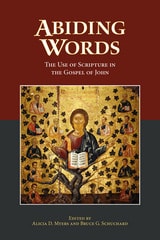
cover of Abiding Words: The Use of Scripture in the Gospel of John

Abiding Words

The Use of Scripture in the Gospel of John

Alicia D. Myers

SBL Press, 2015

A collection of essays by experts from around the world

Like the other New Testament Gospels, the Gospel of John repeatedly appeals to Scripture (Old Testament). Preferring allusions and “echoes” alongside more explicit quotations, however, the Gospel of John weaves Scripture as an authoritative source concerning its story of Jesus. Yet, this is the same Gospel that is often regarded as antagonistic toward “the Jews,” especially the Jewish religious leaders, depicted within it.

Features:

  • Introduces and updates readers on the question of John’s employment of Scripture
  • Showcases useful approaches to more general studies on the New Testament’s use of Scripture, sociological and rhetorical analyses, and memory theory
  • Explores the possible implications surrounding Scripture usage for the Gospel audiences both ancient and contemporary
[more]
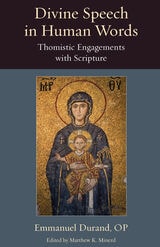
cover of Divine Speech in Human Words: Thomistic Engagements with Scripture

Divine Speech in Human Words

Thomistic Engagements with Scripture

Emmanuel Durand, OP

Catholic University of America Press, 2022
Is the portrait of God revealed in Scripture fundamentally intelligible? The biblical accounts of God reveal seemingly contradictory themes: God’s holiness and narratives telling of his anger; the Divine Omnipotence faced with the Impossible; the suffering Christ upon the Cross and the transcendent Trinity of Persons in God; the unique Savior and the universality of God’s salvific will; and so forth. How are we to hold together all of this data without denying any aspect of the mystery of God? Must we give into our ambient culture’s sense that the biblical God cannot be taken seriously by truly discerning and rational minds when they try to understand “the Divine”? Or, in the midst of this apparent contradiction, can we find the lines of harmony in the revealed mysteries? In Divine Speech in Human Words, Fr. Emmanuel Durand unties some of the knots that face us when we reflect on the God of biblical Revelation. In each of the essays gathered here, Fr. Durand sympathetically articulates the tensions and apparent contradictions experienced by contemporary minds as they strive to understand the revealed truth of God. A whole host of topics are covered in this volume: the Cross and the revelation of the Trinity; God’s holiness and transcendence; divine immutability and the sorrow of a loving God; Divine Providence and human prayer; the fatherhood of God and eschatology; Christ’s way of life; and many others. Drawing philosophical insights from the Thomistic tradition as his intellectual tools, Fr. Durand nonetheless emphasizes the importance of a properly theological mode of reflection, allowing these issues to be illuminated by the revealed truth of Sacred Scripture. Thus, for each of these difficult topics, he shows that a vital theological response must not limit itself to mere logical rigor but, rather, requires metaphysical insight and, above all, sapiential appreciation of God’s revealed word. With such instruments in hand, each essay approaches the tensions of biblical revelation with an eager readiness to show how a thoughtful Thomistic practice of biblical theology can guide faith as it seeks an understanding of both contemporary and perennial theological problems.
[more]
cover of Ecclesial Exegesis: A Synthesis of Ancient and Modern Approaches to Scripture

Ecclesial Exegesis

A Synthesis of Ancient and Modern Approaches to Scripture

Gregory Vall

Catholic University of America Press, 2022
There is broad support today for the idea that biblical scholarship ought to be informed by the faith of the Church and serve the life of the Church. In a word, it should be ecclesial. There is far less agreement, however, when one asks how this goal is to be achieved and what ecclesial exegesis ought to look like. In 1988, Joseph Ratzinger put forth his “Method C” proposal, calling for the development of a new exegetical and hermeneutical synthesis. This would be neither a retreat to the patristic-medieval approach (Method A) nor the continued hegemony of the historical-critical approach (Method B). The latter must be purified of its positivism through a transformational encounter with the former, so that the gifts of both might be released for the life of the Church. Such a synthesis, Ratzinger claimed, would require the philosophical, theological, exegetical, and hermeneutical work of “at least a whole generation” of scholars. Gregory Vall has devoted over thirty years to the development of ecclesial exegesis, and the present volume represents the mature fruit of his labor. Over against those who treat Dei Verbum as Vatican II’s endorsement of the historical-critical method, he demonstrates that the dogmatic constitution actually points to something very much like Ratzinger’s Method C. Employing a dialogic movement between the inductive-exegetical and the deductive-dogmatic, Vall offers nine studies that bring to the surface issues such as the relationship between Old Testament and New Testament, literal sense and spiritual sense, and Scripture and Tradition. While Vall brings theological knowledge and hermeneutical skill to the quest for Method C, he also provides a great deal of valuable exegesis of both testaments. Ecclesial Exegesis is not simply another book of theory. It demonstrates how Method C can be done.
[more]
cover of Myth and Scripture: Contemporary Perspectives on Religion, Language, and Imagination

Myth and Scripture

Contemporary Perspectives on Religion, Language, and Imagination

Dexter E. Callender, Jr.

SBL Press, 2014

An interdisciplinary collection for scholars and students interested in the connections between myth and scripture

In this collection scholars suggest that using “myth” creates a framework within which to set biblical writings in both cultural and literary comparative contexts. Reading biblical accounts alongside the religious narratives of other ancient civilizations reveals what is commonplace and shared among them. The fruit of such work widens and enriches our understanding of the nature and character of biblical texts, and the results provide fresh evidence for how biblical writings became “scripture.”

Features:

  • Essays that explore how myth sheds light on the emergence of scripture
  • Examples drawn from the Ancient Near East, Hebrew Bible, New Testament, and Greco-Roman world
  • Articles by experts from a range of disciplines
[more]
cover of Paul and Scripture: Extending the Conversation

Paul and Scripture

Extending the Conversation

Christopher D. Stanley

SBL Press, 2012

This book, which grew out of the Society of Biblical Literature’s Paul and Scripture Seminar, explores some of the methodological problems that have arisen during the last few decades of scholarly research on the apostle Paul’s engagement with his ancestral Scriptures. Essays explore the historical backgrounds of Paul’s interpretive practices, the question of Paul’s “faithfulness” to the context of his biblical references, the presence of Scripture in letters other than the Hauptbriefe, and the role of Scripture in Paul’s theology. All of the essays look at old questions through new lenses in an effort to break through scholarly impasses and advance the debate in new directions. The contributors are Matthew W. Bates, Linda L. Belleville, Roy E. Ciampa, Bruce N. Fisk, Stephen E. Fowl, Leonard Greenspoon, E. Elizabeth Johnson, Mitchell M. Kim, Steve Moyise, Jeremy Punt, Christopher D. Stanley, and Jerry L. Sumney.
[more]
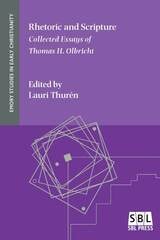
cover of Rhetoric and Scripture: Collected Essays of Thomas H. Olbricht

Rhetoric and Scripture

Collected Essays of Thomas H. Olbricht

Thomas H. Olbricht

SBL Press, 2021

This book offers a unique overview of the development of rhetorical criticism both in North America and internationally through the work of pioneering New Testament scholar Thomas H. Olbricht. Lauri Thurén has gathered nineteen of Olbricht's essays as a guidebook to rhetorical criticism for students, clergy, and scholars. The range of essays from throughout Olbricht's career illuminate the history of rhetorical criticism and reflect the different motivations of ancient and contemporary rhetorical approaches. Essays focus on the history of biblical rhetorical analysis, the rhetorical analysis of biblical texts, the characteristics of rhetorical analysis, and types of biblical rhetorical criticism. A foreword by Thurén and a memorial essay by Carl R. Holladay contextualize Olbricht's work. Anyone interested in the rhetorical study of the New Testament will find this volume inspiring and informative.
[more]
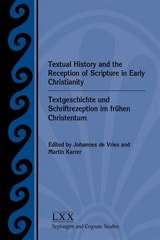
cover of Textual History and the Reception of Scripture in Early Christianity

Textual History and the Reception of Scripture in Early Christianity

Johannes de Vries

SBL Press, 2013
The essays in this volume summarize an international research project on early Christian citations from Israel’s scriptures. These quotations are not only theologically significant but are also part of the textual history of the Septuagint and adjacent textual traditions of the Greek and Hebrew Old Testament. The essays discuss relevant manuscripts (Bible codices, papyri, etc.) up to the fifth century, signs and marginal notes (e.g., the diplé) that were used in the ancient scriptoria, and the specifics of the reception history in early Christianity from Matthew to 1 Peter and from the apostolic fathers to Theophilos of Antioch. The contributors are Felix Albrecht, Ronald H. van der Bergh, Heinz-Josef Fabry, Kerstin Heider, Martin Karrer, Christin Klein, Arie van der Kooij, Siegfried Kreuzer, Horacio E. Lona, Martin Meiser, Maarten J. J. Menken, Matthias Millard, Darius Müller, Ferdinand R. Prostmeier, Alexander Stokowski, Martin Vahrenhorst, Christiane Veldboer, and Johannes de Vries.
[more]
cover of The Inspiration and Truth of Scripture: Testing the Ratzinger Paradigm

The Inspiration and Truth of Scripture

Testing the Ratzinger Paradigm

Aaron Pidel, SJ

Catholic University of America Press, 2023
What does it mean to say that Scripture is God’s Word? And just how true is the Bible? Though sometimes dismissed as “fundamentalist” concerns, these questions also sent twentieth-century Catholic theology searching for a new paradigm of biblical inspiration. Theologians repeatedly attempted to reconcile the traditional conviction that the Bible shares in the omniscience of its divine author with scholarly findings that suggested otherwise. Joseph Ratzinger contributed both negatively and positively to this project, deconstructing the regnant manualist models of inspiration and constructing an alternative inspired by St. Bonaventure. The result is an ecclesial model of surprising comprehensiveness and balance. Indeed, The Inspiration and Truth of Scripture concludes that Ratzinger’s alternative provides the least inadequate paradigm currently on offer today. The Inspiration and Truth of Scripture breaks new ground in several ways. First, it situates Ratzinger within a broader Catholic quest for a theology of inspiration, showing his model offers advantages even relative to those proposed by modern theology’s most eminent minds: John Henry Newman, Pierre Benoit, Karl Rahner, and David Tracy. Secondly, this book shows how Ratzinger’s paradigm generates “tests” for identifying the perennially valid affirmations of Scripture, and thus an approach to resolving disputed biblical questions. Must one who accepts the authority of Scripture believe in the Devil? Are the Marian dogmas really “in” Scripture? To what extent does Jesus’s prohibition of divorce still apply in today’s changed social circumstances? Just how historical are Gospel narratives, like the Last Supper, intended to be? The result is a book that bridges the gap between normative theology and historical exegesis. Overall, The Inspiration and Truth of Scripture presents Ratzinger not as an unimaginative enforcer of doctrinal conclusions but as a creatively faithful theologian, whose reconfiguration of inspiration should serve as the point of departure for all future reflection on the subject.
[more]
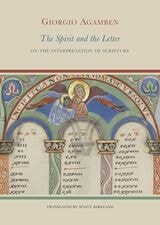
cover of The Spirit and the Letter: On the Interpretation of Scripture

The Spirit and the Letter

On the Interpretation of Scripture

Giorgio Agamben

Seagull Books, 2026

Distinguished philosopher Giorgio Agamben offers an archaeological inquiry into the problem of scriptural interpretation. 

The problem of interpreting Scripture—above all, sacred scripture, but ultimately any form of writing—coincides with the very history of Western culture. It is no surprise, then, that an archaeological inquiry such as the one proposed here—on the problem of interpretation from Origen to Auerbach, from the Talmud to Benjamin—might hold unexpected revelations.

Essential reading for scholars of theology, religious studies, and hermeneutics interested in the history of scriptural interpretation, The Spirit and the Letter highlights how the interpretation of Scripture reveals itself as inseparable from ethics and politics.
 
[more]
cover of Torah Today: A Renewed Encounter with Scripture

Torah Today

A Renewed Encounter with Scripture

By Pinchas H. Peli

University of Texas Press, 2005

The central element of Jewish worship is the yearly cycle of reading the first five books of the Bible, the Five Books of Moses, called the Torah in Hebrew. Torah Today, a compilation of fifty-four essays that grew out of Pinchas Peli's Torah column in the Jerusalem Post, comments upon the weekly readings from the Torah. Written in a wonderfully clear style, each essay brings the reader closer to the rich spiritual world of Torah as it confronts the challenges of modern society. This reissue of Torah Today, with a new preface by Rabbi Harold M. Schulweis, makes this classic work available to a new generation of Bible students.

[more]