Results by title
67 books match the query 'Sea' and 4 start with a
All the Fish in the Sea
Maximum Sustainable Yield and the Failure of Fisheries ManagementCarmel Finley
University of Chicago Press, 2011
Carmel Finley reveals that the fallibility of MSY lies at its very inception—as a tool of government rather than science. The foundational doctrine of MSY emerged at a time when the US government was using science to promote and transfer Western knowledge and technology, and to ensure that American ships and planes would have free passage through the world’s seas and skies. Finley charts the history of US fisheries science using MSY as her focus, and in particular its application to halibut, tuna, and salmon fisheries. Fish populations the world over are threatened, and All the Fish in the Sea helps to sound warnings of the effect of any management policies divested from science itself.
An Anchor in the Sea of Time
EssaysStephen Harrigan
University of Texas Press, 2025
A new collection of essays grappling with identity and memory, from a master of the form.
The author of the New York Times bestselling novel The Gates of the Alamo, the sweeping Texas history Big Wonderful Thing, and decades of incisive journalism, Stephen Harrigan is an adept writer skilled in crafting memorable characters. From this singular voice now comes a collection of essays tackling the most personal, and yet most expansive, themes of all: identity, memory, and time itself.
An Anchor in the Sea of Time unfolds individual stories but also a larger narrative about the development and distortions of history. In one essay, a painting on his grandparents’ wall is seared in Harrigan’s young mind. In another, a group trip to Vietnam stirs up a sobering confrontation with class privilege among Americans who fought there and others, like Harrigan, who did their best not to. The award-winning essay “Off Course” reflects on the father Harrigan never met. And Harrigan’s reporting about the Karankawas, an Indigenous group from the Texas coast once thought to be extinct, takes readers deep into the recesses of collective forgetting and offers glimpses of the possibility of recovery. A vivid encounter with lost selves, vanished worlds, and futures yet unrealized, An Anchor in the Sea of Time is perhaps the most personal book yet from this beloved writer.

Archaeological Survey at Notion / Colophon-by-the-Sea
Edited by Christopher Ratté, Felipe Rojas, and Angela Commito
University of Michigan Press, 2027
Notion, also known as Colophon-by-the-Sea, was an ancient Greek city on the western coast of Anatolia. A comprehensive archaeological survey carried out by the University of Michigan and Brown University (2014–21) yielded rich ceramic evidence for the chronology and commercial connections of the settlement, clarified essential aspects of the city plan, provided opportunities for detailed study of major buildings and public works, and shed new light on both the local geology and the modification of the landscape through terracing and stone extraction. These investigations documented a major program of urban development featuring new fortifications and a new city plan in the early to mid-third century BC, three centuries of prosperous habitation, and the substantial abandonment of the city in the early first century AD. The archaeology of Notion provides vivid evidence for the turbulent history of Ionia in Hellenistic times, and for the different responses of local communities to Roman rule.
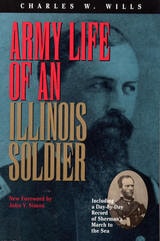
Army Life of an Illinois Soldier
Including a Day-by-Day Record of Sherman's March to the SeaCharles W. Wills. Foreword by John Y. Simon
Southern Illinois University Press, 1996
A high-spirited idealist who craved excitement when he enlisted in the Eighth Illinois Volunteers for three months and reenlisted for three years, Charles W. Wills of Canton, Illinois, wrote frequently to his sister Mary Emily Wills and kept a diary of General William T. Sherman’s campaigns during the last year of the war. In the beginning of his service, Wills could boast that his company refused to enlist "roughs." He reported that he and his comrades "drink no liquors and keep ourselves as cleanly as possible.... Almost all are reading or writing, and I defy anyone to find 75 men without any restraint, paying more attention to the Sabbath. . . . Health generally excellent in our company, because we are all careful."
A student and store clerk before enlisting, Wills found that army life "beats clerking." He enlisted as a private at the age of twenty-one and by twenty-four was a major. He had thought he might receive an infantry commission eventually, but when the opportunity arose for promotion to first lieutenant in the Seventh Illinois Cavalry, "cupidity and ambition" caused him to abandon the Eighth, enabling him to hold rank "without so much walking." For a while, though, he seriously rued his lack of action. "Haven’t I a brilliant record," he wrote. "Thirty-three months in service and not a battle." As Simon points out, however, "in the year ahead, Wills would have more than his fill of battles." Battle starved once, his enthusiasm for carnage waned as he marched with Sherman to the sea. Yet Major Wills was impressed by his troops’ "endurance, spirit and recklessness."
Wills matured in the army. He joined solely to preserve the Union, and his early comments on slaves "lacked sympathy, even decency," according to Simon. Later he came to the point where he would arm blacks—in part, with an eye toward gaining rank by leading the new regiments. Yet he was not blind to the anomalies of a slave society.
Wills died in 1883. To preserve his memory, his sister (now Mary Kellogg) printed his diary in 1904. Two years later, Kellogg combined the diary with the letters Wills had written to her earlier in the war. Simon renders this assessment: "Wills had a sparkling, witty style that contrasted sharply with that of both his contemporaries in the field and the seven regimental veterans who compiled their diaries. In assembling this book, Mary E. Kellogg wisely allowed her brother to speak for himself; rarely intruding a comment of her own, excising from his letters home inevitable expressions of concern for his sister and her welfare but leaving intact the sparkling flow of camp gossip and military speculation."