Results by title
9 books match the query 'Sea stories, American'
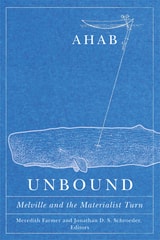
Ahab Unbound
Melville and the Materialist TurnMeredith Farmer
University of Minnesota Press, 2021
Why Captain Ahab is worthy of our fear—and our compassion
Herman Melville’s Captain Ahab is perennially seen as the paradigm of a controlling, tyrannical agent. Ahab Unbound leaves his position as a Cold War icon behind, recasting him as a contingent figure, transformed by his environment—by chemistry, electromagnetism, entomology, meteorology, diet, illness, pain, trauma, and neurons firing—in ways that unexpectedly force us to see him as worthy of our empathy and our compassion.
In sixteen essays by leading scholars, Ahab Unbound advances an urgent inquiry into Melville’s emergence as a center of gravity for materialist work, reframing his infamous whaling captain in terms of pressing conversations in animal studies, critical race and ethnic studies, disability studies, environmental humanities, medical humanities, political theory, and posthumanism. By taking Ahab as a focal point, we gather and give shape to the multitude of ways that materialism produces criticism in our current moment. Collectively, these readings challenge our thinking about the boundaries of both persons and nations, along with the racist and environmental violence caused by categories like the person and the human.
Ahab Unbound makes a compelling case for both the vitality of materialist inquiry and the continued resonance of Melville’s work.
Contributors: Branka Arsić, Columbia U; Christopher Castiglia, Pennsylvania State U; Colin Dayan, Vanderbilt U; Christian P. Haines, Pennsylvania State U; Bonnie Honig, Brown U; Jonathan Lamb, Vanderbilt U; Pilar Martínez Benedí, U of L’Aquila, Italy; Steve Mentz, St. John’s College; John Modern, Franklin and Marshall College; Mark D. Noble, Georgia State U; Samuel Otter, U of California, Berkeley; Donald E. Pease, Dartmouth College; Ralph James Savarese, Grinnell College; Russell Sbriglia, Seton Hall U; Michael D. Snediker, U of Houston; Matthew A. Taylor, U of North Carolina at Chapel Hill; Ivy Wilson, Northwestern U.
Antebellum at Sea
Maritime Fantasies in Nineteenth-Century AmericaJason Berger
University of Minnesota Press, 2012
In the antebellum years, the Western world’s symbolic realities were expanded and challenged as merchant, military, and scientific activity moved into Pacific and Arctic waters. In Antebellum at Sea, Jason Berger explores the roles that early nineteenth-century maritime narratives played in conceptualizing economic and social transitions in the developing global market system and what these chronicles disclose about an era marked by immense change.
Focusing on the work of James Fenimore Cooper and Herman Melville, Berger enhances our understanding of how the nineteenth century negotiated its own tenuous progress by portraying how a wide range of maritime stories lays bare disturbing experiences of the new. Berger draws on Slavoj Žižek’s Lacanian notion of fantasy in order to reconsider the complex way maritime accounts operated in the political landscape of antebellum America, examining topics such as the function of maritime labor know-how within a transformation of scientific knowledge, anxiety produced by conflict between gender-specific and culture-specific forms of enjoyment, and how legal practices illuminate troubling juridical paradoxes at the heart of Polk-era political life.
Addressing the ideas of the antebellum age from unexpected and revealing perspectives, Berger calls on the conception of fantasy to consider how antebellum maritime literature disputes conventional views of American history, literature, and national identity.
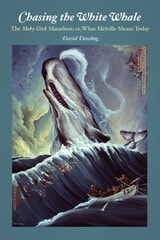
Chasing the White Whale
The Moby-Dick Marathon; or, What Melville Means TodayDavid Dowling
University of Iowa Press, 2010
The experimental artist Peter Fischli once observed, “There’s certainly a subversive pleasure in occupying yourself with something for an unreasonable length of time.” In this same spirit, David Dowling takes it upon himself to attend and report on the all-consuming annual Moby-Dick Marathon reading at the New Bedford Whaling Museum.
The twenty-five-hour nonstop reading of Melville’s titanic epic has inspired this fresh look at Moby-Dick in light of its most devoted followers at the moment of their high holy day, January 3, 2009. With some trepidation, Dowling joined the ranks of the Melvillians, among the world’s most obsessive literary aficionados, to participate in the event for its full length, from “Call Me Ishmael” to the destruction of the Pequod. Dowling not only survived to tell his tale, but does so with erudition, humor, and a keen sense for the passions of his fellow whalers.
The obsession of participants at the marathon reading is startling, providing evidence of Ishmael’s remark that “all men live enveloped in whale-lines. All are born with halters round their necks; but it is only when caught in the swift, sudden turn of death, that mortals realize the silent, subtle, ever-present perils of life.” Dowling organizes his savvy analysis of the novel from its romantic departure to its sledge-hammering seas, detailing the culture of the top brass to the common crew and scrutinizing the inscrutable in and through Melville’s great novel.
Chasing the White Whale offers a case study of the reading as a barometer of how Melville lives today among his most passionate and enthusiastic disciples, who include waterfront workers, professors, naval officers, tattooed teens, and even a member of Congress. Dowling unearths Moby-Dick’s central role in these lives, and by going within the local culture he explains how the novel could have developed such an ardent following and ubiquitous presence in popular culture within our technology-obsessed, quick-fix contemporary world.

Jack London and the Sea
Anita Duneer
University of Alabama Press, 2022
The first book-length study of London as a maritime writer
Jack London’s fiction has been studied previously for its thematic connections to the ocean, but Jack London and the Sea marks the first time that his life as a writer has been considered extensively in relationship to his own sailing history and interests. In this new study, Anita Duneer claims a central place for London in the maritime literary tradition, arguing that for him romance and nostalgia for the Age of Sail work with and against the portrayal of a gritty social realism associated with American naturalism in urban or rural settings. The sea provides a dynamic setting for London’s navigation of romance, naturalism, and realism to interrogate key social and philosophical dilemmas of modernity: race, class, and gender. Furthermore, the maritime tradition spills over into texts that are not set at sea.
Jack London and the Sea does not address all of London’s sea stories, but rather identifies key maritime motifs that influenced his creative process. Duneer’s critical methodology employs techniques of literary and cultural analysis, drawing on extensive archival research from a wealth of previously unpublished biographical materials and other sources. Duneer explores London’s immersion in the lore and literature of the sea, revealing the extent to which his writing is informed by travel narratives, sensational sea yarns, and the history of exploration, as well as firsthand experiences as a sailor in the San Francisco Bay and Pacific Ocean.
Organized thematically, chapters address topics that interested London: labor abuses on “Hell-ships” and copra plantations, predatory and survival cannibalism, strong seafaring women, and environmental issues and property rights from San Francisco oyster beds to pearl diving in the Paumotos. Through its examination of the intersections of race, class, and gender in London’s writing, Jack London and the Sea plumbs the often-troubled waters of his representations of the racial Other and positions of capitalist and colonial privilege. We can see the manifestation of these socioeconomic hierarchies in London’s depiction of imperialist exploitation of labor and the environment, inequities that continue to reverberate in our current age of global capitalism.
Modernity At Sea
Melville, Marx, Conrad In CrisisCesare Casarino
University of Minnesota Press, 2002
Analyzes nineteenth-century seafaring narratives and their importance to ideas of modernity
At once a literary-philosophical meditation on the question of modernity and a manifesto for a new form of literary criticism, Modernity at Sea argues that the nineteenth-century sea narrative played a crucial role in the emergence of a theory of modernity as permanent crisis.
In a series of close readings of such works as Herman Melville’s White-Jacket and Moby Dick, Joseph Conrad’s The Nigger of the "Narcissus” and The Secret Sharer, and Karl Marx’s Grundrisse, Cesare Casarino draws upon the thought of twentieth-century figures including Giorgio Agamben, Louis Althusser, Walter Benjamin, Leo Bersani, Gilles Deleuze, Félix Guattari, and Antonio Negri to characterize the nineteenth-century ship narrative as the epitome of Michel Foucault’s "heterotopia"—a special type of space that simultaneously represents, inverts, and contests all other spaces in culture.Elaborating Foucault’s claim that the ship has been the heterotopia par excellence of Western civilization since the Renaissance, Casarino goes on to argue that the nineteenth-century sea narrative froze the world of the ship just before its disappearance—thereby capturing at once its apogee and its end, and producing the ship as the matrix of modernity.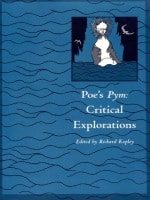
Poe's Pym
Critical ExplorationsRichard Kopley, ed.
Duke University Press, 1992
The product of a decade of research and planning, Poe's "Pym" offers a factual basis for some of the most fantastic elements in the novel and uncovers surprising connections between Poe's text and exploration literature, nautical lore, Arthurian narrative, nineteenth-century journalism, Moby Dick, and other writings. Representing a rich cross-section of current modes of literary study—from source study to psychoanalytic criticism to new historicism—these sixteen essays probe issues such as literary influence, the limits of language, racism, the holocaust, prolonged mourning, and the structure of the human mind. Poe's "Pym" will be an invaluable resource for students of both contemporary criticism and nineteenth-century American culture.
Contributors. John Barth, Susan F. Beegel, J. Lasley Dameron, Grace Farrell, Alexander Hammond, David H. Hirsch, John T. Irwin, J. Gerald Kennedy, David Ketterer, Joan Tyler Mead, Joseph J. Moldenhauer, Carol Peirce, Burton R. Pollin, Alexander G. Rose III, John Carlos Rowe, G. R. Thompson, Bruce I. Weiner
Reading Billy Budd
Hershel Parker
Northwestern University Press, 1990
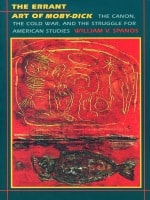
The Errant Art of Moby-Dick
The Canon, the Cold War, and the Struggle for American StudiesWilliam V. Spanos
Duke University Press, 1995
Combining Heideggerian ontology with a sociopolitical perspective derived primarily from Foucault, the reading of Moby-Dick that forms the center of this book demonstrates that the traditional identification of Melville’s novel as a "romance" renders it complicitous in the discourse of the Cold War. At the same time, Spanos shows how New Americanist criticism overlooks the degree to which Moby-Dick anticipates not only America’s self-representation as the savior of the world against communism, but also the emergent postmodern and anti-imperial discourse deployed against such an image. Spanos’s critique reveals the extraordinary relevance of Melville’s novel as a post-Cold War text, foreshadowing not only the self-destructive end of the historical formation of the American cultural identity in the genocidal assault on Vietnam, but also the reactionary labeling of the current era as "the end of history."
This provocative and challenging study presents not only a new view of the development of literary history in the United States, but a devastating critique of the genealogy of ideology in the American cultural establishment.

Whale
K.L. Evans
University of Minnesota Press, 2003
An entirely fresh approach to Moby Dick, by way of Ludwig Wittgenstein
The aim of this thoroughly unconventional work is to demonstrate that Herman Melville’s Moby Dick and Ludwig Wittgenstein’s Philosophical Investigations share the same projects and are, in effect, one and the same book. Confounding and improbable as such an enterprise might seem, Whale! not only successfully reveals the vital intersections between Melville and Wittgenstein but also, more important, makes a compelling argument for why such intersections are essential to understanding common political projects in literature and philosophy.
Written with grace, passion, and wit, Whale! manages to produce a startling and remarkably original reading of one of the most written-about and interpreted books in the American canon. K. L. Evans explores Melville’s vast work as a tale not of vengeance but of affection, and Ahab’s near-pathological agitation as indicative of his refusal to accept the world as unknowable. Between Ahab and the whale, Evans traces a longing for connection and meaning and finds a forceful response to the skeptical view that language is bankrupt and knowledge is uncertain. In Ahab’s hunt for Moby Dick, Whale! discovers a way to reconnect matter with meaning, object with knowledge.