Results by title
5 books match the query 'Second'

A Tenth of a Second
A HistoryJimena Canales
University of Chicago Press, 2009
In the late fifteenth century, clocks acquired minute hands. A century later, second hands appeared. But it wasn’t until the 1850s that instruments could recognize a tenth of a second, and, once they did, the impact on modern science and society was profound. Revealing the history behind this infinitesimal interval, A Tenth of a Second sheds new light on modernity and illuminates the work of important thinkers of the last two centuries.
Tracing debates about the nature of time, causality, and free will, as well as the introduction of modern technologies—telegraphy, photography, cinematography—Jimena Canales locates the reverberations of this “perceptual moment” throughout culture. Once scientists associated the tenth of a second with the speed of thought, they developed reaction time experiments with lasting implications for experimental psychology, physiology, and optics. Astronomers and physicists struggled to control the profound consequences of results that were a tenth of a second off. And references to the interval were part of a general inquiry into time, consciousness, and sensory experience that involved rethinking the contributions of Descartes and Kant.
Considering its impact on much longer time periods and featuring appearances by Henri Bergson, Walter Benjamin, and Albert Einstein, among others, A Tenth of a Second is ultimately an important contribution to history and a novel perspective on modernity.
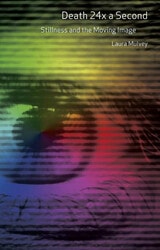
Death 24x a Second
Stillness and the Moving ImageLaura Mulvey
Reaktion Books, 2006
According to Mulvey, new media technologies give viewers the ability to control both image and story, so that movies meant to be seen collectively and followed in a linear fashion may be manipulated to contain unexpected and even unintended pleasures. The individual frame, the projected film’s best-kept secret, can now be revealed by anyone who hits pause. Easy access to repetition, slow motion, and the freeze-frame, Mulvey argues, may shift the spectator’s pleasure to a fetishistic rather than a voyeuristic investment in film.
By exploring how technology can give new life to old cinema, Death 24x a Second offers an original reevaluation of film’s history and its historical usefulness.
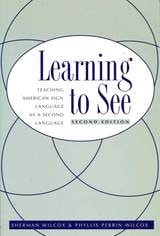
Learning To See
American Sign Language as a Second LanguageSherman Wilcox
Gallaudet University Press, 1997
Learning to See lays solid groundwork for teaching and studying ASL by outlining the structure of this unique visual language. Myths and misconceptions about ASL are laid to rest at the same time that the fascinating, multifaceted elements of Deaf culture are described. Students will be able to study ASL and gain a thorough understanding of the cultural background, which will help them to grasp the language more easily. An explanation of the linguistic basis of ASL follows, leading into the specific, and above all, useful information on teaching techniques.
This practical manual systematically presents the steps necessary to design a curriculum for teaching ASL, including the special features necessary for training interpreters. The new Learning to See again takes its place at the forefront of texts on teaching ASL as a second language, and it will prove to be indispensable to educators and administrators in this special discipline.
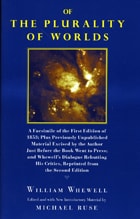
Of the Plurality of Worlds
A facsimile of the first edition of 1853; plus previously unpublished material excised by the author just before the book went to press; and Whewell's dialogue rebutting his critics, reprinted from the second editionWilliam Whewell
University of Chicago Press, 2001
The publication of Plurality in 1853 ignited a bitter Victorian debate on science and religion. This book reprints the first edition in facsimile, together with a vigorous response to his critics that Whewell added later and new introductory and bibliographic material by noted Darwin scholar Michael Ruse. This edition also includes 84 typeset pages—never before published—that Whewell cut from the original book at the last moment. Showing clearly the theological underpinnings of Whewell's thinking, these chapters also reveal the difficulties facing any Victorian who tried to reconcile traditional Christian thought with the findings of modern science.
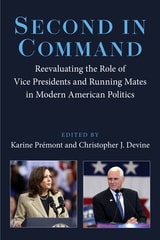
Second in Command
Reevaluating the Role of Vice Presidents and Running Mates in Modern American PoliticsEdited by Karine Prémont and Christopher J. Devine
University of Michigan Press, 2026
In recent years, the office of the vice president has become a focal point of presidential politics and governance. From the emergence of the modern vice presidency under Walter Mondale to Mike Pence’s and Kamala Harris’s dramatic influence on the outcome of the 2020 election, Second in Command explores how vice presidents and vice-presidential candidates have shaped the direction of the country and changed American politics. The frenzy of speculation surrounding the “veepstakes” every four years and extensive media coverage of the vice-presidential debate may seem odd, given the vice presidency’s limited constitutional powers and dismal public reputation.
Dispelling the myth that the vice presidency is a powerless or merely ceremonial role, Second in Command draws on the multidisciplinary expertise of more than a dozen leading vice-presidential scholars to reveal the complex, consequential, and often misunderstood nature of the office. With accessible language and vivid examples, it traces the transformation of vice-presidential power over the past half-century, reveals the evolving electoral significance of vice-presidential running mates, and highlights the need for a deeper public understanding of these pivotal figures. Chapters employ a range of qualitative and quantitative methodologies, including elite interviews, archival research, case studies, and advanced statistical modeling to cover topics such as gender and media effects in running mate selection and the representation of vice presidents in popular culture. This book offers a fresh, engaging, and essential perspective on a vital institution at the heart of American democracy.