Results by title
2 books match the query 'Second Ghetto'
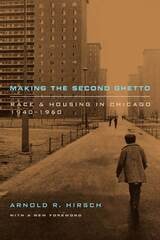
Making the Second Ghetto
Race and Housing in Chicago 1940-1960Arnold R. Hirsch
University of Chicago Press, 1998
In Making the Second Ghetto, Arnold Hirsch argues that in the post-depression years Chicago was a "pioneer in developing concepts and devices" for housing segregation. Hirsch shows that the legal framework for the national urban renewal effort was forged in the heat generated by the racial struggles waged on Chicago's South Side. His chronicle of the strategies used by ethnic, political, and business interests in reaction to the great migration of southern blacks in the 1940s describes how the violent reaction of an emergent "white" population combined with public policy to segregate the city.
"In this excellent, intricate, and meticulously researched study, Hirsch exposes the social engineering of the post-war ghetto."—Roma Barnes, Journal of American Studies
"According to Arnold Hirsch, Chicago's postwar housing projects were a colossal exercise in moral deception. . . . [An] excellent study of public policy gone astray."—Ron Grossman, Chicago Tribune
"An informative and provocative account of critical aspects of the process in [Chicago]. . . . A good and useful book."—Zane Miller, Reviews in American History
"A valuable and important book."—Allan Spear, Journal of American History
[more]
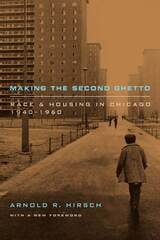
Making the Second Ghetto
Race and Housing in Chicago, 1940-1960Arnold R. Hirsch
University of Chicago Press, 2021
First published in 1983 and praised by the likes of Ta-Nehisi Coates and Thomas Sugrue, Arnold R. Hirsch’s Making the Second Ghetto is the rare book that has only become more piercingly prescient over the years.
Hirsch’s classic and groundbreaking work of urban history is a revelatory look at Chicago in the decades after the Great Depression, a period when the city dealt with its rapidly growing Black population not by working to abolish its stark segregation but by expanding and solidifying it. Even as the civil rights movement rose to prominence, Chicago exploited a variety of methods of segregation—including riots, redevelopment, and a host of new legal frameworks—that provided a national playbook for the emergence of a new kind of entrenched inequality. Hirsch’s chronicle of the strategies employed by ethnic, political, and business interests in reaction to the Great Migration of Southern Blacks in the mid-twentieth century makes startingly clear how the violent reactions of an emergent white population found common ground with policy makers to segregate first a city and then the nation.
This enlarged edition of Making the Second Ghetto features a visionary afterword by historian N. D. B. Connolly, explaining why Hirsch’s book still crackles with “blistering relevance” for contemporary readers.
[more]