Results by title
2 books match the query 'Second Reconstruction'
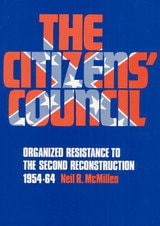
The Citizens' Council
Organized Resistance to the Second Reconstruction, 1954-64Neil R. McMillen
University of Illinois Press, 1971
and decline of the Citizens' Councils of America details the organization's
role in the massive resistance to school desegregation in the South following
the 1954 Brown vs. Board of Education decision. Included are a new preface and
updated bibliography.
"A tour de force of research and
narration. . . in highly readable style. [McMillen] . . . seems to have read
everything the historical record has to offer on the subject and to have known
exactly what to make of it. . . Himself squarely on the side of the future,
he is sensitive to the anguish that prompted the hysteria of the misguided racist. . . .
By any test, a masterful study." -- Journal of Southern History
"Takes seriously the people who
made the movement, when ridicule and caricature would have been an easier analytical
technique. Solidly researched and well written. . . an intriguing story." --
Augustus M. Burns, Social Studies
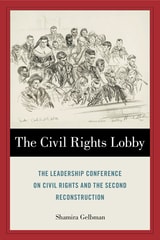
The Civil Rights Lobby
The Leadership Conference on Civil Rights and the Second ReconstructionShamira Gelbman
Temple University Press, 2021
As the lobbying arm of the civil rights movement, the Leadership Conference on Civil Rights (LCCR)—which has operated since the early 1950s—was instrumental in the historic legislative breakthroughs of the Second Reconstruction. The Civil Rights Lobby skillfully recounts the LCCR’s professional and grassroots lobbying that contributed to these signature civil rights policy achievements in the 1950s and ’60s.
Shamira Gelbman explains how the diversity of this interest group coalition both hindered and enabled lobbyists to generate broad-based support for reforms that often seemed risky to legislators. They coordinated their efforts by identifying common ground among member organizations, developing coalitional positions on substantive and strategic questions, and exhorting organizations to mobilize professional and grassroots lobbying resources accordingly. The result was to “speak with one booming voice” to ultimately help secure the passage of the Civil Rights Act of 1964.
The Civil Rights Lobby concludes by reprising key lessons from the LCCR’s organizational development and participation in civil rights policymaking. Gelbman suggests new directions for research on interest group coalitions and explores how the Leadership Conference’s experience sheds light on the politics of the Second Reconstruction.