Results by title

6 books match the query 'Second-wave feminism'
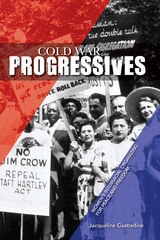
cover of Cold War Progressives: Women's Interracial Organizing for Peace and Freedom

Cold War Progressives

Women's Interracial Organizing for Peace and Freedom

Jacqueline Castledine

University of Illinois Press, 2012

In recognizing the relation between gender, race, and class oppression, American women of the postwar Progressive Party made the claim that peace required not merely the absence of violence, but also the presence of social and political equality. For progressive women, peace was the essential thread that connected the various aspects of their activist agendas. This study maps the routes taken by postwar popular front women activists into peace and freedom movements of the 1960s and 1970s. Historian Jacqueline Castledine tells the story of their decades-long effort to keep their intertwined social and political causes from unraveling and to maintain the connections among peace, feminism, and racial equality.
 
Postwar progressive women and their allies often saw themselves as members of a popular front promoting the rights of workers, women, and African Americans under the banner of peace. However, the Cold War indelibly shaped the contours of their activism. Following the Progressive Party's demise in the 1950s, these activists reentered social and political movements in the early 1960s and met the inescapable reality that their agenda was a casualty of the left-liberal political division of the early Cold War era. Many Americans now viewed peace as a leftist concern associated with Soviet sympathizers and civil rights as the favored cause of liberals. Faced with the dilemma of working to reunite these movements or choosing between them, some progressive women chose to lead such New Left organizations as the Jeannette Rankin Brigade while others became leaders of liberal "second wave" feminist movements.
 
Whether they committed to affiliating with groups that emphasized one issue over others or attempted to found groups with broad popular-front type agendas, Progressive women brought to their later work an understanding of how race, class, and gender intersect in women's organizing. These women's stories demonstrate that the ultimate result of Cold War-era McCarthyism was not the defeat of women's activism, but rather its reconfiguration.
[more]
cover of Daring to Care: American Nursing and Second-Wave Feminism

Daring to Care

American Nursing and Second-Wave Feminism

Susan Gelfand Malka

University of Illinois Press, 2007
Beginning in the 1960s, second-wave feminism inspired and influenced dramatic changes in the nursing profession. Susan Gelfand Malka argues that feminism helped end nursing's subordination to medicine and provided nurses with greater autonomy and professional status. She discusses two distinct eras in nursing history. The first extended from the mid-1960s to the mid-1980s, when feminism seemed to belittle the occupation in its analysis of gender subordination but also fueled nursing leaders' drive for greater authority and independence. The second era began in the mid-1980s, when feminism grounded in the ethics of care appealed to a much broader group of caregivers and was incorporated into nursing education. While nurses accepted aspects of feminism, they did not necessarily identify as feminists. Nonetheless, they used, passed on, and developed feminist ideas that brought about nursing school curricula changes and the increase in self-directed and specialized roles available to caregivers in the twenty-first century.
[more]
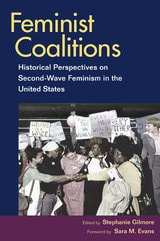
cover of Feminist Coalitions: Historical Perspectives on Second-Wave Feminism in the United States

Feminist Coalitions

Historical Perspectives on Second-Wave Feminism in the United States

Edited by Stephanie Gilmore. Foreword by Sara Evans.

University of Illinois Press, 2007

Much of the scholarship on second-wave feminism has focused on divisions within the women's movement and its narrow conception of race and class, but the contributors to this volume remind readers that feminists in the 1960s and 1970s also formed many strong partnerships, often allying themselves with a diverse range of social justice efforts on a local grassroots level. These essays focus on coalitions and alliances in which feminists and other activists joined forces to address crucial social justice issues such as reproductive rights, the peace movement, women's health, Christianity and other religions, and neighborhood activism, as well as alliances crossing boundaries of race, class, political views, and sexual identity. The contributors bring fresh perspectives to feminist history by calling attention to how women struggled to include and represent diverse women without minimizing the difficulties of conceptualizing a singular feminism. 

Contributors are Maria Bevacqua, Tamar Carroll, Marisa Chappell, Andrea Estepa, Sara M. Evans, Amy Farrell, Stephanie Gilmore, Cynthia Harrison, Elizabeth Kaminski, Wendy Kline, Premilla Nadasen, Caryn Neumann, Anne M. Valk, and Emily Zuckerman.

[more]
cover of No Permanent Waves: Recasting Histories of U.S. Feminism

No Permanent Waves

Recasting Histories of U.S. Feminism

Hewitt, Nancy A

Rutgers University Press, 2010

No Permanent Waves boldly enters the ongoing debates over the utility of the "wave" metaphor for capturing the complex history of women's rights by offering fresh perspectives on the diverse movements that comprise U.S. feminism, past and present. Seventeen essays--both original and reprinted--address continuities, conflicts, and transformations among women's movements in the United States from the early nineteenth century through today.

A respected group of contributors from diverse generations and backgrounds argue for new chronologies, more inclusive conceptualizations of feminist agendas and participants, and fuller engagements with contestations around particular issues and practices. Race, class, and sexuality are explored within histories of women's rights and feminism as well as the cultural and intellectual currents and social and political priorities that marked movements for women's advancement and liberation. These essays question whether the concept of waves surging and receding can fully capture the complexities of U.S. feminisms and suggest models for reimagining these histories from radio waves to hip-hop.
[more]
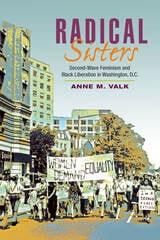
cover of Radical Sisters: Second-Wave Feminism and Black Liberation in Washington, D.C.

Radical Sisters

Second-Wave Feminism and Black Liberation in Washington, D.C.

Anne M. Valk

University of Illinois Press, 2010

Radical Sisters offers a fresh exploration of the ways that 1960s political movements shaped local, grassroots feminism in Washington, D.C. Rejecting notions of a universal sisterhood, Anne M. Valk argues that activists periodically worked to bridge differences for the sake of alleviating women's plight, even while maintaining distinct political bases. While most historiography on the subject tends to portray the feminist movement as deeply divided over issues of race, Valk presents a more nuanced account, showing feminists of various backgrounds both coming together to promote a notion of "sisterhood" and being deeply divided along the lines of class, race, and sexuality.
[more]
cover of This Book Is an Action: Feminist Print Culture and Activist Aesthetics

This Book Is an Action

Feminist Print Culture and Activist Aesthetics

Edited by Jaime Harker and Cecilia Konchar Farr

University of Illinois Press, 2016

The Women's Liberation Movement held a foundational belief in the written word's power to incite social change. In this new collection, Jaime Harker and Cecilia Konchar Farr curate essays that reveal how second-wave feminists embraced this potential with a vengeance. The authors in This Book Is an Action investigate the dynamic print culture that emerged as the feminist movement reawakened in the late 1960s. The works created by women shined a light on taboo topics and offered inspiring accounts of personal transformation. Yet, as the essayists reveal, the texts represented something far greater: a distinct and influential American literary renaissance. On the one hand, feminists took control of the process by building a network of publishers and distributors owned and operated by women. On the other, women writers threw off convention to venture into radical and experimental forms, poetry, and genre storytelling, and in so doing created works that raised the consciousness of a generation. Examining feminist print culture from its structures and systems to defining texts by Margaret Atwood and Alice Walker, This Book Is an Action suggests untapped possibilities for the critical and aesthetic analysis of the diverse range of literary production during feminism's second wave.
[more]