Results by title
10 books match the query 'Secret History'

Improbable Patriot
The Secret History of Monsieur de Beaumarchais, the French Playwright Who Saved the American RevolutionHarlow Giles Unger
Brandeis University Press, 2026
In 1776, the playwright and inventor Pierre-Augustin Caron de Beaumarchais (1732–99) conceived an audacious plan to send aid to the American rebels. What’s more, he convinced King Louis XVI to bankroll the project and single-handedly carried it out. By war’s end, he had supplied Washington’s army with most of its weapons and powder, though he was never paid or acknowledged by the United States. To some, he was a dashing hero, a towering intellect who saved the American Revolution. To others, he was a pure rogue, a double-dealing adventurer who stopped at nothing to advance his fame and fortune. In fact, he was both, and more: an advisor to kings, an arms dealer, and an author of some of the most enduring works of the stage, including The Marriage of Figaro and The Barber of Seville. Now in paperback, Improbable Patriot introduces readers to an unrecognized power player in the Revolutionary War.

Improbable Patriot
The Secret History of Monsieur de Beaumarchais, the French Playwright Who Saved the American RevolutionHarlow Giles Unger
University Press of New England, 2011

Inside the Klavern
The Secret History of a Ku Klux Klan of the 1920sEdited by David A. Horowitz
Southern Illinois University Press, 1999
Inside the Klavern is an annotated collection of the minutes of a thriving Ku Klux Klan in La Grande, Oregon, between 1922 and 1924. The most complete set of Klan minutes ever uncovered, these documents illustrate the inner workings of a Klan chapter of more than three hundred members at a time when the national membership reached into the millions and the Invisible Empire was at the peak of its power. Through an extensive introduction and conclusion as well as brief notes previewing each installment of the minutes, David A. Horowitz places these unique documents in historical perspective.
The La Grande minutes demonstrate Klan hostility to Roman Catholics, Jews, blacks, and "hyphenated" Americans. But they also explain how the chapter exercised requirements for admission, how officers were selected, and how Klansmen encountered difficulties enforcing the moral standards of their order. Because the Klan kligrapp (recording secretary) Harold R. Fosner recorded not only the official proceedings but also volunteered extemporaneous comments and gossip, readers get a genuine feeling for what it was like to attend the meetings. Through his own obvious excitement and commitment to the cause, Fosner re-creates the flavor, tone, and atmosphere of these meetings: "Tis beyond my power of expression to relate the harmony and fellowship which reigned supreme. . . . Suffice to say that these were the golden moments of our lives."
His evaluation of Klan propaganda, too, is telling: "The weekly newsletter from Atlanta, Georgia, contained a little book, the official message of our emperor, one Col. William Joseph Simmons, read before the most noble band of men ever assembled and for the noblest cause in the world. To my firm belief this book is the leading masterpiece of our day and age."
Horowitz concludes that "although it is tempting to judge Jazz Age Klansmen by the standards of later generations, the story provided by the minutes is a complex one—a chronicle of both compassion and complicity in cruelty, of positive social accomplishment and arbitrary and dysfunctional divisiveness."
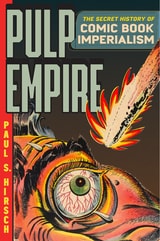
Pulp Empire
The Secret History of Comic Book ImperialismPaul S. Hirsch
University of Chicago Press, 2021
In the 1940s and ’50s, comic books were some of the most popular—and most unfiltered—entertainment in the United States. Publishers sold hundreds of millions of copies a year of violent, racist, and luridly sexual comics to Americans of all ages until a 1954 Senate investigation led to a censorship code that nearly destroyed the industry. But this was far from the first time the US government actively involved itself with comics—it was simply the most dramatic manifestation of a long, strange relationship between high-level policy makers and a medium that even artists and writers often dismissed as a creative sewer. In Pulp Empire, Paul S. Hirsch uncovers the gripping untold story of how the US government both attacked and appropriated comic books to help wage World War II and the Cold War, promote official—and clandestine—foreign policy and deflect global critiques of American racism.
As Hirsch details, during World War II—and the concurrent golden age of comic books—government agencies worked directly with comic book publishers to stoke hatred for the Axis powers while simultaneously attempting to dispel racial tensions at home. Later, as the Cold War defense industry ballooned—and as comic book sales reached historic heights—the government again turned to the medium, this time trying to win hearts and minds in the decolonizing world through cartoon propaganda.
Hirsch’s groundbreaking research weaves together a wealth of previously classified material, including secret wartime records, official legislative documents, and caches of personal papers. His book explores the uneasy contradiction of how comics were both vital expressions of American freedom and unsettling glimpses into the national id—scourged and repressed on the one hand and deployed as official propaganda on the other. Pulp Empire is a riveting illumination of underexplored chapters in the histories of comic books, foreign policy, and race.
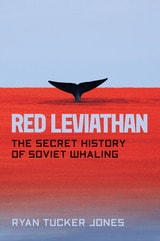
Red Leviathan
The Secret History of Soviet WhalingRyan Tucker Jones
University of Chicago Press, 2022
The Soviet Union killed over six hundred thousand whales in the twentieth century, many of them illegally and secretly. That catch helped bring many whale species to near extinction by the 1970s, and the impacts of this loss of life still ripple through today’s oceans. In this new account, based on formerly secret Soviet archives and interviews with ex-whalers, environmental historian Ryan Tucker Jones offers a complete history of the role the Soviet Union played in the whales’ destruction. As other countries—especially the United States, Great Britain, Japan, and Norway—expanded their pursuit of whales to all corners of the globe, Stalin determined that the Soviet Union needed to join the hunt. What followed was a spectacularly prodigious, and often wasteful, destruction of humpback, fin, sei, right, and sperm whales in the Antarctic and the North Pacific, done in knowing violation of the International Whaling Commission’s rules. Cold War intrigue encouraged this destruction, but, as Jones shows, there is a more complex history behind this tragic Soviet experiment. Jones compellingly describes the ultimate scientific irony: today’s cetacean studies benefited from Soviet whaling, as Russian scientists on whaling vessels made key breakthroughs in understanding whale natural history and behavior. And in a final twist, Red Leviathan reveals how the Soviet public began turning against their own country’s whaling industry, working in parallel with Western environmental organizations like Greenpeace to help end industrial whaling—not long before the world’s whales might have disappeared altogether.

Secret History
Procopius
University of Michigan Press, 1961
. . . How the Great General Belisarius was hoodwinked by his wife, whose lover became a monk.
. . . How Theodora, most depraved of all empresses, won Justinian's love.
. . . How she saved five hundred harlots from a life of sin, made off with her own natural son, and other curious incidents of her passion.
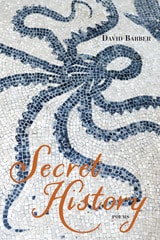
Secret History
PoemsDavid Barber
Northwestern University Press, 2020
In David Barber’s third collection of poetry, the past makes its presence felt from first to last. Drawing on a wealth of eclectic sources and crafted in an array of nonce forms, these poems range across vast stretches of cultural and natural history in pursuit of the forsaken, long-gone, and unsung.
Here is the stuff of lost time unearthed from all over: ballyhoo and murder ballad, the lacrimarium and the xylotheque, the Game of Robbers and the Indian Rope Trick, the obsolete o’o, the old-school word hoard, sunshowers and beaters and breaker boys. Here, to mark the twilight of print and type, are gleanings and borrowings from a mixed bag of throwback bound volumes: The Magic Moving Picture Book, Mandeville’s Travels, The Golden Bough, Franklin Arithmetic, The Millennial Laws of the Shakers, A Conjuror’s Confessions.
Here too are guiding spirits whose like will not pass this way again: Cab Calloway at the Cotton Club; Henry Walter Bates in darkest Amazon; George Catlin among the Choctaw; Little Nemo in Slumberland; Yogi Berra in all his oracular glory. Reveling in vernacular lingo of every vintage even while brooding on dark ages without end, Secret History chronicles a world of long shadows and distant echoes that bears more than a passing resemblance to our own.

The Secret History of Emotion
From Aristotle's Rhetoric to Modern Brain ScienceDaniel M. Gross
University of Chicago Press, 2006
Through a radical rereading of Aristotle, Seneca, Thomas Hobbes, Sarah Fielding, and Judith Butler, among others, Daniel M. Gross reveals a persistent intellectual current that considers emotions as psychosocial phenomena. In Gross’s historical analysis of emotion, Aristotle and Hobbes’s rhetoric show that our passions do not stem from some inherent, universal nature of men and women, but rather are conditioned by power relations and social hierarchies. He follows up with consideration of how political passions are distributed to some people but not to others using the Roman Stoics as a guide. Hume and contemporary theorists like Judith Butler, meanwhile, explain to us how psyches are shaped by power. To supplement his argument, Gross also provides a history and critique of the dominant modern view of emotions, expressed in Darwinism and neurobiology, in which they are considered organic, personal feelings independent of social circumstances.
The result is a convincing work that rescues the study of the passions from science and returns it to the humanities and the art of rhetoric.

The Water Kingdom
A Secret History of ChinaPhilip Ball
University of Chicago Press, 2017
Water, Ball shows, is a key that unlocks much of Chinese culture. In The Water Kingdom, he takes us on a grand journey through China’s past and present, showing how the complexity and energy of the country and its history repeatedly come back to the challenges, opportunities, and inspiration provided by the waterways. Drawing on stories from travelers and explorers, poets and painters, bureaucrats and activists, all of whom have been influenced by an environment shaped and permeated by water, Ball explores how the ubiquitous relationship of the Chinese people to water has made it an enduring metaphor for philosophical thought and artistic expression. From the Han emperors to Mao, the ability to manage the waters ― to provide irrigation and defend against floods ― was a barometer of political legitimacy, often resulting in engineering works on a gigantic scale. It is a struggle that continues today, as the strain of economic growth on water resources may be the greatest threat to China’s future.
The Water Kingdom offers an unusual and fascinating history, uncovering just how much of China’s art, politics, and outlook have been defined by the links between humanity and nature.
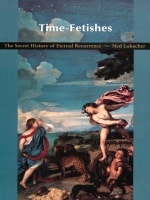
Time-Fetishes
The Secret History of Eternal RecurrenceNed Lukacher
Duke University Press, 1999
The thinkers in this counter-history of the eternal return lingered long enough on the question of time to learn how to resist separating eternity from time, and how to reflect on the possible identity of time and eternity as a way of resisting all prior metaphysical determinations. Drawing out the implications of Nietzsche’s reinvention of the doctrine of return, Lukacher ranges across a broad spectrum of ancient and modern thinkers. Shakespeare’s role in this history as the “poet of time” is particularly significant, for not only does Shakespeare reactivate the pre-Christian arguments of eternal return, he regards them, and all arguments and images concerning the essence of time and Being, from an inimitably ironic perspective.
As he makes transitions from literature to philosophy and psychoanalysis, Lukacher displays a theoretical imagination and historical vision that bring to the forefront a host of pre- and post-Christian texts in order to decipher in them an encounter with the thought of eternal recurrence that has been too long buried under layers of rigid metaphysical interpretation.