Results by title
6 books match the query 'Secret societies'
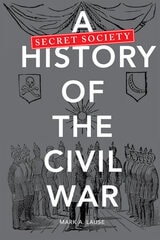
A Secret Society History of the Civil War
Mark A. Lause
University of Illinois Press, 2014
Antebellum secret societies ranged politically from those with progressive or even revolutionary agendas to those that pursued conservative or oppressive goals. This book shows how, in the years leading up to the Civil War, these clandestine organizations exacerbated existing sectional tensions in the United States. Lause's research indicates that the pervasive influence of secret societies may have played a part in key events such as the Freesoil movement, the beginning of the Republican party, John Brown's raid on Harpers Ferry, Lincoln's election, and the Southern secession process of 1860-1861.
This exceptional study encompasses both white and African American secret society involvement, revealing the black fraternal experience in antebellum America as well as the clandestine operations that provided assistance to escaped slaves via the Underground Railroad. Unraveling these pervasive and extensive networks of power and influence, A Secret Society History of the Civil War demonstrates that antebellum secret societies played a greater role in affecting Civil War-era politics than has been previously acknowledged.
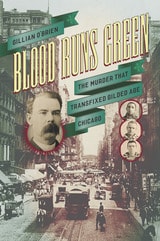
Blood Runs Green
The Murder That Transfixed Gilded Age ChicagoGillian O'Brien
University of Chicago Press, 2015
It was the biggest funeral Chicago had seen since Lincoln’s. On May 26, 1889, four thousand mourners proceeded down Michigan Avenue, followed by a crowd forty thousand strong, in a howl of protest at what commentators called one of the ghastliest and most curious crimes in civilized history. The dead man, Dr. P. H. Cronin, was a respected Irish physician, but his brutal murder uncovered a web of intrigue, secrecy, and corruption that stretched across the United States and far beyond.
Blood Runs Green tells the story of Cronin’s murder from the police investigation to the trial. It is a story of hotheaded journalists in pursuit of sensational crimes, of a bungling police force riddled with informers and spies, and of a secret revolutionary society determined to free Ireland but succeeding only in tearing itself apart. It is also the story of a booming immigrant population clamoring for power at a time of unprecedented change.
From backrooms to courtrooms, historian Gillian O’Brien deftly navigates the complexities of Irish Chicago, bringing to life a rich cast of characters and tracing the spectacular rise and fall of the secret Irish American society Clan na Gael. She draws on real-life accounts and sources from the United States, Ireland, and Britain to cast new light on Clan na Gael and reveal how Irish republicanism swept across the United States. Destined to be a true crime classic, Blood Runs Green is an enthralling tale of a murder that captivated the world and reverberated through society long after the coffin closed.
Fine Boys
A NovelEghosa Imasuen
Ohio University Press, 2021
A coming-of-age tale told from the perspective of Nigeria’s Generation X, caught amid the throes of a nascent pro-democracy movement, demoralizing corruption, and campus violence.
Ewaen is a Nigerian teenager, bored at home in Warri and eager to flee from his parents’ unhappy marriage and incessant quarreling. When Ewaen is admitted to the University of Benin, he makes new friends who, like him, are excited about their newfound independence. They hang out in parking lots, trading gibes in pidgin and English and discovering the pleasures that freedom affords them. But when university strikes begin and ruthlessly violent confraternities unleash mayhem on their campus, Ewaen and his new friends must learn to adapt—or risk becoming the confras' next unwilling recruits.
In his trademark witty, colloquial style, critically acclaimed author Eghosa Imasuen presents everyday Nigerian life against the backdrop of the pro-democracy riots of the 1980s and 1990s, the lost hopes of June 12 (Nigeria’s Democracy Day), and the terror of the Abacha years. Fine Boys is a chronicle of time, not just in Nigeria, but also for its budding post-Biafran generation.
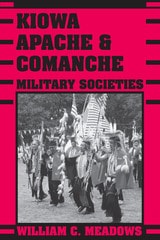
Kiowa, Apache, and Comanche Military Societies
Enduring Veterans, 1800 to the PresentBy William C. Meadows
University of Texas Press, 1999
A CHOICE Outstanding Academic Book
For many Plains Indians, being a warrior and veteran has long been the traditional pathway to male honor and status. Men and boys formed military societies to celebrate victories in war, to perform community service, and to prepare young men for their role as warriors and hunters. By preserving cultural forms contained in song, dance, ritual, language, kinship, economics, naming, and other semireligious ceremonies, these societies have played an important role in maintaining Plains Indian culture from the pre-reservation era until today.
In this book, Williams C. Meadows presents an in-depth ethnohistorical survey of Kiowa, Apache, and Comanche military societies, drawn from extensive interviews with tribal elders and military society members, unpublished archival sources, and linguistic data. He examines their structure, functions, rituals, and martial symbols, showing how they fit within larger tribal organizations. And he explores how military societies, like powwows, have become a distinct public format for cultural and ethnic continuity.
Secrecy and Cultural Reality
Utopian Ideologies of the New Guinea Men's HouseGilbert Herdt
University of Michigan Press, 2003
Secrecy
Silence, Power, and ReligionHugh B. Urban
University of Chicago Press, 2021
With Secrecy, Urban investigates several revealing instances of the power of secrecy in religion, including nineteenth-century Scottish Rite Freemasonry, the sexual magic of a Russian-born Parisian mystic; the white supremacist BrüderSchweigen or “Silent Brotherhood” movement of the 1980s, the Five Percenters, and the Church of Scientology. An electrifying read, Secrecy is the culmination of decades of Urban’s reflections on a vexed, ever-present subject.