Results by title
2 books match the query 'Secretum secretorum'
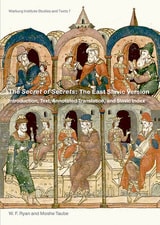
The Secret of Secrets
The East Slavic VersionEdited by W.F. Ryan and Moshe Taube
University of London Press, 2019
The original Arabic Secret of Secrets was probably compiled from multiple sources, and dates from about the tenth century. It purports to be the advice of Aristotle to his pupil Alexander the Great on all the knowledge - political, ethical, military, medical, and occult - needed by a great king. It was translated into Latin, Hebrew, and many European languages. It has been described as one of the most popular books of the Middle Ages. The Hebrew version was translated into a variety of East Slavic, probably in Kiev before 1483. This idiosyncratic version contains major interpolations: a physiognomy by Razes and treatises on poison, sex, and asthma by Maimonides. It is known to have been in the libraries of at least two tsars and two patriarchs in the 16th and 17th centuries. This annotated edition contains a historical introduction, the text, manuscript variants, an analytical glossary, and an English translation.
[more]
The Secret of Secrets
The Scholarly Career of a Pseudo-Aristotelian Text in the Latin Middle AgesSteven J. Williams
University of Michigan Press, 2003
The Secret of Secrets. The title alone promises the revelation of the most treasured arcana and piques our interest. Add the names of Aristotle and Alexander the Great, and our curiosity is securely engaged. Readers reacted similarly during the Latin Middle Ages. The work alleges to be an extended letter of advice sent by Aristotle to his former pupil Alexander the Great while the latter was on a campaign in Persia. It stood at the top of the "best-seller" list for hundreds of years and was read by two different audiences: scholars and laypersons. Steven J. Williams focuses his study on its reception by European scholars, starting with its translation into Latin during the High Middle Ages and carrying the story through to the time when scholarly attention waned around 1550.
An important medieval text that also provides a window onto medieval intellectual life, Secret of Secrets played a modest though significant role in medieval scholarly life: "significant" in that it was used in a variety of scholarly contexts, had some part to play in the scholarly controversies of the day, and was so often read that an impressive number of manuscripts are still extant today; "modest" in that it was cited much less frequently than the major works of its day.
Steven J. Williams is Associate Professor in the Department of History, New Mexico Highlands University.
[more]