Results by title
4 books match the query 'Secular Age'
Grace and Freedom in a Secular Age
Contingency, Vulnerability, and HospitalityPhilip J. Rossi
Catholic University of America Press, 2022
In the course of a long and distinguished academic and civic career, the Canadian philosopher Charles Taylor has been, for articulate atheists and learned believers alike, an incisive, insightful, gracious, and challenging conversation partner on issues that arise at the intersection and interaction of religion, society, and culture.
Grace and Freedom in a Secular Age offers a concise exposition of key ideas – contingency, otherness, freedom, vulnerability and mutuality – that inform his probing analyses of the dynamics of religious belief and religious denial in the pervasive contemporary culture he calls a “a secular age,” within which religious belief and practice have, for many, become just an option. Those ideas provide the basis from which Rossi argues that, despite a clear-eyed recognition of the deep fractures of meaning and the pervasive fragmentation of once stable societal connections that a secular age has brought in its wake, Taylor also sees and affirms strong grounds for hope in a healing of our broken and fractured world and for the possibilities—and the importance of—active human participation in that healing. Taylor points to signs indicative of potent re-compositions and renewals taking place in religious belief and practice from its interaction with the dynamics of secular culture, particularly ones that make possible radical enactments of deeper human solidarity and mutuality, of which the one most often potent is the reconciliation of enemies. In pointing out these signs, Taylor suggests a richly expansive reading of the Christian doctrine of Creation, as it marks the radical contingency of all that is upon a freely bestowed divine self-giving: Creation is the ongoing enactment of the divine hospitality of the Triune God.
[more]
Law and Religion in a Secular Age
Rafael Domingo
Catholic University of America Press, 2023
Law and Religion in a Secular Age seeks to restore the connection between spirituality and justice, religion and law, theology and jurisprudence, and natural law and positive law by building a new bridge suitable for pluralistic societies in the secular age. The author argues for a multidimensional view of reality that includes legal, political, moral, and spiritual dimensions of human nature and society. Each of these dimensions of life needs to recognize the existence, influence, and function of the others, which act as a filter or check on the excesses of each other. This multidimensionality of reality clarifies why no legal theory can fully account for law from the legal dimension alone, just as no moral theory makes perfect sense of morality from the moral dimension—and, for that matter, nothing in physics can fully interpret the physical dimension of reality. The premises of a legal system cannot be fully explained by the legal dimension alone because the fundamental conditions and qualities of justice, freedom, and dignity touch all the dimensions of reality in which the human person acts, including the moral and the spiritual, not just the legal. Building on this multidimensional theory of reality, the author explores the core differences and the essential interconnections between law, morality, religion, and spirituality and some of the legal implications of these connections.
Rafael Domingo reminds readers of the vital role of religion in shaping the conceptual framework of Western legal systems, underscores the spirit of Christianity that inspired legal institutions, principles, and values, and recalls the contributions of specific Christian jurists as central figures for the development of justice in society.
Law and Religion in a Secular Age aims to be a valuable antidote against the dominant legal positivism that has cornered public morality, the defiant secularism that has marginalized religion, and any other legal doctrine that diminishes the spiritual dimension of law and justice.
[more]
Preaching to Convert
Evangelical Outreach and Performance Activism in a Secular AgeJohn Fletcher
University of Michigan Press, 2015
Preaching to Convert offers an intriguing new perspective on the outreach strategies of U.S. evangelicals, framing them as examples of activist performance, broadly defined as acts performed before an audience in the hopes of changing hearts and minds. Most writing about activist performance has focused on left-progressive causes, events, and actors. Preaching to Convert argues against such a constricted view of activism and for a more nuanced understanding of U.S. evangelicalism as a movement defined by its desire to win converts and spread the gospel.
The book positions evangelicals as a diverse, complicated group confronting the loss of conservative Christianity’s default status in 21st-century U.S. culture. In the face of an increasingly secular age, evangelicals have been reassessing models of outreach. In acts like handing out Bible tracts to strangers on the street or going door-to-door with a Bible in hand, in elaborately staged horror-themed morality plays or multimillion-dollar creationist discovery centers, in megachurch services beamed to dozens of satellite campuses, and in controversial “ex-gay” ministries striving to return gays and lesbians to the straight and narrow, evangelicals are redefining what it means to be deeply committed in a pluralist world. The book’s engaging style and careful argumentation make it accessible and appealing to scholars and students across a range of fields.
The book positions evangelicals as a diverse, complicated group confronting the loss of conservative Christianity’s default status in 21st-century U.S. culture. In the face of an increasingly secular age, evangelicals have been reassessing models of outreach. In acts like handing out Bible tracts to strangers on the street or going door-to-door with a Bible in hand, in elaborately staged horror-themed morality plays or multimillion-dollar creationist discovery centers, in megachurch services beamed to dozens of satellite campuses, and in controversial “ex-gay” ministries striving to return gays and lesbians to the straight and narrow, evangelicals are redefining what it means to be deeply committed in a pluralist world. The book’s engaging style and careful argumentation make it accessible and appealing to scholars and students across a range of fields.
[more]
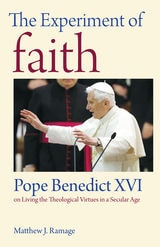
The Experiment of Faith
Pope Benedict XVI on Living the Theological Virtues in a Secular AgeCatholic University of America Press, 2020
Pope Benedict XVI memorably remarked that the Christian faith is a lot like a Gothic cathedral with its stained-glass windows. From the outside, the Church can appear dark, dreary, and worn with age—the crumbling relic of an institution that no longer speaks to men and women living in our modern world. Indeed, for many people today, Christian morality with all of its commandments appears to be a source not of life and joy but instead of suffering and oppression. Even within the Church, many wonder: why should I submit to ancient doctrines and outdated practices that restrict my freedom and impede my happiness?
In this timely and original book, his third exploring the riches of Benedict XVI’s vast corpus, theologian Matthew Ramage sets out to meet this challenge with an in-depth study of the emeritus pontiff’s wisdom on how to live Christian discipleship in today’s increasingly secularized world. Taking as his starting point Benedict’s conviction that the truth of Christianity—like the beauty of a cathedral’s glorious windows—can be grasped only from the inside, Ramage draws on Benedict’s insights to show how all Christians can make the “experiment of faith” by living the theological virtues of faith, hope, and charity in daily life. Along the way, he shares his personal reflections on how Benedict’s wisdom has helped him to navigate difficulties in embracing the faith and provides a way forward to those struggling to live as disciples in a way that is intellectually serious without remaining merely intellectual. In so doing, he also presents a highly nuanced yet accessible approach to defending the truth of the gospel in a world where life in Jesus Christ tends to be seen as unfulfilling, irrelevant, or just one lifestyle choice among others.
[more]