Results by title
6 books match the query 'Securities'
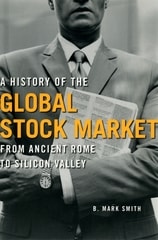
A History of the Global Stock Market
From Ancient Rome to Silicon ValleyB. Mark Smith
University of Chicago Press, 2004
Informative, entertaining, and written for specialists and non-specialists alike, A History of the Global Stock Market is a worthy read for anyone who wants to understand the role of the stock market in the global economy.
Asset Prices and Monetary Policy
Edited by John Y. Campbell
University of Chicago Press, 2008
The contributors examine how central bankers determine their policy prescriptions with reference to the fluctuating housing market, the balance of debt and credit, changing beliefs of investors, the level of commodity prices, and other factors. At a time when the public has never been more involved in stocks, retirement funds, and real estate investment, this insightful book will be useful to all those concerned with the current state of the economy.
Asymmetric Information, Corporate Finance, and Investment
Edited by R. Glenn Hubbard
University of Chicago Press, 1990
In this volume, specialists from traditionally separate areas in economics and finance investigate issues at the conjunction of their fields. They argue that financial decisions of the firm can affect real economic activity—and this is true for enough firms and consumers to have significant aggregate economic effects. They demonstrate that important differences—asymmetries—in access to information between "borrowers" and "lenders" ("insiders" and "outsiders") in financial transactions affect investment decisions of firms and the organization of financial markets. The original research emphasizes the role of information problems in explaining empirically important links between internal finance and investment, as well as their role in accounting for observed variations in mechanisms for corporate control.
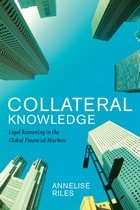
Collateral Knowledge
Legal Reasoning in the Global Financial MarketsAnnelise Riles
University of Chicago Press, 2011
Who are the agents of financial regulation? Is good (or bad) financial governance merely the work of legislators and regulators? Here Annelise Riles argues that financial governance is made not just through top-down laws and policies but also through the daily use of mundane legal techniques such as collateral by a variety of secondary agents, from legal technicians and retail investors to financiers and academics and even computerized trading programs.
Drawing upon her ten years of ethnographic fieldwork in the Japanese derivatives market, Riles explores the uses of collateral in the financial markets as a regulatory device for stabilizing market transactions. How collateral operates, Riles suggests, is paradigmatic of a class of low-profile, mundane, but indispensable activities and practices that are all too often ignored as we think about how markets should work and be governed. Riles seeks to democratize our understanding of legal techniques, and demonstrate how these day-to-day private actions can be reformed to produce more effective forms of market regulation.
The Internationalization of Equity Markets
Edited by Jeffrey A. Frankel
University of Chicago Press, 1994
Eight essays examine such issues as the current extent of international market integration, gains to U.S. investors through international diversification, home-country bias in investing, the role of time and location around the world in stock trading, and the behavior of country funds. Other, long-standing questions about equity markets are also addressed, including market efficiency and the accuracy of models of expected returns, with a particular focus on variances, covariances, and the price of risk according to the Capital Asset Pricing Model.
Wasting a Crisis
Why Securities Regulation FailsPaul G. Mahoney
University of Chicago Press, 2015
With Wasting a Crisis, Paul G. Mahoney offers persuasive research to show that this now almost universally accepted narrative of market failure—broadly similar across financial crises—is formulated by political actors hoping to deflect blame from prior policy errors. Drawing on a cache of data, from congressional investigations, litigation, regulatory reports, and filings to stock quotes from the 1920s and ’30s, Mahoney moves beyond the received wisdom about the financial reforms of the New Deal, showing that lax regulation was not a substantial cause of the financial problems of the Great Depression. As new regulations were formed around this narrative of market failure, not only were the majority largely ineffective, they were also often counterproductive, consolidating market share in the hands of leading financial firms. An overview of twenty-first-century securities reforms from the same analytic perspective, including Dodd-Frank and the Sarbanes-Oxley Act of 2002, shows a similar pattern and suggests that they too may offer little benefit to investors and some measurable harm.