Results by title
29 books match the query 'Security, International'
African Security
Local Issues and Global ConnectionsAbu Bakarr Bah
Ohio University Press, 2024
All International Politics Is Local
The Diffusion of Conflict, Integration, and DemocratizationKristian Skrede Gleditsch
University of Michigan Press, 2002
How does regional interdependence influence the prospects for conflict, integration, and democratization? Some researchers look at the international system at large and disregard the enormous regional variations. Others take the concept of sovereignty literally and treat each nation-state as fully independent. Kristian Skrede Gleditsch looks at disparate zones in the international system to see how conflict, integration, and democracy have clustered over time and space. He argues that the most interesting aspects of international politics are regional rather than fully global or exclusively national. Differences in the local context of interaction influence states' international behavior as well as their domestic attributes.
In All International Politics Is Local, Gleditsch clarifies that isolating the domestic processes within countries cannot account for the observed variation in distribution of political democracy over time and space, and that the likelihood of transitions is strongly related to changes in neighboring countries and the prior history of the regional context. Finally, he demonstrates how spatial and statistical techniques can be used to address regional interdependence among actors and its implications.
Kristian Skrede Gleditsch is Assistant Professor of Political Science at the University of California, San Diego.

Code of Peace
Ethics and Security in the World of the Warlord StatesDorothy V. Jones
University of Chicago Press, 1991
Jones focuses on the progressive development of international law to disclose an underlying code of ethics that enjoys broad support in the world community. Unlike studies that concentrate on what others think that states ought to do, Code of Peace analyzes what states themselves consider proper behavior. Using history as both narrative and argument, Jones shows how the existing ethical code has evolved cumulatively since World War I from a complex interplay between theory and practice. More than an abstract treatise or a merely technical analysis, Jones's study is grounded in the circumstances of war and peace in this century. Treaties and agreements, she argues, are forging a consensus on such principles as human rights, self-determination, and cooperation between states. Jones shows how leaders and representatives of nations, drawing on a rich heritage of philosophical thoughts as well as on their own experiences in a violent world of self-interested conflict, have shaped their thought to the taming of that world in the cause of peace. That is the striking thing about this code: states whose relations are marked by so frequent a recourse to war that they can fairly be called "warlords" have created and pledged themselves to a code of peace.
The implications of Code of Peace for establishing a normative foundation for peace are profound. Historically sound and timely, impeccably researched and elegantly written, the book will be of immediate and lasting value to anyone concerned with the stability of the modern world.
Collective Security beyond the Cold War
George W. Downs, Editor
University of Michigan Press, 1994
Conflict, Security, Foreign Policy, and International Political Economy
Past Paths and Future Directions in International StudiesMichael Brecher and Frank P. Harvey, editors
University of Michigan Press, 2009
No study of international relations is complete without consideration of foreign policy processes and an understanding of state security, conflict in global politics, and the relationship between the world economy and international behavior. Conflict, Security, Foreign Policy, and International Political Economy: Past Paths and Future Directions in International Studies consists of twelve original essays that point out the strengths and weaknesses of current approaches in these research areas as well as suggest agendas for future research.
See table of contents and excerpts.
Frank P. Harvey is Professor of Political Science and Director of the Centre for Foreign Policy Studies at Dalhousie University.
Michael Brecher is the R.B. Angus Professor of Political Science at McGill University and past president of the International Studies Association.
Millennial Reflections on International StudiesThis volume is part of the Millennial Reflections on International Studies project in which forty-five prominent scholars engage in self-critical, state-of-the-art reflection on international studies to stimulate debates about successes and failures and to address the larger questions of progress in the discipline.
Other paperbacks from this project:
Realism and Institutionalism in International Studies
Evaluating Methodology
Critical Perspectives in International Studies
The full collection of essays is available in the handbook Millennial Reflections on International Studies.

Conventional Arms Control and East-West Security
Robert D. Blackwill and F. Stephen Larrabee, eds.
Duke University Press, 1989

Core Europe and Greater Eurasia
A Roadmap for the FutureEdited by Peter W. Schulze
Campus Verlag, 2017
Defacing Power
The Aesthetics of Insecurity in Global PoliticsBrent J. Steele
University of Michigan Press, 2012
"Combining a rich and varied set of theoretical insights with a subtle analysis of the politics of American foreign policy, Defacing Power marks an important contribution toward understanding the power of identity in world politics. Engagingly written and rigorously argued, Steele's challenging analysis is incisive, important, and rewarding."
---Michael C. Williams, Graduate School of Public and International Affairs, University of Ottawa
"Brent Steele's marvelous excavation of the aesthetic dimensions of power is strikingly irreverent, inasmuch as he displays no commitment to ex ante disciplinary or substantive constraints in his quest to disclose those moments of creative action so often overlooked by theories and theorists wedded to the grandiose and the transhistorical. Steele samples and remixes a myriad of sources, arranging them so as to produce a transgressively insightful account of how 'work on the Self,' often condemned as self-indulgent by prior generations of intellectuals, might just point in the direction of a more sustainably secure world."
---Patrick Thaddeus Jackson, School of International Service, American University
"Defacing Power successfully integrates work from Dewey to Morgenthau to Foucault, as well as a wide range of contemporary international relations scholars, in its genealogy of power conceptualizations and characteristics. This book is theoretically sophisticated and serious. It should be of interest to students of international politics, international theory, social theory, and foreign policy."
---Cecelia Lynch, Center for Global Peace and Conflict Studies, University of California, Irvine
Defacing Power investigates how nation-states create self-images in part through aesthetics and how these images can be manipulated to challenge those states' power. Although states have long employed media, such as radio, television, and film, for their own image-making purposes, counterpower agents have also seized upon new telecommunications technologies. Most recently, the Internet has emerged as contested territory where states and other actors wage a battle of words and images.
Moving beyond theory, Brent Steele illustrates his provocative argument about the vulnerability of power with examples from recent history: the My Lai Massacre and the Tet Offensive, September 11 and the al-Qaeda communiqués, the atrocities at Fallujah and Abu Ghraib, and the U.S. response to the Asian tsunami of December 2004. He demonstrates how a nation-state---even one as powerful as the United States---comes to feel threatened not only by other nation-states or terrorist organizations but also by unexpected events that challenge its self-constructed image of security. At the same time, Steele shows that as each generation uses available media to create and re-create a national identity, technological innovations allow for the shifting, upheaval, and expansion of the cultural structure of a nation.
Brent J. Steele is Associate Professor of Political Science at the University of Kansas.
Defensive Internationalism
Providing Public Goods in an Uncertain WorldDavis B. Bobrow and Mark A. Boyer
University of Michigan Press, 2005
-Todd Sandler, Robert R. and Katheryn A. Dockson Professor of International Relations & Economics, University of Southern California
"Boyer and Bobrow's well-written, data-rich analysis of such pressing issues as development assistance, debt management, UN peacekeeping, and environmental protection makes Defensive Internationalism a highly original and provocative contribution to the study of global governance."
-Yale H. Ferguson, Co-Director, Center for Global Change and Governance, Rutgers University
In this pathbreaking study, authors Davis B. Bobrow and Mark A. Boyer argue for "muted optimism" about the future of international cooperation. Leaders of a growing movement that integrates constructivism into traditional international studies concepts and methods, Bobrow and Boyer analyze four key international issues: development cooperation, debt management, peacekeeping operations, and environmental affairs. Their approach integrates elements of public goods theory, identity theory, new institutionalism, and rational choice. Defensive Internationalism is a well-written, creative and coherent synthesis of ideas that have up to now been considered irreconcilable. It is appropriate for upper-level undergraduate and graduate students in international relations, conflict studies, and political economy, and promises to become a foundational work in its field.
Davis B. Bobrow is Professor of Public and International Affairs and Political Science at the University of Pittsburgh.
Mark A. Boyer is Professor of Political Science at the University of Connecticut.
Demilitarization in the Contemporary World
Edited by Peter N. Stearns
University of Illinois Press, 2013
In nine insightful chapters, this volume's contributors outline each nation's demilitarization choices and how they were made. They investigate factors such as military defeat, border security risks, economic pressures, and the development of strong peace cultures among citizenry. Also at center stage is the influence of the United States, which fills a paradoxical role as both an enabler of demilitarization and a leader in steadily accelerating militarization.
Bookended by Peter N. Stearns' thought-provoking historical introduction and forward-looking conclusion, the chapters in this volume explore what true demilitarization means and how it impacts a society at all levels, military and civilian, political and private. The examples chosen reveal that successful demilitarization must go beyond mere troop demobilization or arms reduction to generate significant political and even psychological shifts in the culture at large. Exemplifying the political difficulties of demilitarization in both its failures and successes, Demilitarization in the Contemporary World provides a possible roadmap for future policies and practices.

Divided Korea
Toward a Culture of ReconciliationRoland Bleiker
University of Minnesota Press, 2005
In 2002, North Korea precipitated a major international crisis when it revealed the existence of a secret nuclear weapons program and announced its withdrawal from the Nuclear Nonproliferation Treaty. Earlier in the year, George W. Bush had declared North Korea part of the “axis of evil,” and soon afterward his administration listed the country as a potential target of a preemptive nuclear strike. Pyongyang’s angry reaction ensured the complete deterioration of relations on the Korean peninsula, where only two years before the leaders of North and South Korea had come together in a historic summit meeting.
Few international conflicts are as volatile, protracted, or seemingly insoluble as the one in Korea, where mutual mistrust, hostile Cold War attitudes, and the possibility of a North Korean economic collapse threaten the security of the entire region. For Roland Bleiker, this persistently recurring pattern suggests profound structural problems within and between the two Koreas that have not been acknowledged until now. Expanding the discussion beyond geopolitics and ideology, Bleiker places peninsular tensions in the context of an ongoing struggle over competing forms of Korean identity. Divided Korea examines both domestic and international attitudes toward Korean identity, the legacy of war, and the possibilities for-and anxieties about-unification.
Divided Korea challenges the prevailing logic of confrontation and deterrence, embarking on a fundamental reassessment of both the roots of the conflict and the means to achieve a more stable political environment and, ultimately, peace. In order to realize a lasting solution, Bleiker concludes, the two Koreas and the international community must first show a willingness to accept difference and contemplate forgiveness as part of a broader reconciliation process.
Roland Bleiker is professor of international relations at the University of Queensland. From 1986 to 1988 he served as chief of office for the Swiss delegation to the Neutral Nations Supervisory Commission in Panmunjom.

Empire in Denial
The Politics of State-BuildingDavid Chandler
Pluto Press, 2006

Environmental Security
Simon Dalby
University of Minnesota Press, 2002
A critical look at the relationship between environmental degradation and international relations.
Since the end of the Cold War, environmental matters-especially the international implications of environmental degradation-have figured prominently in debates about rethinking security. But do the assumptions underlying such discussions hold up under close scrutiny? In this first treatment of environmental security from a truly critical perspective, Simon Dalby shows how attempts to explain contemporary insecurity falter over unexamined notions of both environment and security.
Adding environmental history, aboriginal perspectives, and geopolitics to the analysis explicitly suggests that the growing disruptions caused by a carbon-fueled and expanding modernity are at the root of contemporary difficulties. Environmental Security argues that rethinking security means revisiting questions of how we conceive identities as endangered and how we perceive threats to these identities. The book clearly demonstrates that the conceptual basis for critical security studies requires an extended engagement with political theory and with the assumptions of the modern subject as progressive political agent. Viewed thus on a global scale, the environmental security discourse raises profoundly troubling political questions as to who we are and what kind of world we are collectively making in our efforts to be secure.
Failed States and Fragile Societies
A New World Disorder?Ingo Trauschweizer
Ohio University Press, 2014
Since the end of the Cold War, a new dynamic has arisen within the international system, one that does not conform to established notions of the state’s monopoly on war. In this changing environment, the global community must decide how to respond to the challenges posed to the state by military threats, political and economic decline, and social fragmentation. This insightful work considers the phenomenon of state failure and asks how the international community might better detect signs of state decay at an early stage and devise legally and politically legitimate responses.
This collection of essays brings military and social historians into conversation with political and social scientists and former military officers. In case studies from the former Yugoslavia, Somalia, Iraq, and Colombia, the distinguished contributors argue that early intervention to stabilize social, economic, and political systems offers the greatest promise, whereas military intervention at a later stage is both costlier and less likely to succeed.
Contributors: David Carment, Yiagadeesen Samy, David Curp, Jonathan House, James Carter, Vanda Felbab-Brown, Robert Rotberg, and Ken Menkhaus.

Globalization, Nationalism, and Imperialism
A New History of Eastern EuropeJames W. Peterson
Central European University Press, 2023
The authors of this book retell the political and economic history of East-Central Europe, the post-communist Balkans, and the Baltic states and speculate about their future from the vantage point of three competing forces operating in the region: territorial imperialism, globalization, and nationalism.
Exposed to imperial aspirations, the geographic area from the Baltic Sea to the Black Sea has in the past 150 years been subject to alternating waves of globalization and nationalism. The nineteenth century Eastern European empires were open to forces of economic globalization, but all collapsed at the end of World War One. Emerging nation-states embraced the logic of Western-led globalization but were subjugated by Nazi and Soviet empires, which pursued policies of economic autarchy. The demise of the Soviet empire marked the revival of pre-1939 nation-states and the re-entry of forces of liberalism and globalization into the region, with multiple crises of economic transition, ethnic militancy, new forms of authoritarianism, and external security threats. By 2010 negative, nationalist-populist reactions against crises that globalization brought to Eastern Europe became the dominant political trend. The analysis involves the consideration about the very contemporary factors of Brexit and COVID, as well as Russia’s and China’s influences, and their effects on Eastern Europe.
Grand Strategy from Truman to Trump
Benjamin Miller with Ziv Rubinovitz
University of Chicago Press, 2020
American foreign policy is the subject of extensive debate. Many look to domestic factors as the driving forces of bad policies. Benjamin Miller instead seeks to account for changes in US international strategy by developing a theory of grand strategy that captures the key security approaches available to US decision-makers in times of war and peace.
Grand Strategy from Truman to Trump makes a crucial contribution to our understanding of competing grand strategies that accounts for objectives and means of security policy. Miller puts forward a model that is widely applicable, based on empirical evidence from post-WWII to today, and shows that external factors—rather than internal concerns—are the most determinative.

Greenland in Arctic Security
(De)securitization Dynamics under Climatic Thaw and Geopolitical FreezeMarc Jacobsen, Ole Wæver, and Ulrik Pram Gad, Editors
University of Michigan Press, 2024
By combining these different analyses, Greenland in Arctic Security provides new, theoretically informed discussions on how security politics can manifest across different scales and territorial borders. At times, these politics can have consequences beyond their original intent. With Greenland geopolitics and securitization theory of current interest to political and academic debates, this book offers timely insights for readers.
Is There Still a West?
The Future of the Atlantic AllianceEdited & Intro by William Anthony Hay & Harvey Sicherman
University of Missouri Press, 2007
Losing Control
Global Security in the 21st CenturyPaul Rogers
Pluto Press, 2010
When Losing Control was first published a decade ago it was years ahead of its time. Its argument was simple - the real causes of global insecurity were the widening socio-economic divide, global marginalisation and environmental limitations, especially climate change and conflict over energy resources.
Paul Rogers, one of the most original thinkers on international security, pointed to a world in which irregular warfare from the margins would prevent powerful states from maintaining their position. He even predicted accurately how the United States would respond to a catastrophic attack.
The new edition brings the whole analysis right up to date, arguing persuasively that the world’s elite cannot maintain control and that a far more emancipatory and sustainable approach to global security has to be developed.
Losing Control
Global Security in the Twenty-first CenturyPaul Rogers
Pluto Press, 2021
'Outstanding ... combines a glimpse behind the security screens with a sharp analysis of the real global insecurities - growing inequality and unsustainability' - New Internationalist
Written in the late 1990s, Losing Control was years, if not decades, ahead of its time, predicting the 9/11 attacks, a seemingly endless war on terror and the relentless increase in revolts from the margins and bitter opposition to wealthy elites.
Now, more than two decades later and in an era of pandemics, climate breakdown and potential further military activity in the Middle East, Asia and Africa, Paul Rogers has revised and expanded the original analysis, pointing to the 2030s and '40s as the decades that will see a showdown between a bitter, environmentally wrecked and deeply insecure world and a possible world order rooted in justice and peace.
Making Human
World Order and the Global Governance of Human DignityMatthew S. Weinert
University of Michigan Press, 2015
Peace Politics
The United States Between Old and New World OrdersPaul Joseph
Temple University Press, 1993
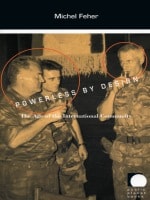
Powerless by Design
The Age of the International CommunityMichel Feher
Duke University Press, 2000
Exemplary of this new approach were Western responses to ethnic cleansing in the former Yugoslavia and genocide in Rwanda. In order to avoid costly interventions, U.S. and European leaders traced these crimes to ancient tribal enmities and professed that the role of the international community should be limited to a humanitarian, impartial, and conciliatory engagement with all the warring parties. They thus managed to appear righteous but powerless, at least until NATO’s intervention in Kosovo. Faced with this doctrine, both the liberal and radical wings of the Western Left found themselves in an uneasy position. Liberals, while lured by their leaders’ humanitarianism were nonetheless disturbed by the dismal results of the policies carried out in the name of the international community. Conversely, anti-imperialist militants were quick to mock the hypocrisy of their governments’ helpless indignation, yet certainly not prepared to demand that Western powers resort to force.
Are we still in this “age of the international community”? Feher shows that with NATO’s intervention in Kosovo, both liberal and radical activists suddenly found their mark: the former welcomed the newfound resolve of their governments, while the latter condemned it as the return of the imperialist “new world order.” For Western leaders, however, the war against Serbia proved an accident rather than a turning point. Indeed, less than a year later, their indifference to the destruction of Chechnya by Russian troops suggested that the discursive strategy exposed in Powerless by Design might remain with us for quite some time.
Rethinking Global Security
Media, Popular Culture, and the "War on Terror"Martin, Andrew
Rutgers University Press, 2006

Securing Approval
Domestic Politics and Multilateral Authorization for WarTerrence L. Chapman
University of Chicago Press, 2011
Among the most momentous decisions that leaders of a state are called upon to make is whether or not to initiate warfare. How their military will fare against the opponent may be the first consideration, but not far behind are concerns about domestic political response and the reaction of the international community.
Securing Approval makes clear the relationship between these two seemingly distinct concerns, demonstrating how multilateral security organizations like the UN influence foreign policy through public opinion without ever exercising direct enforcement power. While UN approval of a proposed action often bolsters public support, its refusal of endorsement may conversely send a strong signal to domestic audiences that the action will be exceedingly costly or overly aggressive. With a cogent theoretical and empirical argument, Terrence L. Chapman provides new evidence for how multilateral organizations matter in security affairs as well as a new way of thinking about the design and function of these institutions.

Security Integration in Europe
How Knowledge-based Networks Are Transforming the European UnionMai'a K. Davis Cross
University of Michigan Press, 2013
The European Union has made remarkable, unprecedented advances in both external and internal security integration. "Epistemic communities" of ambassadors, military generals, scientists, and other experts who supersede national governments in the diplomacy of security decision making are taking advantage of their shared expertise, common culture, professional norms, and frequent meetings to forge new levels of collaboration. Mai'a K. Davis Cross brings together numerous personal interviews and recent government documents across five separate case studies to construct a microsociological account of how EU governance really works and what future role the EU is likely to play internationally.

War Against the People
Israel, the Palestinians and Global PacificationJeff Halper
Pluto Press, 2015
Modern warfare has a new form. The days of international combat are fading. So how do major world powers maintain control over their people today?
This book is a disturbing insight into the new ways world powers such as the US, Israel, Britain and China forge war today. It is a subliminal war of surveillance and whitewashed terror, conducted through new, high-tech military apparatuses, designed and first used in Israel against the Palestinian population. Including nano-technology, hidden camera systems, information databases on civilian activity, automated targeting systems and unmanned drones, it is used to control the very people the nation's leaders profess to serve.
Jeff Halper reveals that this practice is much more insidious than was previously thought. As Western governments claw back individual liberties, War Against the People is a reminder that fundamental human rights are being compromised for vast sections of the world, and that this is a subject that should concern everyone.
When the Stakes Are High
Deterrence and Conflict among Major PowersVesna Danilovic
University of Michigan Press, 2002