Results by title
12 books match the query 'Seduction'
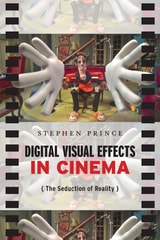
Digital Visual Effects in Cinema
The Seduction of RealityPrince, Stephen
Rutgers University Press, 2012
Avatar. Inception. Jurassic Park. Lord of the Rings. Ratatouille. Not only are these some of the highest-grossing films of all time, they are also prime examples of how digital visual effects have transformed Hollywood filmmaking. Some critics, however, fear that this digital revolution marks a radical break with cinematic tradition, heralding the death of serious realistic movies in favor of computer-generated pure spectacle.
Digital Visual Effects in Cinema counters this alarmist reading, by showing how digital effects–driven films should be understood as a continuation of the narrative and stylistic traditions that have defined American cinema for decades. Stephen Prince argues for an understanding of digital technologies as an expanded toolbox, available to enhance both realist films and cinematic fantasies. He offers a detailed exploration of each of these tools, from lighting technologies to image capture to stereoscopic 3D. Integrating aesthetic, historical, and theoretical analyses of digital visual effects, Digital Visual Effects in Cinema is an essential guide for understanding movie-making today.

East Lynne
Mitchell, Sally
Rutgers University Press, 1984
Postmodern Advertising in Japan
Seduction, Visual Culture, and the Tokyo Art Directors ClubOry Bartal
Dartmouth College Press, 2015
Seduction of the Minotaur
Anaïs Nin
Ohio University Press, 2014
Seduction of the Minotaur is the fifth and final volume of Anaïs Nin’s continuous novel known as Cities of the Interior. First published by Swallow Press in 1961, the story follows the travels of the protagonist Lillian through the tropics to a Mexican city loosely based on Acapulco, which Nin herself visited in 1947 and described in the fifth volume of her Diary. As Lillian seeks the warmth and sensuality of this lush and intriguing city, she travels inward as well, learning that to free herself she must free the “monster” that has been confined in a labyrinth of her subconscious.
This new Swallow Press edition includes an introduction by Anita Jarczok, author of Inventing Anaïs Nin: Celebrity Authorship and the Creation of an Icon.
Swallow Press publishes all five volumes that make up Cities of the Interior: Ladders to Fire, Children of the Albatross, The Four-Chambered Heart, A Spy in the House of Love, and Seduction of the Minotaur.
Seduction, Sophistry, and the Woman with the Rhetorical Figure
Michelle Ballif
Southern Illinois University Press, 2000
The rhetorical tradition, Michelle Ballif asserts, is based on the systematic exclusion of sophistry. In keeping with Aristotle’s prescription, rhetoric continues to be a counterpart to dialectic, a handmaiden to the pursuit of truth—even if that truth is merely probable.
According to Ballif, this search for truth manifests itself among current rhetoric and composition scholars in the form of an assumption that language is primarily communicative (i.e., that language can represent truth more or less faithfully). Ballif shows how invested we are in the notion of truth, in the idea that language represents truth, and in the assumption that the speaking/writing subject has, or should have, some essential relation to truth.
Provocatively, Ballif questions why the profession wants to retain these beliefs in the face of vociferous arguments from "new rhetorics" that the discipline no longer posits a foundational self or truth, and in the face of the poststructuralist critique, which has demonstrated that founding truth is always accomplished by first positing and then negating an “other.” As an alternative to this negative and violent rhetorical process, Ballif suggests a turn to sophistry as embodied in the figure of Woman, one with the power to seduce us (literally, to lead astray) from our truth and our demand for it.
This figuration of Woman, however, is not the dialectical other used to sustain the identity and privilege of Man. On the contrary, this Woman is an Other Woman: A Third Woman as a Third Sophistic practice that escapes Plato’s binary (philosophic rhetoric vs. sophistry) and renders the distinction between truth and deception incalculable. Ballif examines three figurations of the Third Woman as Third Sophistic as offered by Gorgias, Friedrich Nietzsche, and Jean Baudrillard.
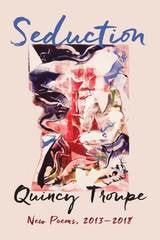
Seduction
New Poems, 2013-2018Quincy Troupe
Northwestern University Press, 2019
time is a bald eagle, a killer soaring high in the blue, / music to men
dodging bullets in speeding cars, / knew death, hoped it'd never come . . .
In this collection we are seduced by Troupe's opus. This is the poet's art laid bare. He is our "Eye." Visions of the transatlantic slave trade, portraits of American violence, pop culture, and historical voices are the lyrical relics in Troupe's masterful verse. One of American literature's most important rhythmical artists, Troupe has created a chronicle reaching through history for the collective "I/Eye" that is all of us.
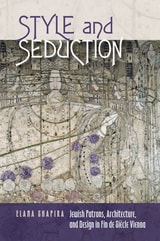
Style and Seduction
Jewish Patrons, Architecture, and Design in Fin de Siècle ViennaElana Shapira
Brandeis University Press, 2016
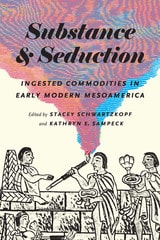
Substance and Seduction
Ingested Commodities in Early Modern MesoamericaEdited by Stacey Schwartzkopf and Kathryn E. Sampeck
University of Texas Press, 2017
Chocolate and sugar, alcohol and tobacco, peyote and hallucinogenic mushrooms—these seductive substances have been a nexus of desire for both pleasure and profit in Mesoamerica since colonial times. But how did these substances seduce? And when and how did they come to be desired and then demanded, even by those who had never encountered them before? The contributors to this volume explore these questions across a range of times, places, and peoples to discover how the individual pleasures of consumption were shaped by social, cultural, economic, and political forces.
Focusing on ingestible substances as a group, which has not been done before in the scholarly literature, the chapters in Substance and Seduction trace three key links between colonization and commodification. First, as substances that were taken into the bodies of both colonizers and colonized, these foods and drugs participated in unexpected connections among sites of production and consumption; racial and ethnic categories; and free, forced, and enslaved labor regimes. Second, as commodities developed in the long transition from mercantile to modern capitalism, each substance in some way drew its enduring power from its ability to seduce: to stimulate bodies; to alter minds; to mark class, social, and ethnic boundaries; and to generate wealth. Finally, as objects of scholarly inquiry, each substance rewards interdisciplinary approaches that balance the considerations of pleasure and profit, materiality and morality, and culture and political economy.
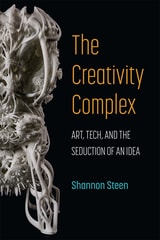
The Creativity Complex
Art, Tech, and the Seduction of an IdeaShannon Steen
University of Michigan Press, 2023
“Creativity” is a word that excites and dazzles us. It promises brilliance and achievement, a shield against conformity, a channel for innovation across the arts, sciences, technology, and education, and a mechanism for economic revival and personal success. But it has not always evoked these ideas. The Creativity Complex traces the history of how creativity has come to mean the things it now does, and explores the ethical implications of how we use this term today for both the arts and for the social world more broadly. Richly researched, the book explores how creativity has been invoked in arenas as varied as Enlightenment debates over the nature of cognition, Victorian-era intelligence research, the Cold War technology race, contemporary K-12 education, and even modern electoral politics. Ultimately, The Creativity Complex asks how our ideas about creativity are bound up with those of self-fulfillment, responsibility, and the individual, and how these might seduce us into joining a worldview and even a set of social imperatives that we might otherwise find troubling.

The Seduction of Brazil
The Americanization of Brazil during World War IIBy Antonio Pedro Tota
University of Texas Press, 2009
Following completion of the U.S. air base in Natal, Brazil, in 1942, U.S. airmen departing for North Africa during World War II communicated with Brazilian mechanics with a thumbs-up before starting their engines. This sign soon replaced the Brazilian tradition of touching the earlobe to indicate agreement, friendship, and all that was positive and good—yet another indication of the Americanization of Brazil under way during this period.
In this translation of O Imperialismo Sedutor, Antonio Pedro Tota considers both the Good Neighbor Policy and broader cultural influences to argue against simplistic theories of U.S. cultural imperialism and exploitation. He shows that Brazilians actively interpreted, negotiated, and reconfigured U.S. culture in a process of cultural recombination. The market, he argues, was far more important in determining the nature of this cultural exchange than state-directed propaganda efforts because Brazil already was primed to adopt and disseminate American culture within the framework of its own rapidly expanding market for mass culture. By examining the motives and strategies behind rising U.S. influence and its relationship to a simultaneous process of cultural and political centralization in Brazil, Tota shows that these processes were not contradictory, but rather mutually reinforcing.
The Seduction of Brazil brings greater sophistication to both Brazilian and American understanding of the forces at play during this period, and should appeal to historians as well as students of Latin America, culture, and communications.
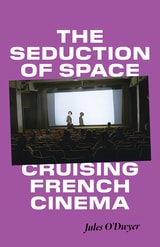
The Seduction of Space
Cruising French CinemaJules O'Dwyer
University of Minnesota Press, 2025
A bold and far-reaching new study of French queer cinema reimagines the relationship between sexuality and space
Spatiality has long been a crucial and potent lens for understanding French culture and aesthetics. While canonical greats of French cinema such as Jean-Luc Godard, Agnès Varda, and Louis Malle invoked the notion of flânerie to explore ideas of modernism, spatial exploration, and urban sociality, Jules O’Dwyer demonstrates how a more recent generation of French queer filmmakers continues to engage with—and contest—this legacy by focusing attention on the cognate practice of cruising.
Through the work of Jacques Nolot, Sébastien Lifshitz, Christophe Honoré, Vincent Dieutre, Alain Guiraudie, and others, The Seduction of Space draws film theory, queer studies, and spatial inquiry into close proximity to examine the politics of cruising and the gendering of space. Making the case that cinema not only documents the queer spaces of the past but continues to produce them, O’Dwyer maps the relationships between sex and spatiality as he takes up such varied topics as public sex in the porn theater, racial eroticization in the banlieue, and the ecocritical valences of rural cruising.
Foregrounding the crucial role that spatiality plays in shaping the parameters of France’s visual cultures and political imaginary, The Seduction of Space is both an urgent queer reconceptualization of this tradition and a clarion call for film scholars to tarry with the politics of sexuality in all its messiness.
Retail e-book files for this title are screen-reader friendly with images accompanied by short alt text and/or extended descriptions.
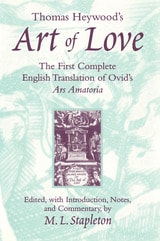
Thomas Heywood's Art of Love
The First Complete English Translation of Ovid's Ars AmatoriaEdited, with Introduction, Notes, and Commentary by M. L. Stapleton
University of Michigan Press, 2000
The present edition represents the first instance in which the translation has been edited in a scholarly manner. Besides a full Introduction that accounts for the history of Loues Schoole, Ovid in the English Renaissance, and the editorial method, each of the three books of the poem includes a Commentary that provides cross-references within the text; glosses for unusual, archaic, or regional forms peculiar to Heywood's English; annotations from sourcebooks that Heywood used to identify or understand characters from classical history, literature, and mythology; and explanations for any emendations the editor deemed necessary. In his efforts to make the Ars a seventeenth-century poem, Heywood contemporizes Ovid's references to dress, behavior, courtship, marriage, games, theater, agriculture, horsemanship, war, literature --all of which the Commentary explains at great length.
Loues Schoole will find readership in these areas: early modern history, literature, and culture; classical studies; Renaissance drama; the history of sexuality; and translation theory.
M. L. Stapleton is Associate Professor of English and Philosophy, Stephen F. Austin State University.