Results by title
3 books match the query 'Self (Philosophy) in literature'
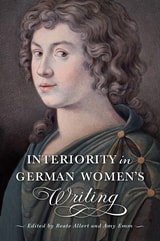
Interiority in German Women's Writing
Beate Allert
University of Delaware Press, 2026
Interiority in German Women’s Writing for the first time systematically gathers and engages with contributions of German women authors to the discourse on interiority (Innerlichkeit) from 1750 to 1850. This volume shifts the recent focus on abstract theoretical and medical discourses on inwardness to the origins of interiority in literature and philosophy as written and experienced by women from the Age of Sensibility (Empfindsamkeit) to the Romantic era. At the same time, it makes a claim for and explores the ramifications of understanding interiority as a feminine discourse. Contributors investigate the works of women authors who searched to find rescue from their cultural and personal entrapment via creative spaces and various modes of interiority in theatrical performances, poetic writings, letters, biographical narratives, prose, and fairy tales. From the case studies and literary analyses in the volume, interiority emerges as a spectrum of approaches to defining, resisting, and transforming the innermost self.
Narrative Structures and the Language of the Self
Matthew Clark
The Ohio State University Press, 2010
Narrative Structures and the Language of the Self by Matthew Clark offers a new way of thinking about the interrelation of character and plot. Clark investigates the characters brought together in a narrative, considering them not as random collections but as structured sets that correspond to various manifestations of the self. The shape and structure of these sets can be thought of as narrative geometry, and various geometries imply various theories of the self. Part One, “Philosophical Fables of the Self,” examines narratives such as The Talented Mr. Ripley,A Farewell to Arms,A Separate Peace, and The Master of Ballantrae in order to show successively more complex versions of the self as modeled by Descartes, Hegel, Freud, and Mead. Part Two, “The Case of the Subject,” uses Case Grammar to extend the discussion to additional roles of the self in narratives such as The Waves,The Great Gatsby,Fifth Business, and Howards End as examples of the self as experiencer, the self as observer, the instrumental self, and the locative self. The book ends with an extended analysis of the subject in Hartley’s The Go-Between. Throughout, the discussion is concerned with practical analysis of specific narratives and with the development of an understanding of the self that moves beyond the simple dichotomy of the self and the other, the subject and the object.
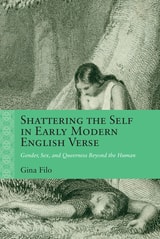
Shattering the Self in Early Modern English Verse
Gender, Sex, and Queerness Beyond the HumanGina Filo
Northwestern University Press, 2026
Rejecting the ideals of stability and sexual mastery demanded of masculine subjects, early modern English poets threw the limits of bodies and selves into question to embrace erotic experiences of genderqueer and transspecies embodiment and affiliation. Through close readings of still-canonical and lesser-read writers including William Shakespeare, John Donne, and Thomas Traherne, Gina Filo shows how these experimental encounters at the limits of the human were inextricable parts of the early modern literary and sexual imaginaries.
In its exploration of nonnormative forms of erotic attachment and embodiment, Shattering the Self in Early Modern English Verse: Gender, Sex, and Queerness Beyond the Human contributes to the burgeoning fields of early modern trans and ecocritical studies while also drawing on contemporary queer theory. Filo neither seeks to naively recuperate a fantasized past nor cedes relationality, sociality, or generativity to the normative. Instead, she shows how the embrace of erotic possibility, flexible, unstable subjectivities, and querying of the limits of “the human” were core features of early modern poetics, reconfiguring our understanding of English literary history and queer relationality today.