Results by title
64 books match the query 'Self in literature' and 3 start with a
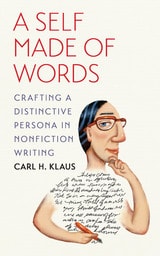
A Self Made of Words
Crafting a Distinctive Persona in Nonfiction WritingCarl H. Klaus
University of Iowa Press, 2013
Confident or fretful, solemn or sassy, tough or tender, casual or formal: the self you project in writing—your persona—is the byproduct of numerous decisions you make about what to say and how to say it. Though any single word or phrase or sentence might make little difference within the scope of an entire essay or book, collectively they create an impression of who you are or seem to be—an impression that’s sure to influence how readers respond to your work. Thus it’s essential to take charge of how you come across on the page, to craft an appropriate persona for whatever you’re writing, whether it’s a personal essay, a blog, a technical report, a letter to the editor, or a memoir. In this wise and ingenious little guide, noted essayist Carl Klaus shows you how to adapt your self to the needs of such varied nonfiction, by varying his own persona to illustrate the distinctive effect produced by each aspect and element of writing.
Klaus divides his book into two parts: first, an introduction to the nature and function of a persona, then a survey of the most important elements of writing that contribute to the character of a persona, from point of view and organization to diction and sentence structure. Both parts contain exercises that will give you practice in developing a persona of your choice. Challenging and stimulating, each of his exercises focuses on a distinctly different aspect of composition and style, so as to help you develop the skills of a versatile and personable writer. By focusing on the most important ways of projecting your self in nonfiction prose, you can learn to craft a distinctive self in your writing.
[more]

Apology to Apostrophe
Autobiography and the Rhetoric of Self-Representation in SpainJames D. Fernandez
Duke University Press, 1992
Who writes "I"? To whom are autobiographies addressed? What kinds of readers are inscribed in autobiographical narratives? In Apology to Apostrophe, James D. Fernández's offers a lucid and powerful meditation on the nature of autobiographical writing through his investigation of the historical conditions and literary stagings of autobiographical writing in Spain.
As Fernández demonstrates, recent developments in critical theory provide new and fruitful approaches to autobiographical works that have long been neglected, misunderstood, or, in some cases, virtually unknown. Focusing primarily but not exclusively on nineteenth-century Spain, Fernández exposes a rhetorical tension that often occurs in autobiographical discourse, between self-justification, or "apology," and the transcendence of this worldly impulse, or "apostrophe." This tension, he argues, is of particular interest in the case of Spain, but not peculiar to that nation, and his attention to the theoretical nature of autobiography leads to insightfl considerations of many canonical European autobiographies, including those of Saint Augustine, Rousseau, Saint Teresa, and Cardinal Newman.
Considering Spanish autobiography in the context of first-person narrative in Europe and in the terms of current debates on the relationship between writing and selfhood, Apology to Apostrophe marks a significant advance in our historical understanding and critical discussion of the genre. The book will be of great value not only to Hispanists but also to those interested in autobiography and cultural history.
[more]
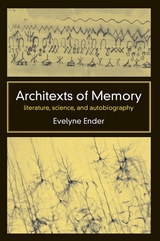
Architexts of Memory
Literature, Science, and AutobiographyEvelyne Ender
University of Michigan Press, 2005
In this impressively interdisciplinary study, Evelyne Ender revisits master literary works to suggest that literature can serve as an experimental laboratory for the study of human remembrance. She shows how memory not only has a factual basis but is inseparable from fictional and aesthetic elements. Beautifully written in accessible prose, and impressive in its scope, the book takes up works by Proust, Woolf, George Eliot, Nerval, Lou Andreas-Salome, and Sigmund Freud, getting to the heart of essential questions about mental images, empirical knowledge, and the devastations of memory loss in ways that are suggestive and profound. Architexts of Memory joins a growing body of work in the lively field of memory studies, drawing from clinical psychology, psychoanalysis, and neurobiology as well as literary studies.
"An important, cogently argued, subtle and rich study of a topic of great interest."
--Mieke Bal, University of Amsterdam
"A work of literary studies positioned at the intersection of tradition and innovation. Evelyne Ender's book brings fashionable cultural concerns to bear on traditional literary texts-her superb pedagogical skills lure and guide the reader through the most difficult psychoanalytical concepts."
--Nelly Furman, Cornell University
Evelyne Ender is Professor of French Studies, University of Washington. She is the author of Sexing the Mind: Nineteenth-Century Fictions of Hysteria.
[more]