Results by title
3 books match the query 'Self-presentation in art'
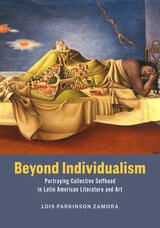
Beyond Individualism
Portraying Collective Selfhood in Latin American Literature and ArtLois Parkinson Zamora
University of Chicago Press, 2025
A sweeping analysis of “archetypal realism” in Latin American literature and art.
Beyond Individualism examines the portrayal of collective identities over two centuries in Latin American literature and visual art. Lois Parkinson Zamora shows that many authors and artists are less concerned with singular selves than with selves-in-relation: less with individual autonomy than with communal affiliation. Their works—sometimes situated under the labels Neobaroque, magical realism, Surrealism, Expressionism, and idealism—resist the kind of psychological realism typical of European and North American novels, moving instead toward a wholly new kind of fiction.
Zamora calls this new Latin American form “archetypal realism” because its characters represent entities larger than themselves. They may embody entire communities, cultures, families, religious orders, or ideal planets. Through deft readings of collective characters in fiction by Gabriel García Márquez, Isabel Allende, Jorge Luis Borges, and more alongside the art of Diego Rivera, Remedios Varo, and Xul Solar, Zamora reveals a modernity based not on Enlightenment conceptions of selfhood but on community, collectivity, and kinship.
[more]

Carnalities
The Art of Living in LatinidadMariana Ortega
Duke University Press, 2025
In Carnalities, Mariana Ortega presents a phenomenological study of aesthetics grounded in the work of primarily Latinx artists. She introduces the idea of carnal aesthetics informed by carnalities, creative practices shaped by the self’s affective attunement to the material, cultural, historical, communal, and spiritual. For Ortega, carnal aesthetics offers a way to think about the affective and bodily experiences of racialized selves. Drawing on Gloria Anzaldúa, Chela Sandoval, José Esteban Muñoz, Alia Al-Saji, Helen Ngo, Maurice Merleau-Ponty, Roland Barthes, and others, Ortega examines photographic works on Latinx subjects. She analyzes the photography of Laura Aguilar, Verónica Gabriela Cárdenas, and Susan Meiselas, among others, theorizing photography as a carnal, affective medium that is crucial for processes of self-formation, resistance, and mourning in Latinx life. She ends with an intimate reading of photography through a reflection of her own crossing from Nicaragua to the United States in 1979. Motivated by her experience of loss and exile, Ortega argues for the importance of carnal aesthetics in destabilizing and transforming normative, colonial, and decolonial subjects, imaginaries, and structures.
[more]
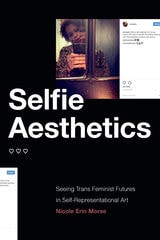
Selfie Aesthetics
Seeing Trans Feminist Futures in Self-Representational ArtNicole Erin Morse
Duke University Press, 2022
In Selfie Aesthetics Nicole Erin Morse examines how trans feminine artists use selfies and self-representational art to explore transition, selfhood, and relationality. Morse contends that rather than being understood as shallow emblems of a narcissistic age, selfies can produce politically meaningful encounters between creators and viewers. Through close readings of selfies and other digital artworks by trans feminist artists, Morse details a set of formal strategies they call selfie aesthetics: doubling, improvisation, seriality, and nonlinear temporality. Morse traces these strategies in the work of Zackary Drucker, Vivek Shraya, Tourmaline, Alok Vaid-Menon, Zinnia Jones, and Natalie Wynn, showing how these artists present improvisational identities and new modes of performative resistance by conveying the materialities of trans life. Morse shows how the interaction between selfie creators and viewers constructs collective modes of being and belonging in ways that envision trans feminist futures. By demonstrating the aesthetic depth and political potential of selfie creation, distribution, and reception, Morse deepens understandings of gender performativity and trans experience.
[more]