Results by title
10 books match the query 'Sepulchral monuments'
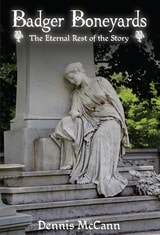
Badger Boneyards
The Eternal Rest of the StoryDennis McCann
Wisconsin Historical Society Press, 2010
Cemeteries Gravemarkers
Richard Meyer
Utah State University Press, 1992
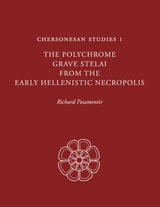
Chersonesan Studies 1
The Polychrome Grave Stelai from the Early Hellenistic NecropolisBy Richard Posamentir
University of Texas Press, 2010
Chersonesan Studies 1 presents the painted grave stelai of the Early Hellenistic necropolis of Chersonesos Taurike, a Greek city on the northern shore of the Black Sea. This unique collection of over one hundred objects is of major interest to students of ancient art and Greek culture. Their polychrome decoration has been extraordinarily well preserved, a rarity in the ancient world. They compose a remarkable, even unique, body of evidence of Greek funerary memorial sculpture: their shapes are gender-specific, their depicted objects are gender- and age-specific, and they can be ascribed to a handful of specific workshops. Their surprising uniformity requires an explanation, since comparable assemblages from other parts of the Greek world show substantial diversity in all these aspects.
This book provides the first complete catalog and description of the stelai, together with full-color illustrations of all the significant stelai and many details. Through his painstaking recovery and reassembling of fragments, as well as the use of advanced photographic techniques, Richard Posamentir has been able to add a whole new dimension to the study of these artifacts. The volume covers the history of the stelai, analysis of the workshops, and reconstruction of the necropolis that the stelai originally graced. A comparison chapter discusses how the stelai fit into the context of Greek funerary art and provides insights into the culture and society of a city on the Black Sea.

Ethnicity and the American Cemetery
Richard Meyer
University of Wisconsin Press, 1993
Contributors examine the material objects found within the cemeteries, as well as the customary practices bound to them. Contributors are from the fields of folklore, cultural history, historical archaeology, landscape architecture, and philosophy. Heavily illustrated, the volume also features an extensive annotated bibliography.
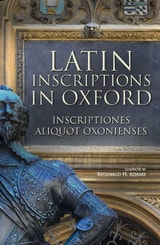
Latin Inscriptions in Oxford
Compiled with Translations by Reginald H. Adams
Bodleian Library Publishing, 2015
For Latin Inscriptions in Oxford, Reginald H. Adams, a former scholar at St. John’s College, University of Oxford, has translated a selection of Latin inscriptions. Among them, he finds a great many tributes and memorials—to Queen Anne, Cardinal Wolsey, and T. E. Lawrence, but also to Irene Frude, a “most kindly landlady” on Little Clarendon who “provided each day for almost thirty-five years enormous breakfasts.” Some of the inscriptions offer concise commentary—“Without experiment, it is not possible to know anything adequately.” While others are instructive like the Rhodes House’s warning, “Let no one who is smoke-bearing enter here.”
Evocative mementoes of the past, the inscriptions collected by Adams bring insight to the vivid history of Oxford, the city and the university.
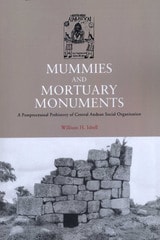
Mummies and Mortuary Monuments
A Postprocessual Prehistory of Central Andean Social OrganizationBy William H. Isbell
University of Texas Press, 1997
Since prehistoric times, Andean societies have been organized around the ayllu, a grouping of real or ceremonial kinspeople who share labor, resources, and ritual obligations. Many Andean scholars believe that the ayllu is as ancient as Andean culture itself, possibly dating back as far as 6000 B.C., and that it arose to alleviate the hardships of farming in the mountainous Andean environment.
In this boldly revisionist book, however, William Isbell persuasively argues that the ayllu developed during the latter half of the Early Intermediate Period (around A.D. 200) as a means of resistance to the process of state formation. Drawing on archaeological evidence, as well as records of Inca life taken from the chroniclers, Isbell asserts that prehistoric ayllus were organized around the veneration of deceased ancestors, whose mummified bodies were housed in open sepulchers, or challups, where they could be visited by descendants seeking approval and favors. By charting the temporal and spatial distribution of chullpa ruins, Isbell offers a convincing new explanation of where, when, and why the ayllu developed.
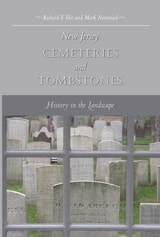
New Jersey Cemeteries and Tombstones
History in the LandscapeVeit, Richard F
Rutgers University Press, 2008
From the earliest memorials used by Native Americans to the elaborate structures of the present day, Richard Veit and Mark Nonestied use grave markers to take an off-beat look at New Jersey’s history that is both fascinating and unique.
New Jersey Cemeteries and Tombstones presents a culturally diverse account of New Jersey’s historic burial places from High Point to Cape May and from the banks of the Delaware to the ocean-washed Shore, to explain what cemeteries tell us about people and the communities in which they lived. The evidence ranges from somber seventeenth-century decorations such as hourglasses and skulls that denoted the brevity of colonial life, to modern times where memorials, such as a life-size granite Mercedes Benz, reflect the materialism of the new millennium. Also considered are contemporary novelties such as pet cemeteries and what they reveal about today’s culture. To tell their story the authors visited more than 1,000 burial grounds and interviewed numerous monument dealers and cemetarians.
This richly illustrated book is essential reading for history buffs and indeed anyone who has ever wandered inquisitively through their local cemeteries.
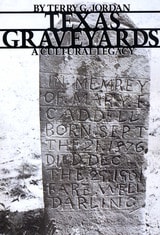
Texas Graveyards
A Cultural LegacyBy Terry Jordan
University of Texas Press, 1982
Where more poignantly than in a small country graveyard can a traveler fathom the flow of history and tradition? During the past twenty years, Terry G. Jordan has traveled the back roads and hidden trails of rural Texas in search of such cemeteries. With camera in hand, he has visited more than one thousand cemeteries created and maintained by the Anglo-American, black, Indian, Mexican, and German settlers of Texas. His discoveries of sculptured stones and mounds, hex signs and epitaphs, intricate landscapes and unusual decorations represent a previously unstudied and unappreciated wealth of Texas folk art and tradition. Texas Graveyards not only marks the distinct ethnic and racial traditions in burial practices but also preserves a Texas legacy endangered by changing customs, rural depopulation, vandalism, and the erosion of time.
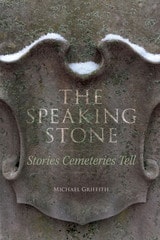
The Speaking Stone
Stories Cemeteries TellMichael Griffith
Ohio University Press, 2021
Published by the University of Cincinnati Press
The Speaking Stone: Stories Cemeteries Tell is a literary love letter to the joys of wandering graveyards. While working on a novel, author and longtime Cincinnati resident Michael Griffith starts visiting Spring Grove Cemetery and Arboretum, the nation’s third-largest cemetery. Soon he’s taking almost daily jaunts, following curiosity and accident wherever they lead. The result is this fascinating collection of essays that emerge from chance encounters with an interesting headstone, odd epitaph, unusual name, or quirk of memory. Researching obituaries, newspaper clippings, and family legacies, Griffith uncovers stories of race, feminism, art, and death.
Rather than sticking to the cemetery’s most famous, or infamous, graves, Griffith stays true to the principle of ramble and incidental discovery. The result is an eclectic group of subjects, ranging from well-known figures like the feminist icon and freethinker Fanny Wright to those much less celebrated— a spiritual medium, a temperance advocate, a young heiress who died under mysterious circumstances. Nearly ninety photos add dimension and often an element of playfulness.
The Speaking Stone examines what endures and what does not, reflecting on the vanity and poignancy of our attempt to leave monuments that last. In doing so, it beautifully weaves connections born out of the storyteller’s inquisitive mind.
This Place of Silence
Ohio's Cemeteries and Burial GroundsIan Adams; Randall Lee Schieber; Robin L. Smith
Ohio University Press, 2024