Results by title
8 books match the query 'Serfdom'
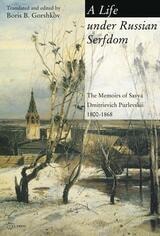
A Life under Russian Serfdom
The Memoirs of Savva Dmitrievich Purlevskii, 1800–68Boris B. Gorshkov
Central European University Press, 2005
This is a translation of one of very few Russian serfs' memoirs. Savva Purlevskii recollects his life in Russian serfdom and life of his grandparents, parents, and fellow villagers. He describes family and communal life and the serfs' daily interaction with landlords and authorities. Purlevskii came from an initially prosperous family that later became impoverished. Early in his childhood, he lost his father. Purlevskii did not have a chance to gain a formal education. He lived under serfdom until 1831 when at the age of 30 he escaped his servitude.Gorshkov's introduction provides some basic knowledge about Russian serfdom and draws upon the most recent scholarship. Notes provide references and general information about events, places and people mentioned in the memoirs.
[more]

Enserfment and Military Change in Muscovy
Richard Hellie
University of Chicago Press, 1971
[more]
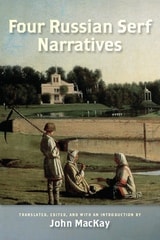
Four Russian Serf Narratives
Translated, edited, and with an introduction by John MacKay
University of Wisconsin Press, 2009
Although millions of Russians lived as serfs until the middle of the nineteenth century, little is known about their lives. Identifying and documenting the conditions of Russian serfs has proven difficult because the Russian state discouraged literacy among the serfs and censored public expressions of dissent. To date scholars have identified only twenty known Russian serf narratives.
Four Russian Serf Narratives contains four of these accounts and is the first translated collection of autobiographies by serfs. Scholar and translator John MacKay brings to light for an English-language audience a diverse sampling of Russian serf narratives, ranging from an autobiographical poem to stories of adventure and escape. “Autobiography” (1785) recounts a highly educated serf’s attempt to escape to Europe, where he hoped to study architecture. The long testimonial poem “News About Russia” (ca. 1849) laments the conditions under which the author and his fellow serfs lived. In “The Story of My Life and Wanderings” (1881) a serf tradesman tells of his attempt to simultaneously escape serfdom and captivity from Chechen mountaineers. The fragmentary “Notes of a Serf Woman” (1911) testifies to the harshness of peasant life with extraordinary acuity and descriptive power.
These accounts offer readers a glimpse, from the point of view of the serfs themselves, into the realities of one of the largest systems of unfree labor in history. The volume also allows comparison with slave narratives produced in the United States and elsewhere, adding an important dimension to knowledge of the institution of slavery and the experience of enslavement in modern times.
[more]
Hayek's The Road to Serfdom
A Brief IntroductionBruce Caldwell
University of Chicago Press, 2013
The Road to Serfdom, F. A. Hayek’s 1944 warning against the dangers of government control, continues to influence politics more than seventy years after it was turned down by three American publishers and finally published by the University of Chicago Press. A classic work in political philosophy, intellectual and cultural history, and economics, the definitive edition of The Road to Serfdom included this essay as its Introduction. Here, acclaimed Hayek biographer and general editor of the Collected Works of F. A. Hayek series, Bruce Caldwell explains how Hayek came to write and publish the book, assesses misunderstandings of Hayek’s thought, and suggests how Hayek’s fears of Socialism lead him to abandon the larger scholarly project he had planned in 1940 to focus instead on a briefer, more popular and political tract—one that has influenced political and economic discourse ever since.
[more]
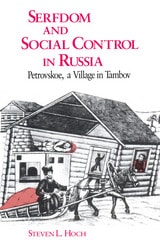
Serfdom and Social Control in Russia
Petrovskoe, a Village in TambovSteven L. Hoch
University of Chicago Press, 1986
[more]

The Other Road to Serfdom and the Path to Sustainable Democracy
Eric Zencey
University Press of New England, 2012
Our planet is finite. Our political and economic systems were designed for an infinite planet. These difficult truths anchor the perceptive analysis offered in The Other Road to Serfdom and the Path to Sustainable Democracy. With wit, energy, and a lucid prose style, Eric Zencey identifies the key elements of “infinite planet” thinking that underlie our economics and our politics—and shows how they must change. Zencey’s title evokes F. A. Hayek, who argued that any attempt to set overall limits to free markets—any attempt at centralized planning—is “the road to serfdom.” But Hayek’s argument works only if the planet is infinite. If Hayek is right that planning and democracy are irreducibly in conflict, Zencey argues, then on a finite planet, “free markets operated on infinite planet principles are just the other road to serfdom.” The alternative is ecological economics, an emergent field that accepts limits to what humans can accomplish economically on a finite planet. Zencey explains this new school of thought and applies it to current political and economic concerns: the financial collapse, terrorism, population growth, hunger, the energy and oil industry’s social control, and the deeply rooted dissatisfactions felt by conservative “values” voters who have been encouraged to see smaller government and freer markets as the universal antidote. What emerges is a coherent vision, a progressive and hopeful alternative to neoconservative economic and political theory—a foundation for an economy that meets the needs of the 99% and just might help save civilization from ecological and political collapse.
[more]
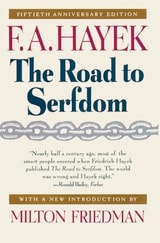
The Road to Serfdom
F. A. Hayek
University of Chicago Press, 1994
A classic work in political philosophy, intellectual and cultural history, and economics, The Road to Serfdom has inspired and infuriated politicians, scholars, and general readers for half a century. Originally published in England in the spring of 1944—when Eleanor Roosevelt supported the efforts of Stalin, and Albert Einstein subscribed lock, stock, and barrel to the socialist program—The Road to Serfdom was seen as heretical for its passionate warning against the dangers of state control over the means of production. For F. A. Hayek, the collectivist idea of empowering government with increasing economic control would inevitably lead not to a utopia but to the horrors of nazi Germany and fascist Italy.
First published by the University of Chicago Press on September 18, 1944, The Road to Serfdom garnered immediate attention from the public, politicians, and scholars alike. The first printing of 2,000 copies was exhausted instantly, and within six months more than 30,000 were sold. In April of 1945, Reader's Digest published a condensed version of the book, and soon thereafter the Book-of-the-Month Club distributed this condensation to more than 600,000 readers. A perennial best-seller, the book has sold over a quarter of a million copies in the United States, not including the British edition or the nearly twenty translations into such languages as German, French, Dutch, Swedish, and Japanese, and not to mention the many underground editions produced in Eastern Europe before the fall of the iron curtain.
After thirty-two printings in the United States, The Road to Serfdom has established itself alongside the works of Alexis de Tocqueville, John Stuart Mill, and George Orwell for its timeless meditation on the relation between individual liberty and government authority. This fiftieth anniversary edition, with a new introduction by Milton Friedman, commemorates the enduring influence of The Road to Serfdom on the ever-changing political and social climates of the twentieth century, from the rise of socialism after World War II to the Reagan and Thatcher "revolutions" in the 1980s and the transitions in Eastern Europe from communism to capitalism in the 1990s.
F. A. Hayek (1899-1992), recipient of the Medal of Freedom in 1991 and co-winner of the Nobel Memorial Prize in Economics in 1974, was a pioneer in monetary theory and the principal proponent of libertarianism in the twentieth century.
On the first American edition of The Road to Serfdom:
"One of the most important books of our generation. . . . It restates for our time the issue between liberty and authority with the power and rigor of reasoning with which John Stuart Mill stated the issue for his own generation in his great essay On Liberty. . . . It is an arresting call to all well-intentioned planners and socialists, to all those who are sincere democrats and liberals at heart to stop, look and listen."—Henry Hazlitt, New York Times Book Review, September 1944
"In the negative part of Professor Hayek's thesis there is a great deal of truth. It cannot be said too often—at any rate, it is not being said nearly often enough—that collectivism is not inherently democratic, but, on the contrary, gives to a tyrannical minority such powers as the Spanish Inquisitors never dreamt of."—George Orwell, Collected Essays
[more]
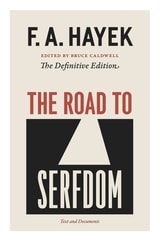
The Road to Serfdom
Text and Documents--The Definitive EditionF. A. Hayek
University of Chicago Press, 2007
An unimpeachable classic work in political philosophy, intellectual and cultural history, and economics, The Road to Serfdom has inspired and infuriated politicians, scholars, and general readers for half a century. Originally published in 1944—when Eleanor Roosevelt supported the efforts of Stalin, and Albert Einstein subscribed lock, stock, and barrel to the socialist program—The Road to Serfdom was seen as heretical for its passionate warning against the dangers of state control over the means of production. For F. A. Hayek, the collectivist idea of empowering government with increasing economic control would lead not to a utopia but to the horrors of Nazi Germany and Fascist Italy.
First published by the University of Chicago Press on September 18, 1944, The Road to Serfdom garnered immediate, widespread attention. The first printing of 2,000 copies was exhausted instantly, and within six months more than 30,000 books were sold. In April 1945, Reader’s Digest published a condensed version of the book, and soon thereafter the Book-of-the-Month Club distributed this edition to more than 600,000 readers. A perennial best seller, the book has sold 400,000 copies in the United States alone and has been translated into more than twenty languages, along the way becoming one of the most important and influential books of the century.
With this new edition, The Road to Serfdom takes its place in the series The Collected Works of F. A. Hayek. The volume includes a foreword by series editor and leading Hayek scholar Bruce Caldwell explaining the book's origins and publishing history and assessing common misinterpretations of Hayek's thought. Caldwell has also standardized and corrected Hayek's references and added helpful new explanatory notes. Supplemented with an appendix of related materials ranging from prepublication reports on the initial manuscript to forewords to earlier editions by John Chamberlain, Milton Friedman, and Hayek himself, this new edition of The Road to Serfdom will be the definitive version of Hayek's enduring masterwork.
[more]